 Getly
How to Use a Time-Blocking Planner (Without Burning Out)
You know the feeling. You wake up with a whole day ahead of you and somehow, by 6 p.m., you have done everything except the one thing you meant to do. The day wasn't empty — it was full of small things, interruptions, and "just five minutes" that turned into an hour. The time didn't disappear. It leaked.
That is what open-ended days do to an ADHD brain. Without a shape, the day fills itself — and it almost never fills itself with the thing that matters most.
Time blocking is the simplest fix I know. Not the rigid, color-coded, every-minute-accounted-for version. The gentle one. Here is how it actually works.
Why open-ended days leak time
An ADHD brain struggles with two things that make open days dangerous: time blindness and decision fatigue. "Later" means never — if a task has no time attached to it, it floats. And every time you finish something and have to decide what to do next, you spend energy on the decision instead of the work.
A time blocking planner printable solves both problems at once. The day gets a shape before it starts: this hour is for this thing. You don't have to decide in the moment, and you don't have to remember what you meant to do — you just look down.
The key word is shape, not schedule. A schedule punishes you for drifting. A shape catches you when you do.
Start with three anchors, not thirty blocks
The biggest mistake people make with time blocking is filling the whole day on day one. Hour by hour, 7 a.m. to 10 p.m., every box colored in. That version lasts about two days — because it was built for a robot, not a person.
Start with three anchors instead:
Morning anchor. One block, 60–90 minutes, for the thing that matters most today. Not your inbox. Not errands. The one thing that would make today feel like a win. Put it early, before the day has a chance to eat it.
Afternoon anchor. One block for the second-most-important thing — or for the admin pile: emails, calls, the life-maintenance stuff that never feels urgent until it is.
Evening anchor. One block for you. Rest counts. A walk, a book, time with people you like — if it isn't on the page, the day will happily fill that slot with scrolling.
Three blocks. That is the whole system on day one. Everything between them is open space, and open space is allowed.
What to do when you drift (you will drift)
Drifting is not failure. Drifting is the default. The difference between a time-blocking day and an open day is what happens after the drift.
On an open day, you drift and the day is gone. On a blocked day, you drift, you notice, you look at the page, and you know exactly where you meant to be. You don't restart the day. You just step back into the next block — or you move the block. Blocks move. They are pencil, not stone.
If a block gets eaten by something unexpected, don't try to "make it up" by cramming. Move it to tomorrow's morning anchor. The planner doesn't keep score.
The 3-block minimum day
Some days are hard days. Low energy, bad sleep, too much noise. On those days, the full plan is too much — and that is fine, because the system has a floor.
The 3-block minimum day is: one morning anchor, one afternoon anchor, one evening anchor. No more. If you do those three things, the day counts. If you do two of them, the day still counts. The minimum exists so that a bad day doesn't become a zero day — and a zero day doesn't become a zero week.
This is the part most time blocking planner template designs get wrong. They are built for your best week. Yours needs to survive your worst one.
How to set it up in five minutes
You don't need a new routine. You need five minutes tonight:
1. Look at tomorrow. Pick the one thing that matters most. Put it in the morning anchor.
2. Pick the second thing. Afternoon anchor.
3. Pick something kind for the evening anchor.
4. Leave the rest blank. Blank is not wasted — blank is breathing room.
Do that for a week. If a block keeps getting skipped, the block is wrong, not you — change the time, shrink it, or drop it. The planner adjusts to your life, not the other way around.
A planner built for the way your brain actually works
That is the idea behind everything we make at MindBloom Studio: calm systems for overwhelmed brains. No streaks, no guilt, no wasted pages. Just simple, printable pages designed to be picked up again after the days you miss — because those days happen, and they don't cancel your progress.
If your days need a shape, start here:
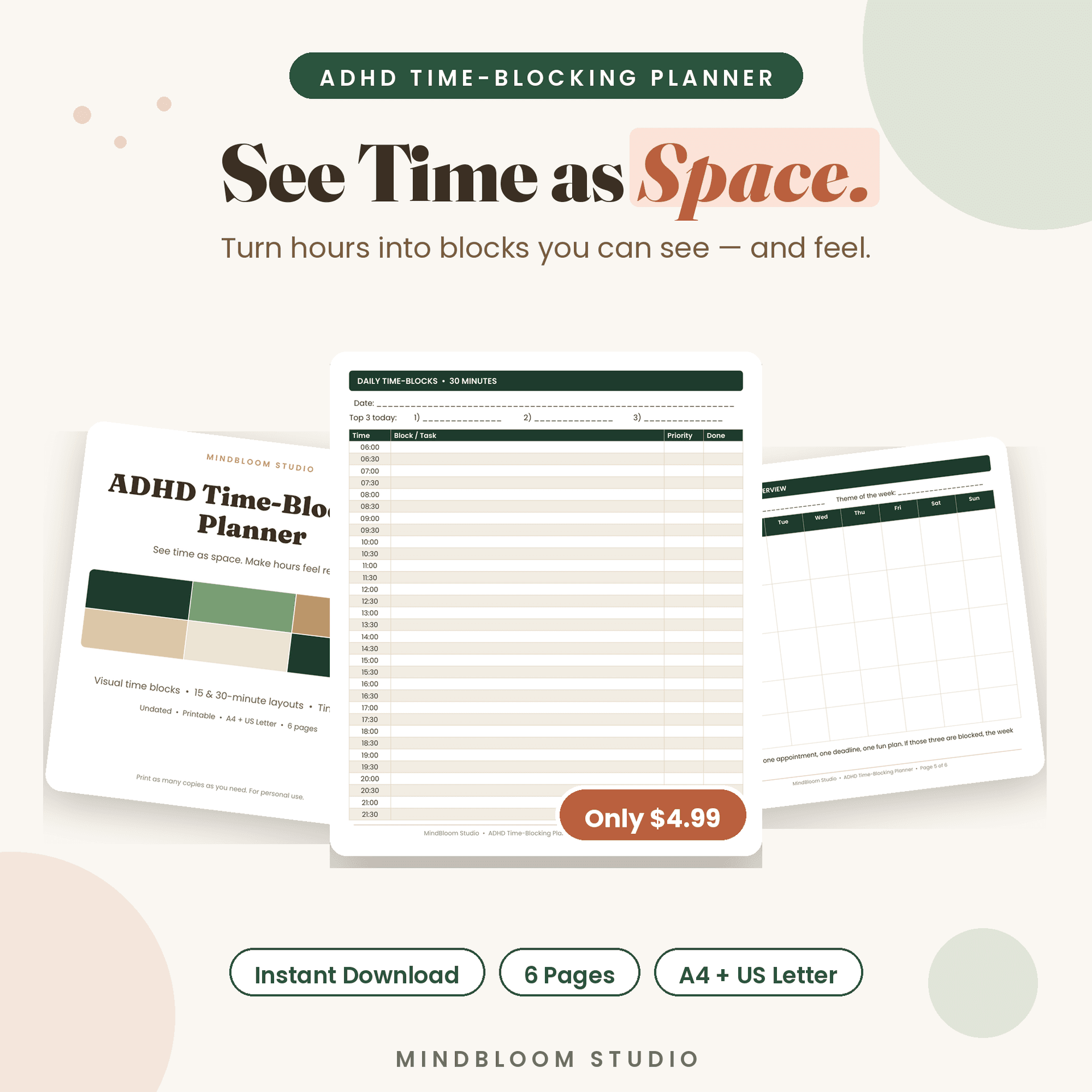
ADHD Time-Blocking Planner
$4.99
And if you want the full set — daily, weekly, and focus pages that work together — the bundle puts them all in one place:
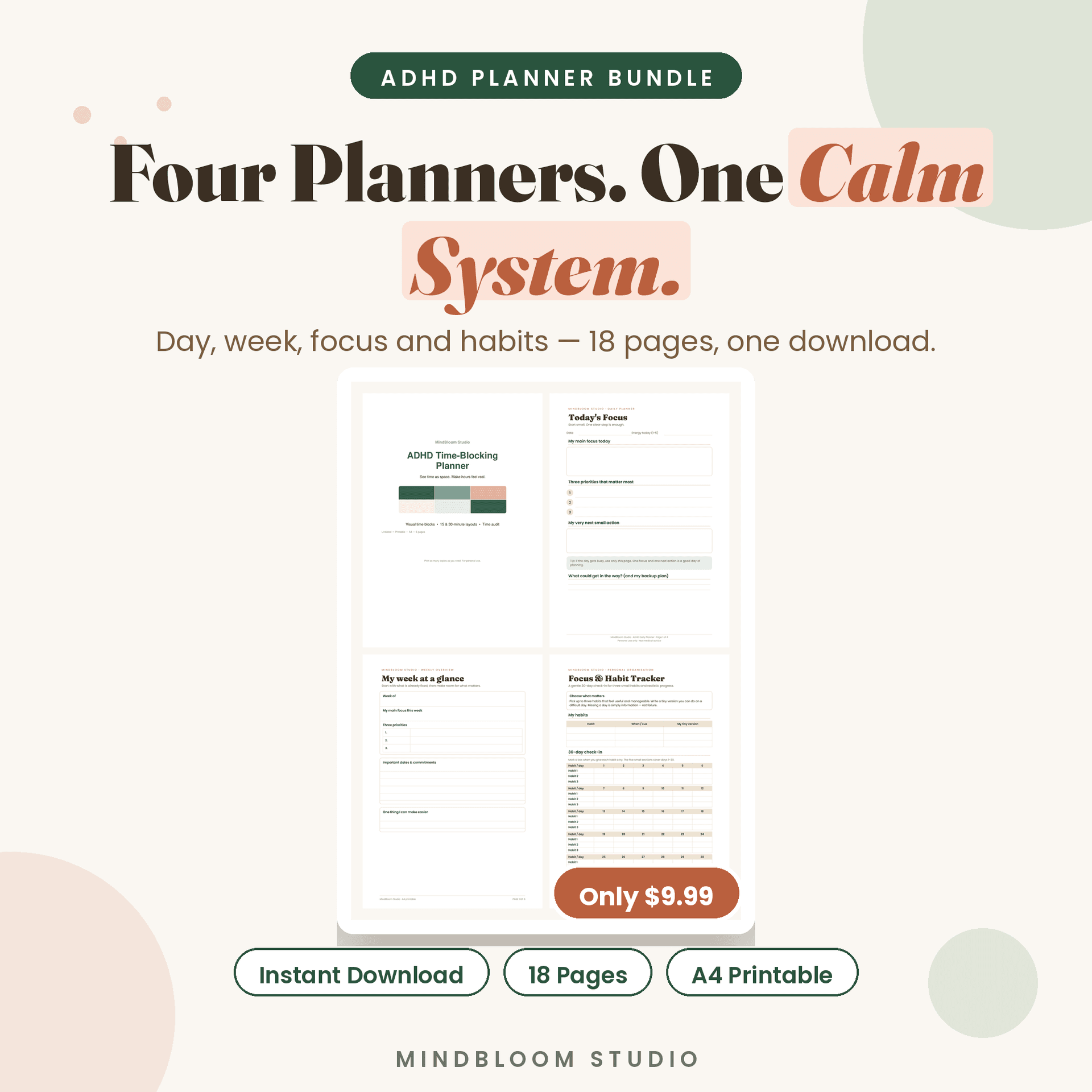
ADHD Planner Bundle — 4 Printable Planners (18 Pages)
$9.99
The point was never to control every hour. The point is to look down, see where you meant to be, and step back in — as many times as it takes.
*MindBloom printables are planning tools, not medical advice.*