 Getly
An ADHD Budget That Doesn't Need Willpower
You know the money is gone before you know where it went. A coffee here, a "treat yourself" there, a 2 a.m. purchase you barely remember making. Then the end of the month arrives, the numbers don't add up, and the shame shows up right on schedule.
If that sounds familiar, here is the part nobody tells you: it is not a willpower problem. It is a dopamine problem.
An ADHD brain is wired to chase the small, immediate reward — the click, the delivery, the new thing — because the bigger, slower reward (savings, a paid-off card, a calm month) barely registers. A budget built on willpower asks the weakest part of the system to do the hardest job. No wonder it fails by the second week.
A budget that works for an ADHD brain doesn't fight the wiring. It works with it. Here is how.
The 48-hour waitlist rule
Impulse spending is almost never about the thing. It is about the moment — the boredom, the stress, the 2 a.m. restlessness. The urge feels urgent because the dopamine hit is right there, one tap away.
The 48-hour waitlist breaks the link between the urge and the purchase. When you want something that isn't essential, you don't say no. You write it on the waitlist, with the date and the price. Then you wait 48 hours.
Most of the time, something interesting happens: by day two, the urgency is gone. The thing that felt essential on Tuesday feels forgettable on Thursday. The items that survive 48 hours are usually the ones actually worth buying — and you buy them on purpose, not on impulse.
The waitlist works because it doesn't ask you to resist. It asks you to delay. Delay is a much smaller ask — and it is the whole trick.
See the month at a glance
Traditional budgets are spreadsheets full of numbers. Numbers don't stick for a brain that thinks in pictures. What sticks is a map.
A visual money map puts the whole month on one page: what comes in, what has to go out, and what is left — in shapes you can actually see. When the month is visible, two things change. First, you stop being surprised by bills you forgot existed. Second, the "money left" number stops being abstract. It is right there, in front of you, every time you open the page.
This is why a good adhd budget planner looks different from a normal budget. It is not more detailed. It is more visible. One page, one glance, the whole story.
The one-number budget
Most budgets fail because they have too many categories. Groceries, dining out, transport, subscriptions, household, personal, entertainment — by the third week, tracking them all is a second job, and the second job is the first thing to go.
Try one number instead. After the fixed bills are paid, there is one number: what you can spend this month on everything else. One number to watch, one number to check. If you are under it, you are fine. If it is running low, you know — without opening a spreadsheet.
One number is not less serious than twenty categories. It is more honest. A budget you actually check beats a detailed budget you abandoned in February.
Debt, without the shame
Debt is the part of money that carries the most shame — and shame is the least useful budgeting tool ever invented. Shame doesn't pay anything down. It just makes you avoid looking.
The debt snowball is simple: list your debts smallest to largest, pay the minimum on all of them, and throw every spare dollar at the smallest one. When it is gone, move to the next. The order matters less than the momentum — each paid-off debt is a visible win, and visible wins are what keep an ADHD brain going.
No lectures. No "how did you let it get this bad." Just a list, a plan, and one small win at a time.
A money system built for the way your brain actually works
That is the idea behind everything we make at MindBloom Studio: calm systems for overwhelmed brains. No streaks, no guilt, no wasted pages. Just simple, printable pages designed to be picked up again after the days you miss — because those days happen, and they don't cancel your progress.
If your money needs a system that works with your brain instead of against it, start here:
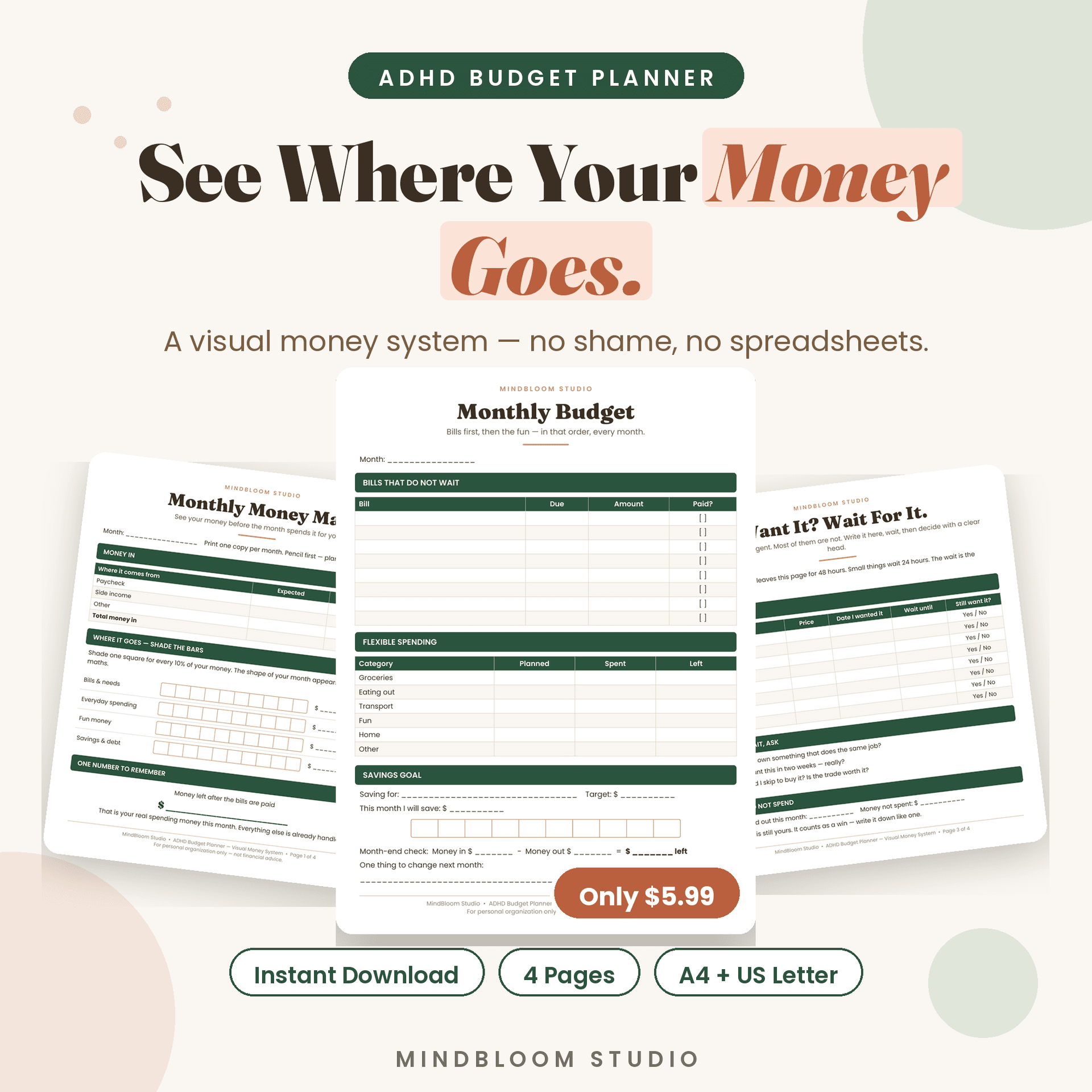
ADHD Budget Planner Printable | Visual Money System
$5.99
A budget that needs willpower will fail you. An adhd money system built on a glance, a waitlist, and one number just might stick.
*Planning tool, not financial advice.*