 Getly
Most people use an AI writing tool the way they use a search engine: type a vague sentence, look disappointed at the result, type a slightly different vague sentence. The gap is rarely the model. It is that a useful prompt is a *brief*, and writing a brief from nothing is work.
A prompt library fixes the economics of that. You write the brief once, properly, and then reuse it with the blanks filled in.
What separates a prompt that works from a prompt that rambles
Four ingredients, in this order:
1. Role and audience. Not "write something about my product" but "you are writing for a small plumbing company's existing customers".
2. The job. One outcome: a follow-up email, a price comparison, three title options. Prompts that ask for five things get five mediocre things.
3. The constraints. Length, tone, what must be included, what must never be claimed.
4. The shape of the output. A numbered list, a table, a 120-word paragraph. Ask for the container and you stop reformatting.
The blank parts - your product, your customer, your numbers - are what you fill in each time. Everything else is the template, and the template is what you are buying.
The categories that actually get reused
Across a year of small business use, the same jobs come back:
A library organised by job is worth more than a library organised by cleverness, because you search it when you have a task, not when you have an idea.
Reuse beats invention
Three habits that make a library pay for itself:
Filling in the blanks correctly
When a template has placeholders, replacing them badly is the whole failure mode. Two rules:
What it does not do
What is in the download
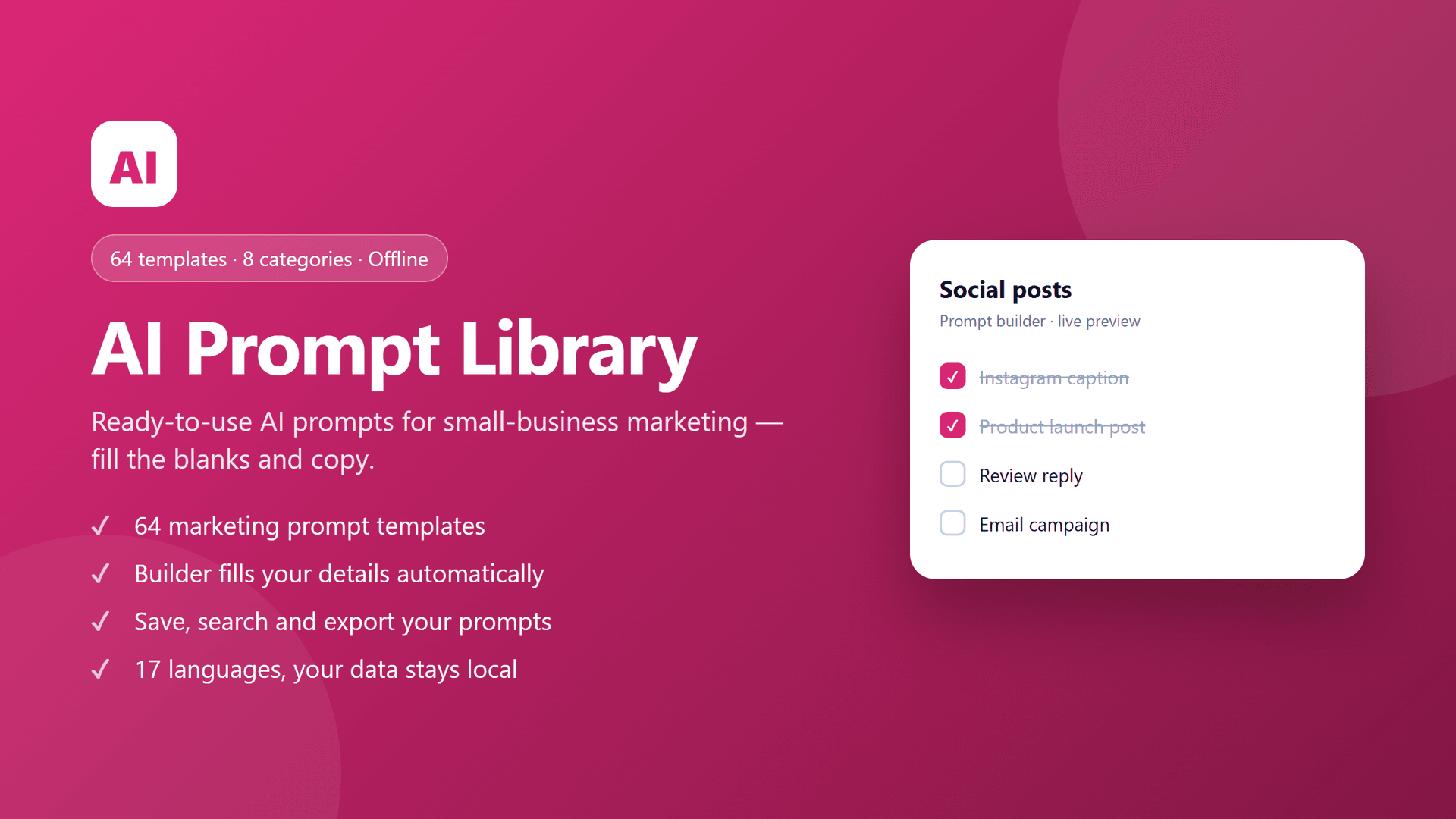
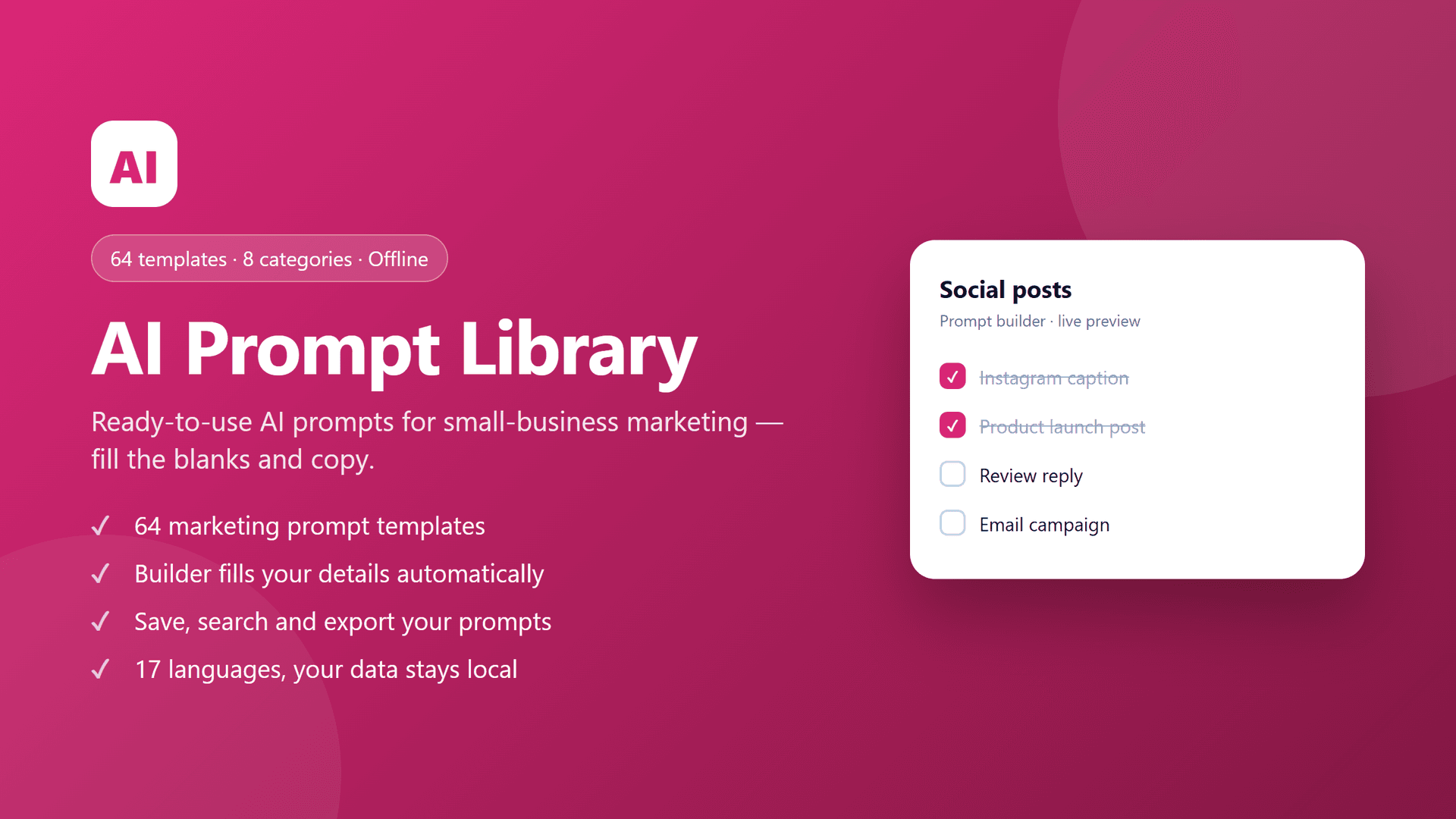
64 templates across eight categories, in a Windows program that runs from a folder, an Android app, and a web/PWA edition - one purchase, three formats, seventeen languages of interface, no account and no subscription. Placeholders are marked and fillable inside the app, and the filled prompt is one click from your clipboard.
AI Prompt Library - 64 Small Business Marketing Prompt Templates (Offline, Windows, Android, Web)
$14.00
Questions people ask before buying
Which AI tools does it work with? All of them. It produces text you paste, so the tool is your choice and can change next month.
Are the prompts in English? The templates are written in English, because that is where most prompt behaviour has been documented. The interface is available in seventeen languages.
Can I add my own prompts? Yes - that is how a library becomes yours. The 64 are the starting point, not the ceiling.
Will the same prompt always give the same answer? No, and that is fine. The prompt sets the brief; the variation is where you pick the better draft. If every month you bill for work and hate invoicing it, [the offline invoicing app](https://www.getly.store/product/freelancer-billing-offline-invoicing-time-tracking-app-windows-android-web-mvcitu66) solves the other half of that afternoon.