 Getly
What Planner Actually Works for ADHD?
You've probably been here before. You find a planner that looks perfect — clean pages, a beautiful cover, a system that promises this will finally be the year you stay organized. You fill in the first two days with real enthusiasm. Day three, you forget. Day four, you mean to catch up. By the end of the week, the planner is sitting on your desk with two filled pages and 363 empty ones, quietly making you feel worse.
If that sounds familiar, here is the part nobody tells you: the planner failed you, not the other way around.
Why most planners get abandoned after two days
Most planners are designed for brains that work in straight lines. They assume you will sit down every morning, write the same kind of plan, and follow it in order. They assume a missed day means a failed week. And they assume that more structure — more boxes, more categories, more color-coding — will fix the problem.
For an ADHD brain, that kind of planner is a trap. The moment you miss a day, the blank page becomes proof that you have already failed, and starting again feels harder than never starting at all. A planner covered in dates you skipped doesn't motivate you. It judges you.
And then there is the novelty problem. A new planner is exciting for about 48 hours. The excitement is doing all the work — not the system. When the novelty fades, the planner has to earn its place on your desk every single day. Most planners can't, because they were built to look good in a product photo, not to survive a real Tuesday.
What actually works
The best planner for ADHD is not the prettiest one, or the one with the most features. It is the one you will actually open tomorrow. After watching what real ADHD brains stick with, a few patterns show up again and again.
Undated pages. A planner with printed dates turns every missed day into a wasted page. An undated adhd planner lets you skip a week and pick up exactly where you left off — no guilt, no blank pages staring at you, no feeling that you have ruined the whole book. The planner waits for you. That one change removes the biggest reason people quit.
Top 3, not top 30. A to-do list with twenty items is not a plan; it is a wall. The planners that work ask you for just three priorities — the three things that would make today feel like a win. Everything else is a bonus. Three is small enough to start, and starting is the whole battle.
A brain dump first. ADHD brains hold everything at once: the email you forgot, the birthday next week, the random idea at 2 a.m. A good adhd planner gives all of that noise somewhere to go before it asks you to plan anything. Dump it out, then choose. Planning with a full head is like packing a suitcase that is already full.
Time blocking, gently. Open-ended days are where time disappears. A time blocking planner printable works because it gives the day a shape — this hour is for this thing — without demanding perfection. The point is not to follow the blocks exactly. The point is that when you drift (and you will drift), you can look down and see where you meant to be.
Forgiving missed days. The planner that works for you is the one that forgives you. No streaks to break. No "day 47 of your routine" counters. A missed day is just a day you missed, and tomorrow is a fresh page. The best ADHD planner is the one that is still useful on your worst week, not just your best one.
Fast capture. If writing something down takes more than a few seconds, it won't happen. The systems that stick are the ones you can use in the thirty seconds between tasks — one line, one box, done.
How to start (without starting over)
You do not need a new system, a new routine, or a perfect Monday. Try this instead:
1. Pick one page — just one — and use it tomorrow. Not a whole planner. One page.
2. Write your top 3 before you check your phone.
3. When the day goes sideways, write down what actually happened. That is still planning.
If the page helps, use it again the next day. If it doesn't, change one thing — not the whole system. Small, boring, repeatable beats impressive and abandoned every time.
A planner built for the way your brain actually works
That is the idea behind everything we make at MindBloom Studio: calm systems for overwhelmed brains. No streaks, no guilt, no wasted pages. Just simple, printable pages designed to be picked up again after the days you miss — because those days happen, and they don't cancel your progress.
If time blocking sounds like the shape your day needs, start here:
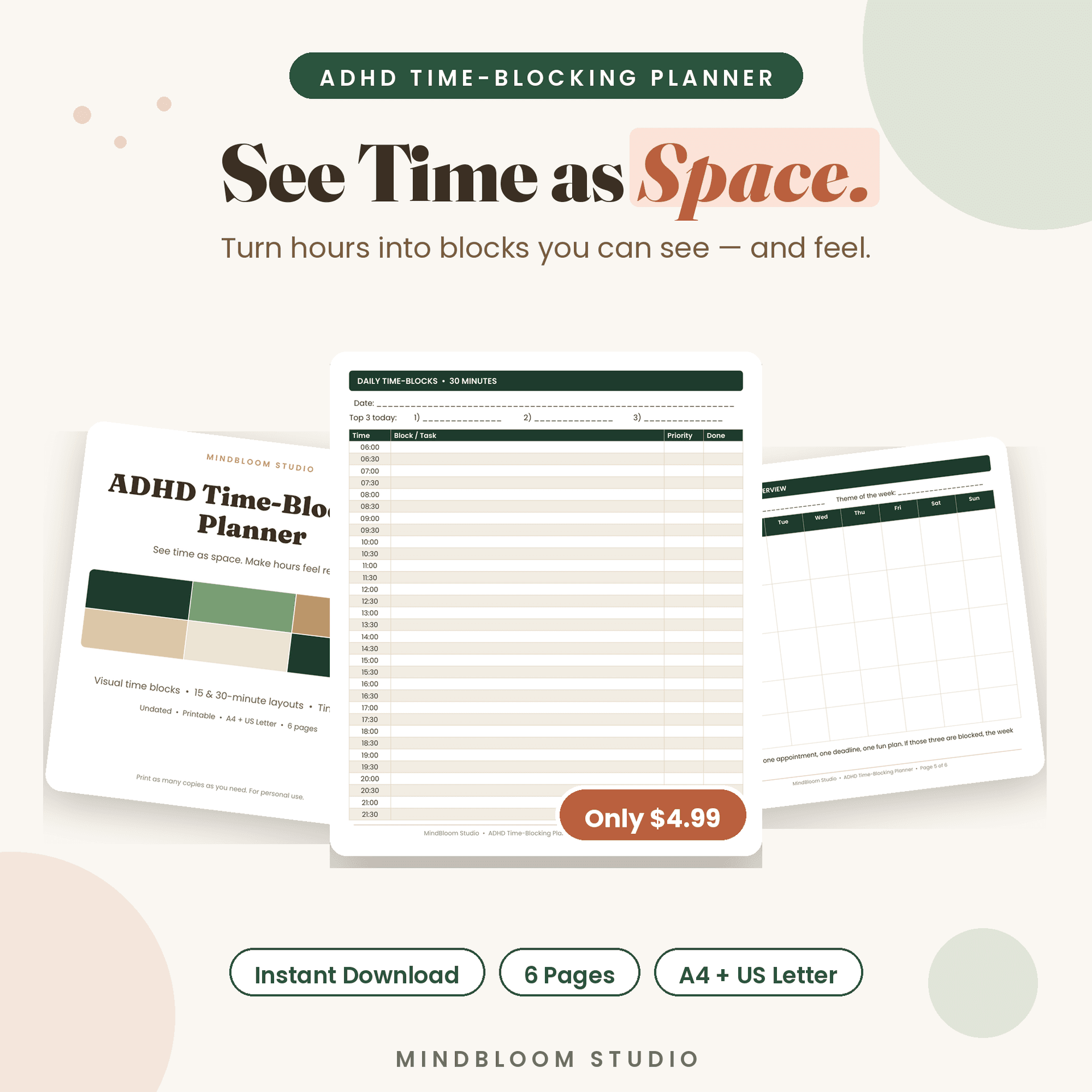
ADHD Time-Blocking Planner
$4.99
And if you want the full set — daily, weekly, and focus pages that work together — the bundle puts them all in one place:
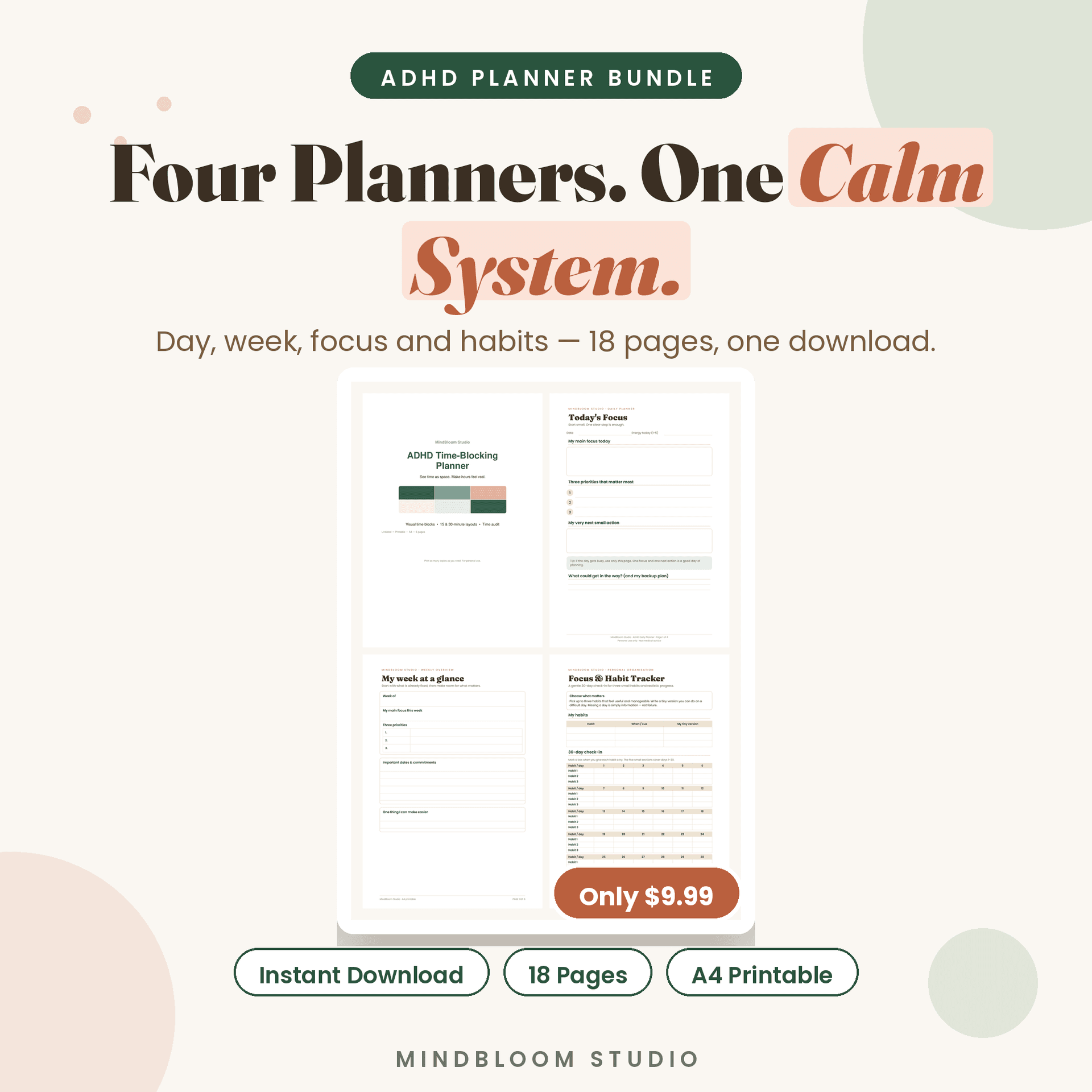
ADHD Planner Bundle — 4 Printable Planners (18 Pages)
$9.99
The right planner won't fix your brain. It just needs to be there, open, on the days you need it — and quiet on the days you don't.
*MindBloom printables are planning tools, not medical advice.*