 Getly
Getly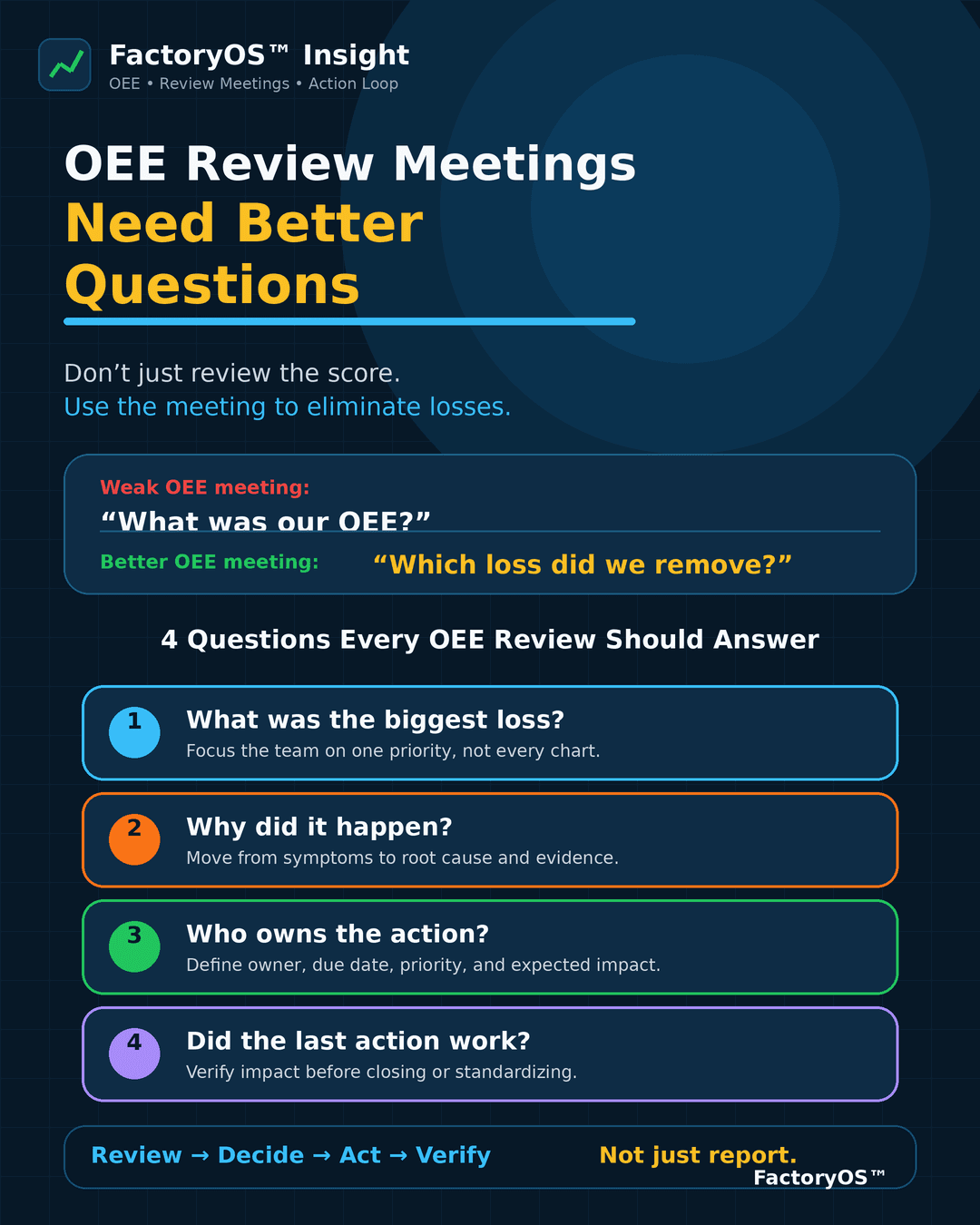
Most factories do not have an OEE meeting problem.
They have a question problem.
Every week, teams review the dashboard:
What was our OEE?
Did Availability improve?
Why did Performance drop?
Why is Quality lower?
Then the meeting ends.
And next week, the same losses return.
The problem is not the dashboard.
The problem is that many OEE meetings review performance instead of eliminating losses.
A strong OEE meeting should answer 4 questions:
1. What was the biggest loss?
Do not discuss every chart. Choose the loss that matters most: downtime, changeover, minor stops, speed loss, scrap, rework, or waiting.
2. Why did it happen?
Do not jump from loss to action too fast. Connect the loss to evidence:
When did it happen?
Where did it happen?
Is it recurring?
Was there a standard?
Was the standard followed?
3. Who owns the action?
No owner means no improvement.
Every action needs an owner, due date, priority, expected impact, and follow-up.
4. Did the last action work?
Task completion is not effectiveness.
The real question is:
Did the action reduce the loss and prevent recurrence?
Without verification, OEE meetings create activity.
With verification, they create improvement.
The purpose of an OEE review meeting is not:
“What was our OEE?”
It is:
“Which loss did we remove, and can we prove it?”
Review → Decide → Act → Verify
That is the thinking behind FactoryOS™ — connecting OEE, loss analysis, root causes, action ownership, and verification into one practical operating loop.
#OEE #Manufacturing #LeanManufacturing #TPM #OperationalExcellence #ContinuousImprovement #FactoryOS #IndustrialEngineering #ProductionManagement #MaintenanceManagement #RootCauseAnalysis #ProcessImprovement #ManufacturingExcellence #SixSigma #MES