 Getly
Getly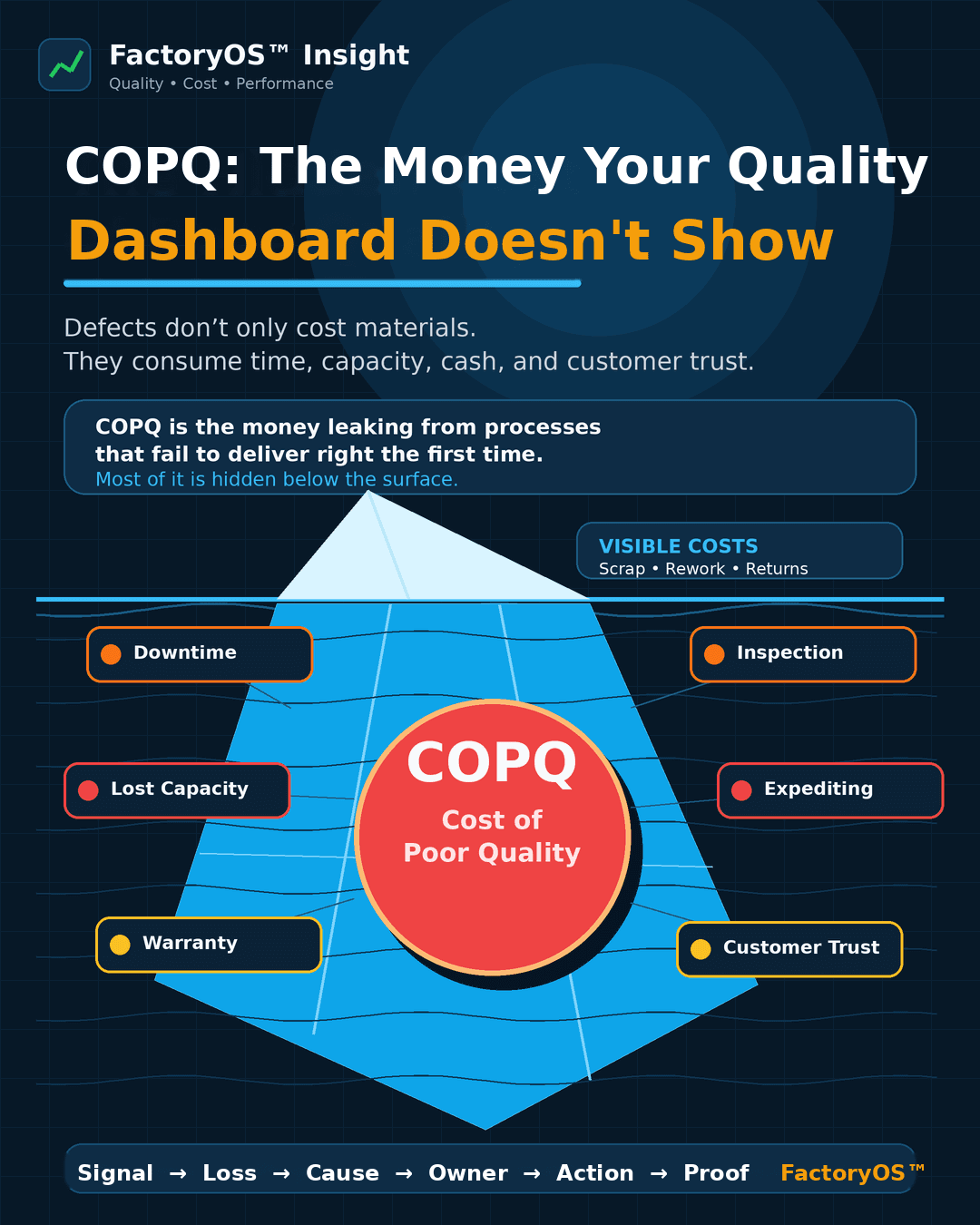
Most factory quality dashboards show a comfortable number:
“Defect Rate: 1.2%”
“Scrap Cost: $4,500 this month”
And everyone in the meeting nods, thinking quality is under control.
But that 1.2% is just the tip of the iceberg.
The real cost of poor quality (COPQ) is not just the scrap material you throw away. It is the hidden operational friction that never shows up on a standard QA chart.
Here is what your quality dashboard is missing:
1. Lost Capacity — when a machine runs rework, it is not running new production. You are paying twice for the same machine hour.
2. Sorting & Inspection — the hours operators spend manually checking parts after a defect signal is found.
3. Troubleshooting & RCA — the collective engineering hours spent in meetings trying to find the cause.
4. Expedited Shipping — the premium freight fees paid to deliver delayed parts to an angry customer.
5. Customer Administration — the time your sales, quality, and management teams spend handling complaints, returns, and warranty claims.
Visible COPQ: Scrap and Rework.
Hidden COPQ: Lost Time, Extra Labor, Premium Freight, and Lost Trust.
In many factories, the visible COPQ is only 15% of the total. The remaining 85% is bleeding straight into your margins, completely invisible.
If you only measure the defect rate, you are only managing the symptom.
To fix the margin bleed, you have to connect the quality signal to the operational action loop.
That is why we built the FactoryOS™ Cost of Poor Quality (COPQ) Tracker.
Built entirely inside Notion, this lightweight tool helps you move beyond basic defect tracking. It connects:
→ The quality defect (Signal)
→ The true operational cost (Loss)
→ The root-cause investigation (Cause)
→ The team member responsible (Owner)
→ The corrective standard update (Action)
→ The financial verification (Proof)
Because quality improvement is not a dashboard project.
It is a financial discipline.
Signal → Loss → Cause → Owner → Action → Proof
That is the loop.
That is the system.
#FactoryOS #COPQ #QualityManagement #SixSigma #LeanManufacturing #OperationalExcellence #ContinuousImprovement #IndustrialEngineering #ProductionManagement #FactoryPerformance #LightweightMES #ProcessImprovement #CostReduction #ManufacturingExcellence #DataDrivenDecisions #QualityControl #TPM #RootCauseAnalysis