 Getly
Getly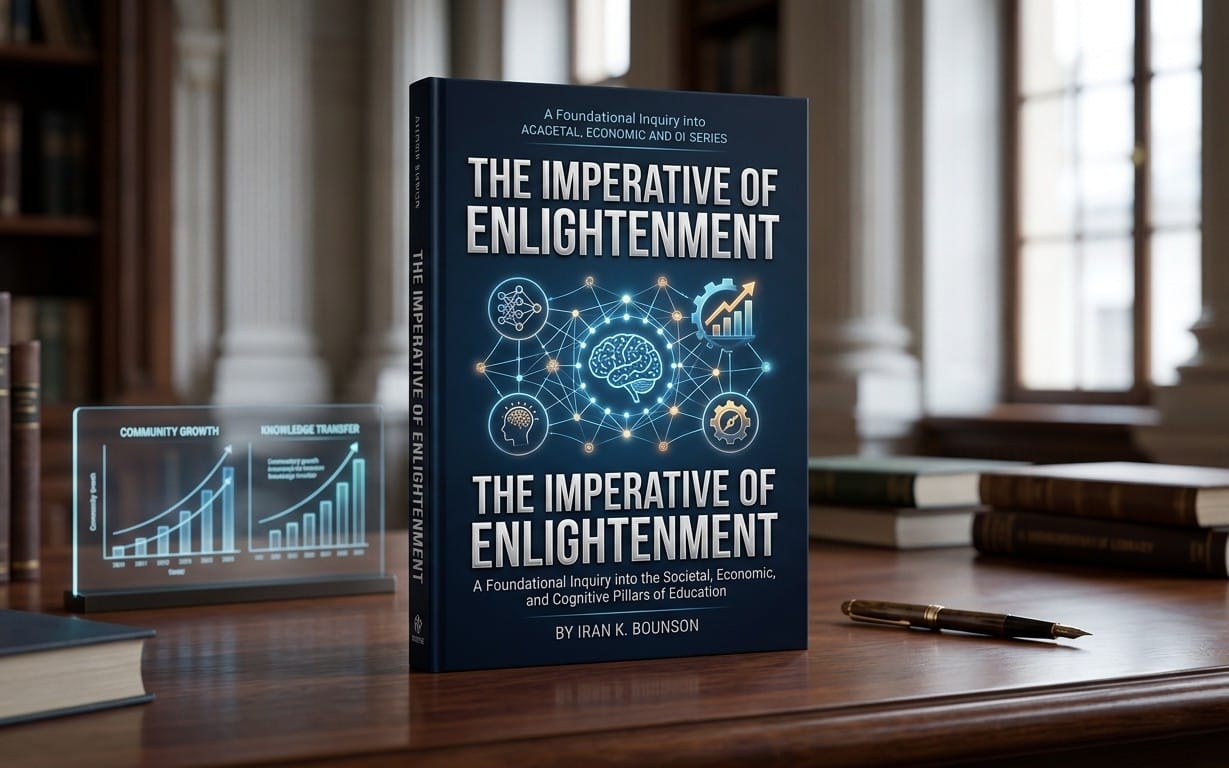 -25% OFF
Education & Courses
Education
"The Imperative of Enlightenment," is an advanced educational treatise published in June 2026 that details why education is structurally vital to human civilization. Rather than focusing on classroom technology, it provides an informative look at the core societal, economic, and cognitive pillars of learning.
Product Description
Document Overview: "The Imperative of Enlightenment"
Published in June 2026 by the Global Educational Policy Board, this academic and policy-oriented treatise is titled "The Imperative of Enlightenment: A Foundational Inquiry into the Societal, Economic, and Cognitive Pillars of Education." Moving beyond the logistics of school administration, this publication delivers an in-depth analysis of how education serves as the structural core for human cognitive advancement, economic freedom, democratic survival, and scientific progress.
Comprehensive Chapter Breakdown
Chapter 1: The Epistemological Value: Cognitive Transformation
This section shifts the view of education away from simple rote memorization, defining it instead as a vital neurological mechanism that fundamentally upgrades how the human brain processes information.
Schema Acquisition: The text notes that an untrained mind naturally relies on immediate emotional heuristics and unvetted cognitive biases. Education systematically installs structured mental frameworks—or schemas—allowing individuals to objectively categorize data, spot logical fallacies, and evaluate reality based on empirical evidence.
The Verification Equation: To illustrate this cognitive insulation against misinformation, the book introduces a formal verification index:
$$V_i = f(E_d \cdot L_a)$$
where an individual’s truth-evaluation capability ($V_i$) is directly scaled by their empirical data literacy ($E_d$) and logical analysis metrics ($L_a$).
Metacognitive Growth: The highest goal of education is identified as metacognition—the conscious awareness and mastery of one's own learning processes. Training this capacity yields an 82% increase in systemic problem-solving capacity and drives up to 10 to 15 points of upward variability in early intellectual reasoning patterns.
Chapter 2: Socio-Economic Mobility and Poverty Alleviation
From a macroeconomic standpoint, the book frames education as the most powerful engine for financial self-determination ever engineered, bypassing inherited privilege.
Breaking Poverty Cycles: Generational poverty is described as a closed loop where lack of capital restricts opportunity. Education disrupts this baseline by equipping individuals with high-demand specialized skills, allowing them to transform raw physical labor into high-value cognitive and technical output.
The Economic Multiplier: The treatise highlights a staggering global economic baseline: for every single year of primary or secondary schooling added across a nation's population, its macroeconomic output expands by a compound 10% in national gross domestic product (GDP) per capita. This shift insulates workers against sudden automation trends by anchoring their career value to complex problem-solving.
Chapter 3: Democratic Health, Civil Discourse, and Social Cohesion
This chapter provides an informative warning: free societies and democratic institutions cannot physically endure without an analytically educated populace.
Propaganda Resistance: In a modern media environment filled with weaponized deepfakes and echo chambers, education serves as a defense mechanism. Curricula that actively integrate media literacy show a 73% drop in student susceptibility to online propaganda and confirmation bias.
Civic Engagement and Peace: Educated, literate citizens are proven to be 2.5 times more likely to actively participate in democratic processes, voter turnout, and community safety monitoring. Furthermore, grounding populations in history, philosophy, and the social sciences fosters civic empathy, breaking down xenophobia and creating stable, low-crime communities.
Chapter 4: The Innovation Catalyst: Driving Human Progress
The final chapter details humanity's historical triumphs over systemic existential threats—such as disease, starvation, and extreme isolation—as direct results of structured, cumulative education.
Knowledge Compounding: Without formal educational archives, each generation would be forced to independently reinvent basic societal assets like sanitation, farming, or the wheel. Education acts as civilization's shared hard drive, allowing new generations to inherit past scientific breakthroughs and immediately use them as springboards for advanced discoveries like mRNA vaccines, green energy grids, or space travel.
Unleashing Hidden Capital: The document concludes with a core truth: while genius is distributed evenly across all zip codes and communities worldwide, opportunity is not. A robust, accessible global educational infrastructure searches out and empowers bright minds in historically overlooked spaces, providing them with the exact tools needed to pioneer future civilizational breakthroughs.
Education & Courses
Education
"The Imperative of Enlightenment," is an advanced educational treatise published in June 2026 that details why education is structurally vital to human civilization. Rather than focusing on classroom technology, it provides an informative look at the core societal, economic, and cognitive pillars of learning.
Tags
Frequently asked questions
Do I get access instantly?
Yes. This is a digital product — you can download it right after checkout, straight from your library.
Can I use it for commercial projects?
Your purchase includes a standard license for personal and commercial use. See the product description for any usage limits set by the seller.
What's your refund policy?
You're covered by a 30-day money-back guarantee. If something isn't right, request a refund from your order and the seller will review it.
What file formats and sizes will I get?
You'll download the files exactly as the seller packaged them (about 32.05 KB). See the product details and description for the included formats.
Do I get free updates?
Yes — when the seller ships a new version, you can re-download the latest files from your library at no extra cost. Check the changelog for recent updates.
Price
$15.00