 Getly
Getly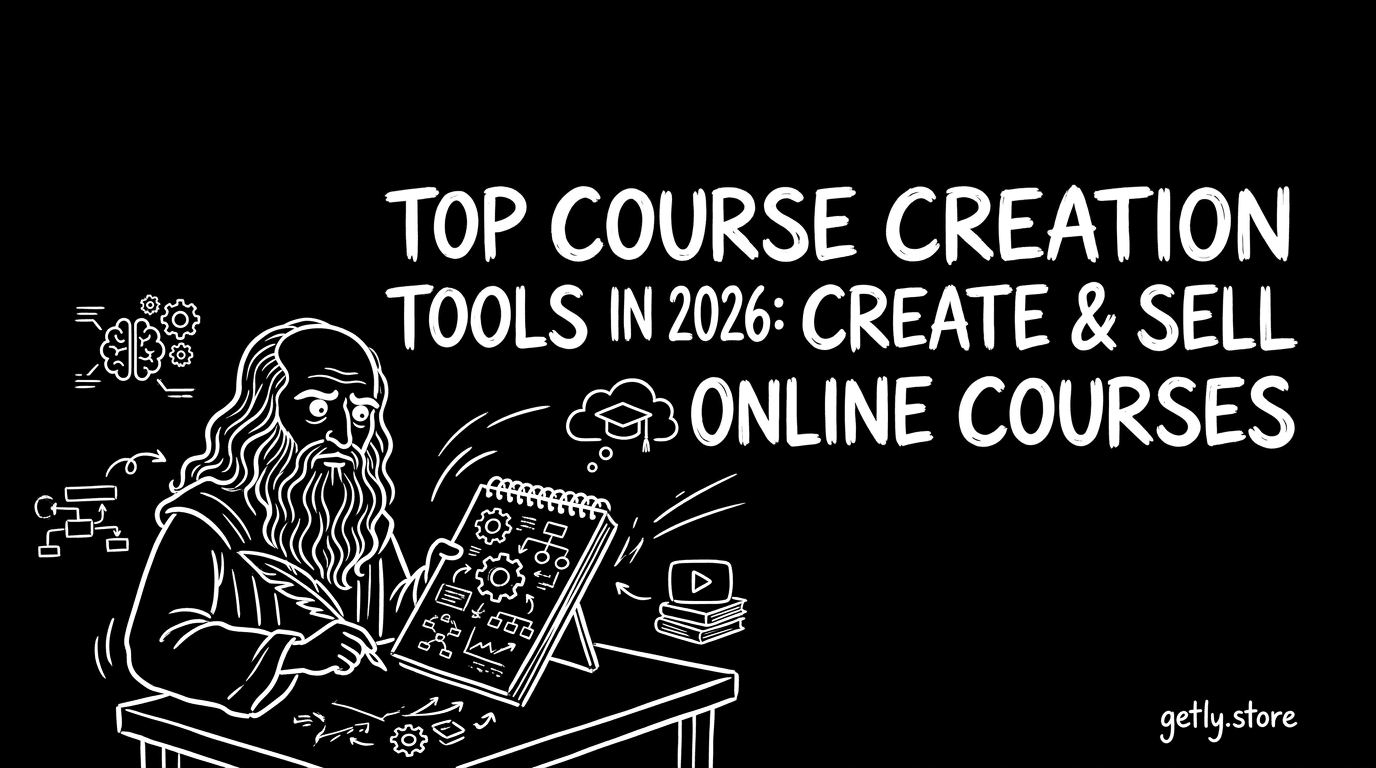
Online courses have never been easier to launch-but the tooling is what decides whether you build something learners finish (and pay for) or something that quietly stalls. In 2026, the best course creation tools help you script, record, design, host, market, and sell in one connected workflow.
This guide breaks down the best tools for online courses by use case-so you can choose the right stack to create digital course content fast, deliver it reliably on an online course platform, and sell online courses with confidence.
Quick Answer: What are the best course creation tools in 2026?
The best course creation tools in 2026 combine four things: (1) fast course authoring, (2) reliable hosting and video delivery, (3) automation for sales and onboarding, and (4) analytics that tell you what students actually finish.
If you’re deciding where to start, pick a tool for course building first, then add a platform layer (hosting + payments + licensing), and finally layer your marketing and automation. That sequencing prevents tool sprawl and reduces time-to-launch.
- Choose a course authoring tool for structure, quizzes, and lesson flow-don’t start with marketing.
- Use an online course platform that supports payments, delivery, and licensing cleanly.
- Upgrade your workflow with AI for scripting, outlines, and repurposing (but keep a human editing pass).
- Track completion and engagement early; pricing improves when your funnel understands learner behavior.
How to choose course creation tools for your course type
The right course creation tools depend less on “what’s popular” and more on your course format: video-heavy, cohort-based, software training, templates, or a knowledge library with downloads. In 2026, learners expect smooth navigation, mobile readability, and fast access-so your tooling must support that.
Start by listing your deliverables (videos, worksheets, code files, templates, assets, community access). Then match tools to each deliverable type so you don’t rebuild content in multiple systems.
Match tools to the deliverables you’ll actually sell
Many creators underestimate how much tooling depends on the “extras”: downloadable resources, assignments, live Q&A, and multi-license tiers. If you sell files, you’ll want a platform that handles licensing, downloads, invoices, and (ideally) basic anti-piracy support.
Here’s a practical mapping you can use:
- Video-first courses: authoring + chapters + transcripts + engagement analytics.
- Template/asset courses: delivery system that supports files and clean permissions.
- Software/dev training: ability to bundle resources, docs, and updates.
- Cohort/community: scheduling, access control, and messaging or integration.
Decide how you’ll sell: instant access vs. funnel sales
In 2026, many course creators run two tracks: instant-access purchases (for self-serve learners) and funnel-based onboarding (for premium cohorts, higher-touch coaching, or advanced tracks). Your tool stack should support both without making you manually transfer files and permissions.
Consider how you’ll handle the first experience: welcome emails, completion check-ins, and “what to do next” guidance. When onboarding is automated, support tickets drop and completion improves.
Pro tip: Don’t pick tools that fight your workflow. If you write scripts in a doc, your authoring tool should import structure easily. If you record in your DAW/screen software, your publishing workflow should preserve quality and captions with minimal re-encoding.
Best course authoring tools for creating digital course content
Course authoring tools are where your instruction becomes a real learning product: lesson structure, player experience, quizzes, assignments, and progress. The best tools for online courses in 2026 help you create faster and maintain learner momentum.
Think of authoring as the “engine” that turns ideas into a coherent curriculum. A weak authoring layer can’t be fixed later with ads or a nicer landing page.
Look for templates, quiz logic, and lesson navigation
A high-performing course has predictable navigation: learners should always know where they are and what comes next. Authoring tools should support chapters, checklists, and lesson prerequisites. For knowledge retention, quiz and assignment tools matter-but only if they’re easy to build.
In practice, the most useful authoring features in 2026 are:
- Curriculum outlines that translate into chapters automatically
- Quizzes with explanations (not just right/wrong)
- Assignments for uploads or link submissions
- Accessibility basics: captions, transcripts, mobile layout
- Progress tracking that’s visible to learners
Use AI to draft-then edit for accuracy and tone
AI can accelerate scripting, lesson planning, and content repurposing. But the best course creation tools don’t replace your expertise; they reduce production friction. In 2026, creators win by using AI to create the first draft, then using their knowledge to fix examples, edge cases, and credibility details.
For example, you can use AI to generate: lesson outlines, workshop agendas, practice prompts, and variations of homework questions. Your job is to validate: “Is this technically correct? Would my audience understand this? What’s the real-world example?”
Success story pattern (common in 2026): Creators who pair AI scripting with a strict “human QA checklist” cut course build time by weeks while maintaining higher student satisfaction scores-because examples and pacing are still grounded in real instruction.
What is an online course platform and what should it include?
An online course platform is the system that hosts your content, manages access, and supports payments and delivery. If authoring is the engine, the platform is the vehicle: it’s what students experience when they click “Buy.”
In 2026, the best platforms don’t only host video-they also handle digital goods delivery, licensing, customer support workflows, and automation that keeps learners on track.
Core platform features that directly affect sales
When you sell online courses, your platform’s checkout and delivery flow impacts conversion rates. If learners can’t access instantly, they abandon. If downloads and licenses are confusing, you get refunds. If payment notifications are unreliable, you get support pings.
Prioritize these platform capabilities:
- Payments + instant delivery with clear confirmation
- Course access controls per customer and purchase
- Digital delivery for files, templates, downloads, and updates
- Multi-license tiers for selling to individuals vs. teams
- Automated invoices for business buyers
- Analytics for what’s watched, completed, and revisited
Bundle your course with assets to increase perceived value
Students don’t just buy lessons-they buy outcomes. Bundling supporting materials (templates, worksheets, code starter kits, style sheets, shader files) makes those outcomes feel tangible. The best digital course stacks treat bundling as part of curriculum design.
For instance, if your course teaches a technical workflow, include the “final” outputs learners can compare against, plus the intermediate assets to practice with. That reduces frustration and improves completion.
Common mistake: Selling only a video library. When learners can’t download the working files or templates, they struggle to apply what they learn-completion drops, and refunds rise.
How to create and sell online courses with a launch-ready workflow
Creating and selling a course is a production pipeline, not a one-off upload. In 2026, the fastest launches use a workflow that connects writing, recording, packaging, payment setup, and post-purchase onboarding.
Below is a practical “build → publish → sell” sequence that reduces rework and helps you iterate quickly after launch.
Step-by-step: from curriculum to checkout in 30–45 days
Use this timeline as a baseline. Your actual speed depends on course length and production complexity (screen capture vs. studio recording vs. technical assets).
- Define the outcome: one measurable promise (e.g., “Build X in Y days”).
- Outline lessons: each lesson ties to a skill or deliverable.
- Create lesson assets: slides, templates, project files, checklists.
- Script and record: aim for clarity and “teach-back” pacing.
- Package for delivery: chapters, transcripts, downloadable resources.
- Set pricing + license tiers: individual vs. team vs. reseller (if relevant).
- Configure checkout + delivery: test access in multiple browsers/devices.
- Launch with onboarding emails: welcome, how-to, and “what to do first.”
Notice what’s not on the list: “tweak your homepage 200 times.” The course product must work first. Then you optimize conversion.
Use learning analytics to improve your next cohort
After launch, track engagement metrics that correlate with student outcomes: watch-through rate, quiz pass rates, and which lessons drive forward progress. In 2026, creators who use analytics early can fix weak segments fast-like replacing an unclear demo or adding a missing template.
Build a simple feedback loop:
- Review completion: identify the lesson where drop-off spikes.
- Review quiz results: target the concepts learners repeatedly miss.
- Review refund reasons: map them to missing expectations (scope, pace, or prerequisites).
Pro tip: When you find a confusing lesson, don’t “explain more.” Replace it with a shorter demo plus a downloadable template. Learners act faster when the next step is concrete.
Which tools should you combine for the best online course stack?
The “best tools for online courses” in 2026 isn’t a single product-it’s a stack. You want tools that don’t duplicate work: one for authoring, one for hosting/delivery and payments, and optionally one for marketing automation and analytics.
To make this decision easy, here’s a comparison of common stack components and what to optimize.
Course stack comparison (pick by goal)
| Goal | Primary tool type | Must-have feature | Secondary tools |
|---|---|---|---|
| Fast publish a video course | Authoring + hosting | Chapters + transcripts | Email onboarding, basic analytics |
| Sell files + templates | Delivery + licensing platform | Download delivery with tiers | Bundle builder, invoice automation |
| Premium course with cohorts | Platform access controls | Scheduling + permission management | CRM + support workflow |
| Scale content output | Workflow + AI drafting | Outline + repurpose automation | A/B testing, segmented emails |
Where marketplaces fit (especially for digital goods)
Marketplaces can reduce friction: you get distribution, built-in checkout, and a delivery model that’s designed for digital products. If your “course” includes heavy downloadable value-templates, project files, starter kits-marketplace-style delivery can be especially helpful.
For creators selling both instruction and assets, you also want clean licensing. That’s where multi-license tiers and instant delivery matter. If you’re selling an outcome-based course plus supporting materials, bundling becomes part of your offer-not an afterthought.
As you build your stack, it’s also worth checking how a platform handles creator payments, subscription perks (like unlimited downloads), and anti-copyright enforcement workflows-because the “operational load” is real when you publish repeatedly.
80% of revenue to creators is a compelling reason many educators and digital artists diversify into marketplaces and platform ecosystems. But the more important question is: does the platform reduce your admin work and protect your product?
FAQ: course creation tools, platforms, and selling
What are the best course creation tools for beginners in 2026?
The best beginner setup combines a simple authoring experience (chapters, transcripts, basic quizzes) with an online course platform that handles payments and delivery automatically. Choose tools that let you publish quickly, then iterate based on completion and learner feedback.
In general, prioritize speed-to-launch and a clean onboarding flow before adding advanced features.
How do I sell online courses if my content includes downloads?
Use a platform that supports digital delivery plus multi-license tiers if you plan to sell to both individuals and teams. Your checkout should trigger instant access to the lesson content and all downloadable assets.
Test access immediately after purchase on mobile and desktop to avoid delivery issues that lead to refunds.
What should I look for in an online course platform?
Look for payments, access controls, automated invoices, download delivery, and analytics. If you plan to scale, also prioritize customer communications (welcome emails, reminders) and a reliable way to manage updates to course materials.
These features directly impact conversion, completion, and support load.
Is AI useful for course creation tools?
AI is best used for drafting outlines, scripts, lesson plans, and repurposing content into worksheets or practice prompts. The highest-quality courses still require human editing to ensure accuracy, examples, and tone match your audience.
Think of AI as a production assistant, not a substitute for expertise.
How do I choose the right pricing for my first course?
Price your first course based on the outcome and time saved, not just production cost. Then validate with a launch that gathers completion data and refund reasons.
Improve the course before trying to “price optimize.” Better learning outcomes usually justify higher pricing more than marketing tweaks.
Conclusion: build the right course stack and launch with clarity
In 2026, the top course creation tools help you turn curriculum into a smooth learner experience: clear lesson flow, dependable hosting, and a sales-to-delivery system that doesn’t break at checkout. When your stack supports both learning and operations, you spend less time troubleshooting and more time teaching.
If you want a soft next step, start by choosing one course authoring tool and one platform layer that match your deliverables (video, templates, files). Then build a “minimum lovable course” and iterate using completion data-your best version will come faster than you think.
Optional inspiration: If you teach technical workflows, consider bundling an asset pipeline and practice projects alongside instruction-learners apply faster when they can compare their outputs to real deliverables.