 Getly
Getly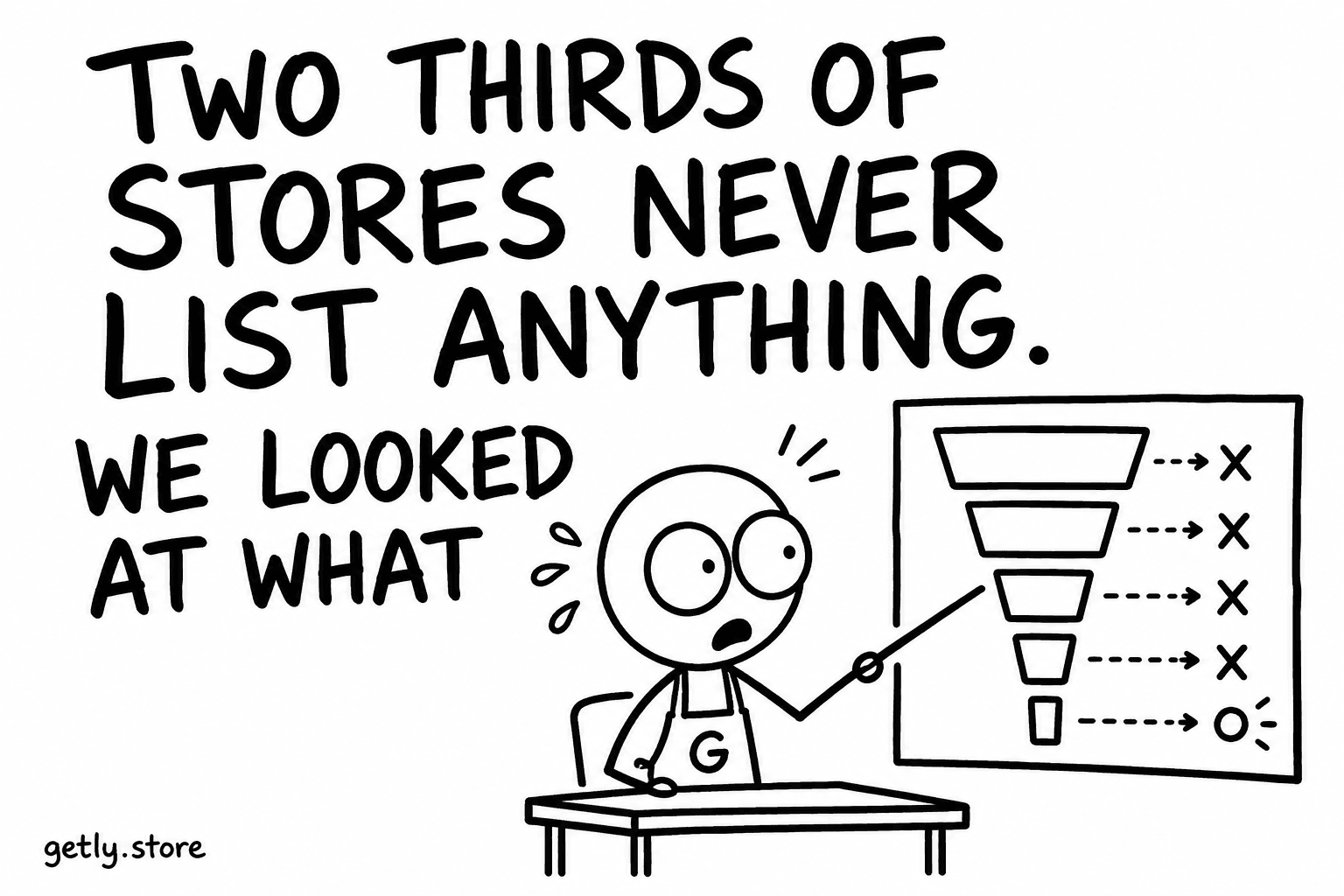
Here is one ratio from the catalogue, on 29 August 2026. Of every three stores created, only one goes on to publish a live product.
Nearly two thirds of people who set up a store never listed anything. That is a bigger number than any conversion problem further down the funnel, and it is worth being direct about, including the parts that are our fault.
What we know about where they stop
The product wizard reports each step it reaches, which lets us see where people get stuck rather than guess. Two findings from that data changed the product.
The first was a dead button. The publish control was disabled until a file was attached — and a disabled button emits no click, runs no validation, and says nothing. People pressed it repeatedly and nothing happened. Over 14 days we recorded 198 such presses from 60 sessions, plus 53 rage-clicks, and zero error messages shown, because showing an error requires a click the browser never delivered. The reason was on screen, in small grey text, aligned right. The button now clicks, states the reason, and takes you to the step that fixes it.
The second was the description gate. Listings need 150 characters of description before they can go live. Among sessions that hit that block, 36.8% went on to publish; among sessions that did not, 47.3% did. The threshold itself is not the problem — the median live listing carries 1,091 characters, so the floor is far below what people actually write. The problem was that the way out was invisible: the AI draft button that would have unblocked them was a 7-pixel outline control in the header, found by 15 of 83 blocked sellers.
What we cannot see, and will not pretend to
Those are the stops we can measure. They do not account for two thirds of every store created, and it would be dishonest to imply otherwise.
Most people who create a store and never list are, we suspect, doing something entirely reasonable: looking around, deciding this is not the week, or discovering that the product they had in mind needs another month of work. A store costs nothing to create, which is deliberate, and the flip side of that is that creating one means very little.
We would rather say that plainly than invent a funnel diagram for it.
If you are one of the 2,968
Two things from the data are worth knowing before you decide the moment has passed.
The median store that has sold something made its first sale while holding a single product. Not a catalogue, not a launch, not a content strategy. One thing, listed. The stores that now carry five or six products got there afterwards.
And the requirements to publish are shorter than they look: a file, one image, a category, 150 characters of description, and a licence type. That is the whole gate. Everything else — bundles, coupons, upsells, a custom domain, a Getly Page — exists and can wait indefinitely.
What we are doing about it
The two fixes above are shipped. Beyond them, the honest answer is that we have improved the parts of this we can see and have limited insight into the rest, which is why product-wizard sessions are instrumented at every step and why blocked publishes now carry a stable reason code instead of disappearing into a disabled button.
If you started a store and stopped, the most useful thing you could do for the next person is tell us where you stopped. The contact form on the site reaches a human, and "I gave up at the file step because X" is worth more to us than any amount of funnel analysis.