 Getly
Getly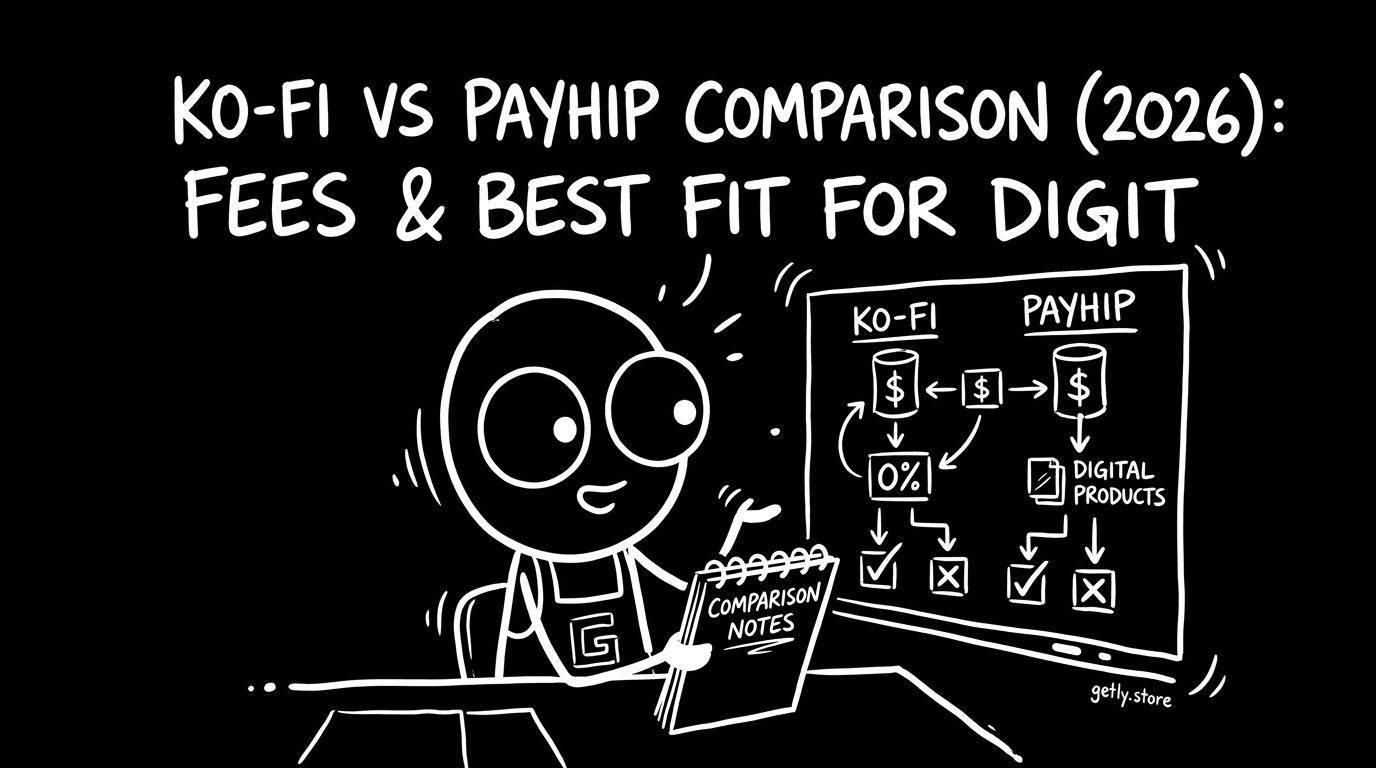
Ko-fi vs Payhip in 2026 comes down to one practical question: do you want a checkout tool for your existing audience, or a supporter-first page with limited storefront depth? This ko-fi payhip comparison focuses on the real drivers that change your bottom line: transaction fees, payouts, and whether buyers can discover you inside the platform.
TL;DR - Which Should You Pick?
- Pick Ko-fi when you sell digital products as tips, commissions, or small drops from an artist-style audience, not as a catalog-first storefront.
- Pick Payhip when you have your own traffic and want the lowest per-sale percentage on the free plan, accepting that Payhip does not provide buyer-side marketplace discovery.
- On fee math, Payhip costs you more per sale on the free plan (about ~8% effective) than Ko-fi (about ~3% effective), before payment processor charges.
- Neither Ko-fi nor Payhip supports crypto payouts, so if you need native stablecoin payments, you must look beyond both.
- If you care about EU tax handling via a merchant-of-record model, both platforms fall short because neither acts as Merchant of Record.
Fee Math at $10, $50, and $200
Both Ko-fi and Payhip charge payment processor fees in addition to their own structure. Ko-fi takes 0% commission on all plans, but Stripe/PayPal processor fees apply, which leads to an effective fee of about ~3% at common price points.
Payhip charges a 5% per transaction on the free plan (and higher subscription tiers lower that percentage), plus payment processing. At the free plan price points below, Payhip’s effective fee lands around ~8%.
| Sale Price | Ko-fi fees | Ko-fi net | Payhip fees | Payhip net | Winner |
|---|---|---|---|---|---|
| $10 | ~3% | $9.41 | ~8% | $9.20 | Ko-fi |
| $50 | ~3% | $48.30 | ~8% | $46.20 | Ko-fi |
| $200 | ~3% | $193.40 | ~8% | $183.70 | Ko-fi |
Ko-fi vs Payhip: Verdict by Use Case
| Use Case | Pick | Why |
|---|---|---|
| SaaS / subscription product | Choose based on your audience | Both platforms work best when your buyers already show up from your channels. Neither platform description here provides buyer-side marketplace discovery, so your own demand matters more than the storefront. |
| Selling 1-2 ebooks or templates | Payhip | Payhip targets creators who sell simple digital downloads and want cheap per-sale checkout on the free plan. Ko-fi fits too, but Ko-fi’s positioning starts as a support platform with limited storefront depth. |
| Selling to EU buyers | Either, with tax owned by you | Neither acts as Merchant of Record, so you should plan around VAT or sales tax responsibility rather than relying on a platform-managed tax model. |
| Small ticket items (under $20) | Ko-fi | Ko-fi’s effective fee at $10 lands around ~3% with a $9.41 net example, while Payhip’s free-plan effective fee at $10 lands around ~8% with a $9.20 net example. |
| Higher volume ($5k+/mo) | Ko-fi for fee efficiency | When your price points follow typical small-to-mid downloads, Ko-fi’s ~3% effective fee structure stays meaningfully lighter than Payhip’s ~8% effective fee structure on the free plan (per the given price points). |
| Need crypto payouts | Neither | Both platforms state crypto payouts are not supported. If stablecoin payouts matter, you need a marketplace that supports native crypto payouts. |
Feature Differences That Actually Matter
Subscription and recurring billing: Ko-fi lists “Monthly subscription: Free (Ko-fi Gold optional at $6/mo or $60/yr for branded customization).” Payhip lists “Monthly subscription: Free / $29 / $99.” Neither platform description here confirms how well they handle recurring billing for a SaaS-like product. In practice, you should treat both as checkout systems first and confirm how they map to your subscription logic before you commit.
Affiliates: Payhip’s fee and plan data does not mention affiliate tooling in the provided facts. Ko-fi’s provided facts also do not mention affiliate programs. So the practical takeaway for ko-fi or payhip comparison readers is simple: if you rely on affiliates to generate sales, do not assume either platform gives you strong marketplace-style attribution without verifying that specific capability in your use case.
Course delivery and structured digital content: Neither platform facts here define course delivery workflows. Ko-fi’s best-fit description emphasizes supporters, tips, commissions, memberships, and small digital downloads, and it also calls out limited storefront depth. Payhip’s best-fit description emphasizes creators with their own audience who want low per-transaction percentage for ebooks, PDFs, and simple downloads. If your “course” experience needs a strong learning UI, confirm that the platform’s delivery and gating behavior matches what you expect.
Public API and customization: The provided facts do not list API support or customization depth for Ko-fi or Payhip. So you should judge them based on the plan tiers you choose and the storefront experience you can actually build today, rather than assuming parity with more marketplace-like platforms.
Buyer-side marketplace discovery: Both Ko-fi and Payhip explicitly state “Has buyer-side marketplace discovery: NO.” That matters because it shifts the growth equation. You should expect that buyers find you through your audience (social, email, SEO you control), not because the platform surfaces you in a marketplace feed that sells for you.
Suspension Risk and Account Stability
Based on the verified facts given here, we cannot quantify suspension rates or “public reports” for either platform. We can say both platforms have clear monetization models and live payout methods, and both list “Crypto payouts: NO” and “Has buyer-side marketplace discovery: NO” as consistent product traits. That consistency suggests stable positioning rather than frequent platform pivots.
If you plan to rely on the platform as a key revenue stream, use a belt-and-suspenders approach: keep your own buyer channel (email list, community, or at least a consistent social funnel), and ensure you can reproduce the selling flow even if the platform restricts your account. That reduces your risk more than any one-platform promise.
Migration Path: Switching Between Ko-fi and Payhip
Moving from ko-fi vs payhip usually means rebuilding your storefront setup and re-linking your audience. Realistically, you will export or recreate product details (titles, files, pricing, and licenses if you use them), then set up the new platform listings and connect your payout method. You then redirect traffic from your existing links and content to the new checkout URLs (and update any store links you share publicly).
The effort depends on how many SKUs you carry. As a rough workflow estimate, plan for a few hours per 50 products to recreate listings, verify downloads, and test the checkout. What does not transfer automatically includes your existing customers, your storefront history, and the purchase context tied to the old platform’s system.
When to Pick a Third Option
Ko-fi and Payhip both report “Crypto payouts: NO” in the provided facts, and both also report “Has buyer-side marketplace discovery: NO.” If you need either stablecoin payouts or a true marketplace discovery surface, you should look beyond both platforms.
A third option like Getly fits when you want native stablecoin payouts (USDT or USDC) and a buyer-facing digital-goods marketplace with categories and browsing, not just checkout buttons. If neither of those gaps matters to you, stick with the ko-fi payhip comparison and choose based on fees and your audience.
Bottom Line
In 2026, Ko-fi vs Payhip breaks along economics and intent. Ko-fi wins on the provided fee math at $10, $50, and $200, and it matches creators who sell digital downloads from a supporter-first, artist-style page. Payhip fits creators who already own the audience and want simple checkout for ebooks and templates, but its free-plan effective fee shown here costs more per sale. Your next step: compare your likely price points and payout needs, then visit ko-fi.com and payhip.com to validate the exact selling flow you need.
If you plan to sell into EU markets or rely on tax handling, treat “Merchant of Record: NO” as a signal to plan your VAT or sales tax approach yourself before launch.
Frequently asked questions
Which one has lower effective fees on the provided price points, Ko-fi or Payhip?
Ko-fi. At $10 Ko-fi nets $9.41 versus Payhip net $9.20, and at $50 Ko-fi nets $48.30 versus Payhip net $46.20. At $200 Ko-fi nets $193.40 versus Payhip net $183.70.
Do Ko-fi or Payhip support crypto payouts?
No. Both Ko-fi and Payhip list crypto payouts as not supported in the provided facts.
Do either platform provide buyer-side marketplace discovery?
No for both. The verified facts for both platforms explicitly state “Has buyer-side marketplace discovery: NO.”
Who handles VAT or sales tax as Merchant of Record on Ko-fi vs Payhip?
Neither. Both platforms list “Acts as Merchant of Record (handles VAT/sales tax): NO,” so you should not assume tax collection and remittance happens on your behalf.
If I switch from Ko-fi to Payhip, will my customers and order history transfer automatically?
No. The practical migration you should expect involves rebuilding product listings and redirecting traffic; customers and platform-specific order history do not transfer automatically.