 Getly
Getly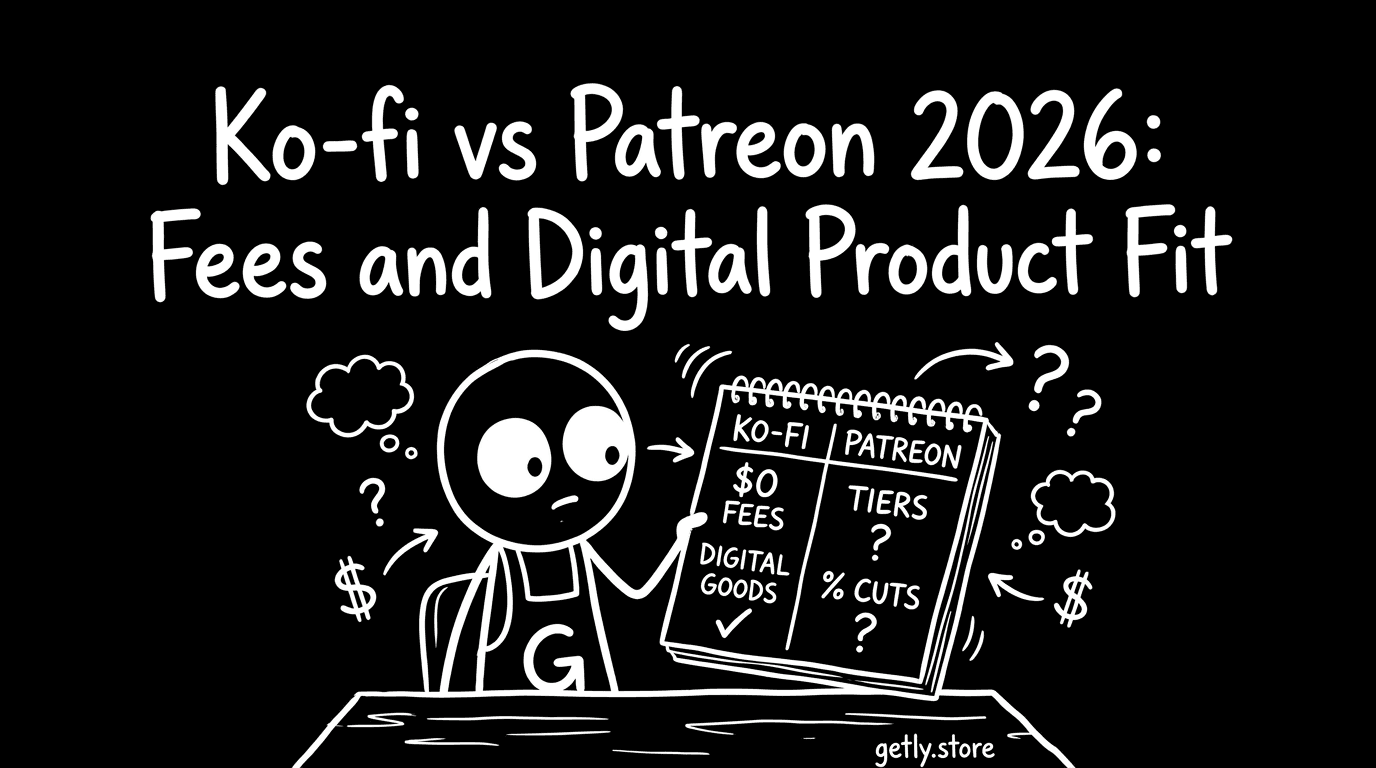
Pick between ko-fi vs patreon in 2026 by starting with how you sell. Ko-fi supports tip-first monetization with 0% commission on its side, while Patreon charges 8% to 12% of pledges plus payment processing, and it’s built for recurring memberships.
For digital creators who sell discrete downloads like ebooks, templates, or packs, the fee math and checkout behavior matter more than branding. Use the comparison below to match the platform to your product type and supporter expectations.
TL;DR — Which Should You Pick?
- Choose ko-fi when you monetize with tips, commissions, memberships, or small digital downloads and you want the platform side to take 0% commission.
- Choose patreon when you sell recurring monthly subscription memberships and you want a membership-first home for exclusive content.
- Pick the platform with your fee pattern: Ko-fi’s effective fee sits around ~3% (plus processor costs), while Patreon’s effective fee shows up around ~12% to ~17% on a $10 monthly pledge.
- If you sell mostly one-off product sales, ko-fi fits the selling style better than Patreon’s membership mechanics.
- If you want a “marketplace storefront” with built-in buyer discovery, neither ko-fi nor Patreon offers buyer-side marketplace discovery (you should look at a marketplace built for catalog browsing).
Fee Math at $10, $50, and $200
Ko-fi charges 0% commission on all plans. In practice, your effective cost comes from the payment processor fees, which Ko-fi describes as ~3% + 30¢ via Stripe/PayPal. The ground-truth effective nets show how those processor fees translate into creator take-home at common sale prices.
Patreon charges a 8% (Pro) to 12% (Premium) commission of patron pledges, plus payment processing of ~3-5%. The ground-truth effective fee line already rolls those pieces into a single approximation for typical pledge price points.
| Sale Price | Ko-fi fees | Ko-fi net | Patreon fees | Patreon net | Winner |
|---|---|---|---|---|---|
| $10 | ~3% | $9.41 | ~12-17% effective | ~$8.25 to $8.80 | Ko-fi |
| $50 | ~3% | $48.30 | ~12-17% effective | ~$41.50 to $44.00 | Ko-fi |
| $200 | ~3% | $193.40 | ~12-17% effective | ~$166.00 to $176.00 | Ko-fi |
Ko-fi vs Patreon: Verdict by Use Case
| Use Case | Pick | Why |
|---|---|---|
| SaaS or subscription product | Patreon | Patreon’s best fit targets creators monetizing recurring monthly subscriptions for exclusive content, which matches a membership-driven SaaS motion more cleanly than a tip-first model. |
| Selling 1-2 ebooks or templates | Ko-fi | Ko-fi’s artist community fit and 0% commission align better with discrete digital downloads, while Patreon centers on ongoing monthly pledges. |
| Selling to EU buyers | Neither, pick based on your checkout needs | Both platforms state no Merchant of Record handling VAT or sales tax, so you need to manage taxes in your own workflow regardless of whether you use ko-fi or patreon. |
| Small ticket items (under $20) | Ko-fi | Ko-fi’s effective fee shows around ~3% at a $10 sale ($9.41 net). Patreon’s effective fee on a $10 monthly pledge lands closer to ~12% to ~17%. |
| Higher volume ($5k+/mo) | Ko-fi | With Ko-fi taking 0% commission and the effective processor-based cost around ~3%, the fee delta grows as volume increases versus Patreon’s 8% to 12% commission plus processing. |
| Need crypto payouts | Neither | Both platforms list Crypto payouts: NO, so you need another option that supports crypto payouts if that requirement is non-negotiable. |
Feature Differences That Actually Matter
Recurring billing support: Patreon’s design centers on monthly subscriptions for ongoing exclusive content. It markets itself as a membership-first platform, and the best-fit description in the ground truth points to creators monetizing supporters with recurring content. Ko-fi supports memberships too, but it starts as a tipping/support destination and works best when you sell more like “support + downloads” than like “subscription catalog.”
Affiliate program built-in: Ko-fi and Patreon both support “creator economy” activity, but the only ground-truth affiliate detail in this comparison belongs to Getly, not to either ko-fi or patreon. So for a strict ko-fi vs patreon decision, you should treat built-in affiliate functionality as uncertain from the provided facts and focus on the fee structure and the billing model instead.
Course delivery and discrete digital products: Patreon’s strongest fit sits with exclusive monthly content rather than a catalog of discrete storefront downloads. That design choice shows up in the fee math too: Patreon calculates cost around pledges and membership behavior. Ko-fi fits creators monetizing one-time tips, commissions, memberships, and small digital downloads, and its weakness statement highlights that it does not behave like a serious storefront for catalog sellers.
Public API, custom domains, and buyer discovery: The provided ground-truth facts do not confirm a public API or custom-domain controls for either ko-fi or patreon, and they explicitly flag buyer-side marketplace discovery: NO for both. That means your growth strategy needs to bring the audience yourself. You should expect discovery to come from social channels, search, and your own marketing, not from a built-in marketplace browsing surface.
Watch the Merchant of Record gap. Both platforms state they do not act as Merchant of Record and do not handle VAT/sales tax, so you should plan your tax workflow accordingly.
Suspension Risk and Account Stability
On stability, the provided ground-truth facts do not include any suspension rates, termination policies, or public reliability metrics for either ko-fi or patreon. You should therefore treat “account risk” as something to validate with each platform’s current policy pages and community reports rather than trying to infer it from fees or feature sets.
If you want the safest operational path, align your product format with what the platform is optimized for: Patreon handles recurring membership content best, and Ko-fi handles tip and download-style monetization better. A platform mismatch can trigger slower growth or higher support overhead, even when the account stays healthy.
Migration Path: Switching Between Ko-fi and Patreon
Start with your content format. If you move from Ko-fi downloads to Patreon subscriptions, you need to repackage offers into a recurring membership structure. If you move from Patreon into Ko-fi, you’ll likely convert pledges into one-time tips, downloadable products, and smaller membership offers. This re-offering work usually takes more time than the technical setup because you must decide what changes for existing supporters.
Next, rebuild your sales surface: create the new page/store, re-upload digital assets, and update links in your bio and key landing pages. Plan for manual effort around catalogs (for example, tens of products may take hours to recreate cleanly). Also assume that customer identity, order history, and reviews do not transfer automatically across platforms, even if the audience overlaps.
When to Pick a Third Option
Go beyond ko-fi vs patreon when you need either (a) native crypto payouts or (b) a real marketplace storefront that helps buyers discover products. Both ko-fi and patreon list Crypto payouts: NO and both list buyer-side marketplace discovery: NO, so a marketplace designed for catalog browsing becomes the more direct fit.
One example that matches the crypto and storefront needs is Getly. Getly operates as a digital-goods marketplace with crypto stablecoin payouts (USDT/USDC) and a buyer catalog experience. If you’re not chasing crypto payouts and you already have an audience, ko-fi or patreon still covers most creator use cases. If crypto payouts or marketplace discovery sits at the core of your model, you should evaluate a marketplace like Getly first.
Bottom Line
In 2026, ko-fi vs patreon boils down to subscription versus downloads and fee math: Ko-fi keeps platform commission at 0% and shows effective nets around $9.41 on a $10 sale, while Patreon’s effective commission-plus-processing lands closer to ~12% to ~17% on a $10 monthly pledge. Visit ko-fi for one-off downloads and tip-style monetization, or visit patreon if your core business relies on recurring monthly memberships.
Next step: open both product pages, test the checkout flow for your offer type, and map your monetization plan to the platform that matches it best. For ko-fi, start here: https://ko-fi.com. For Patreon, start here: https://www.patreon.com.
Frequently asked questions
Which platform has buyer-side marketplace discovery?
Neither ko-fi nor Patreon provides buyer-side marketplace discovery based on the provided facts. You should expect to drive traffic from your own channels.
Do ko-fi or Patreon handle VAT or sales tax as Merchant of Record?
No. Both platforms state they do not act as Merchant of Record and do not handle VAT/sales tax. You manage tax responsibilities in your own workflow.
What are the effective fees at a $10 price point?
Ko-fi’s effective fee is ~3% and results in $9.41 net on a $10 sale. Patreon’s effective fee on a $10 monthly pledge is ~12% to ~17% depending on plan and processor, so the net lands around the low-$8 range.
Can either platform pay creators in crypto?
No. Both platforms list crypto payouts as NO, so you need another provider if crypto payouts are a requirement.
Which platform fits selling discrete ebooks and templates?
Ko-fi fits discrete digital downloads and one-off monetization better based on its stated best-fit description and 0% commission on its side. Patreon fits recurring monthly subscription memberships more cleanly.