 Getly
Getly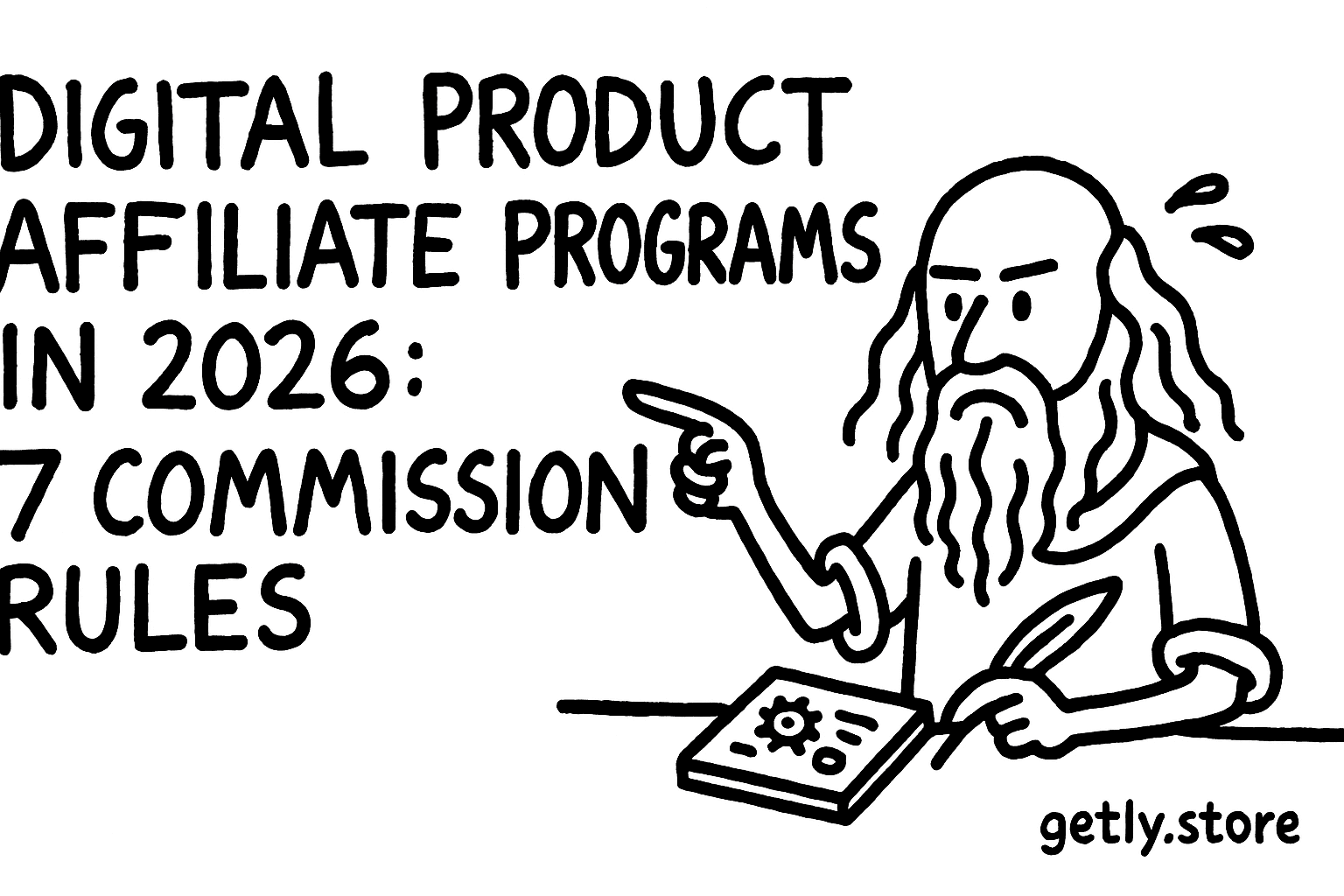
You can turn affiliate marketing into a steady creator monetization strategy, but only if your commission math stays consistent from click to payout. In 2026, digital product affiliate programs reward setup, tracking discipline, and clean rules around refunds, own traffic, and attribution windows. Here are seven commission rules that keep your program profitable and predictable.
- Use a fixed attribution window and communicate it clearly so affiliates trust the results.
- Separate affiliate commissions from platform revenue splits, and cap where it prevents margin collapse.
- Decide how you treat refunds, bundles, and multiple products in one checkout.
- Give affiliates fair credit for both content-driven traffic and long-tail discovery.
- Plan payouts on a real schedule so affiliate earnings feel real, not theoretical.
What is affiliate marketing for creators in 2026?
Affiliate marketing for creators means you publish a unique link, coupon, or storefront entry, then earn commission when a buyer purchases a digital product through your attribution. In 2026, the best programs feel simple on the surface, but they run on precise tracking and revenue rules behind the scenes.
Digital products make affiliates easier than physical goods because delivery happens instantly after purchase. That reduces churn, helps buyers decide fast, and gives you cleaner attribution because purchases do not get stuck behind shipping timelines.
Why digital product affiliate programs behave differently
Digital product affiliate programs typically convert on value and trust. Creators promote templates, scripts, compliance toolkits, preset packs, generators, and spreadsheets because these assets solve a specific workflow problem right now.
That means your commission rules should focus on conversion quality: accurate attribution, fair credit, and transparent payout timing. If your rules feel “random,” affiliates stop testing traffic and move on to programs that pay predictably.
Best creator monetization strategies pair affiliates with content
The strongest creator monetization strategies still start with content distribution. You build an audience through tutorials, comparisons, and use-case demos, then affiliate links act like a “checkout layer” for that content.
For example, if you create short-form vertical series education, a short drama script template becomes an obvious next step. If you create e-commerce operations content, an Excel template with an auto dashboard becomes a fast ROI purchase. Those are the buyer journeys where affiliate commission rules matter most.
Rule #1: Set attribution window rules that affiliates can trust
The first commission rule that works in 2026: define your attribution window and keep it stable. Affiliates build strategy around the time between a click and a purchase, so your program needs consistent timing.
Getly’s affiliate attribution credits a purchase when the referred buyer buys within a 90-day window from the affiliate click. That means an affiliate does not need to “catch” an immediate checkout every time.
Use a longer window for long-tail buyer decisions
Digital product purchases often happen after the buyer compares options, checks licensing, or validates the file format. A 90-day attribution window matches real buyer behavior better than shorter windows that force affiliates to chase only impulse purchases.
When you advertise the attribution window, you also reduce disputes. Affiliates can forecast how long it takes their audience to move from interest to purchase.
Communicate attribution in plain language
Affiliates need one sentence they can reuse in their own promotion. Something like: “Purchases credited when they happen within 90 days of your click” prevents confusion later.
Then add one practical tip: remind affiliates to avoid link redirects or broken tracking in their landing pages. If the click does not reach the tracking link, attribution becomes impossible.
Pro tip: In 2026, affiliates trust programs that publish attribution rules publicly. Put the window in your affiliate welcome message and keep it consistent across posts, FAQs, and creator dashboard screens.
Rule #2: Calculate commission from the seller’s share (not gross)
The second commission rule: calculate the affiliate commission based on the seller’s share of the sale, then apply your affiliate percentage to that value. This protects margins and prevents “commission math” surprises.
In Getly’s affiliate model, the affiliate commission rate uses the seller-set commission percentage, and that commission gets applied to the seller’s share of the sale (with the platform take structure running separately). This matters because affiliate marketing for creators can fail when you commission affiliates on gross prices without considering how platform revenue is handled.
Understand the margin structure that keeps the program sustainable
Getly operates a one-tier commission model where sellers keep between 80% and 90% depending on volume and traffic source rules. Affiliate commissions then apply to the seller’s portion, keeping creator margin usable as you scale affiliate growth.
This approach helps you avoid a common failure mode: sellers undercut themselves by overpaying affiliates before they even cover the marketplace’s processing costs and take.
Cap commission to prevent margin collapse
Getly caps the seller-set affiliate commission percentage at 50%. That single rule prevents affiliates from receiving an outsized portion that would push the seller’s effective earnings too low to remain profitable.
In practice, this gives creators a stable “maximum generosity” ceiling while still letting them run performance-focused offers for their top products.
Success pattern: Affiliates promote harder when the commission feels fair, and sellers keep enough profit to keep files updated and marketing active. A revenue-split-aware calculation keeps both sides invested.
Rule #3: Make refunds a first-class part of commission policy
The third commission rule: treat refunds explicitly in your commission policy. Affiliates care about refund handling because refund churn can turn a “promising funnel” into a loss.
On Getly, refunds do not count as completed sales, and no commission is charged on refunded amounts. That means affiliate earnings reflect actual completed revenue rather than clicks that later fail.
Write refund rules that affiliates can repeat
When you publish your program terms, include a simple line: “No commission on refunded purchases.” This clarity reduces affiliate disputes and prevents “commission clawback” anxiety.
It also helps affiliates focus on quality traffic. Creators who understand the product fit better tend to generate fewer refund events.
Protect yourself from “bait offers”
Refund policies also discourage affiliates from promoting irrelevant products just to earn quick commissions. Digital product affiliate programs work best when affiliates select offers they can stand behind.
If you let affiliates earn commission on refunded orders, you train the market to treat your products like lead magnets instead of real purchases.
Common mistake: Paying commission on gross sales without a “refund reverses commission” rule. That setup burns seller margins and eventually kills affiliate trust.
Rule #4: Decide how affiliate rules interact with own traffic
The fourth commission rule: separate affiliate credit from the concept of “own traffic.” Affiliates should win on partner-driven demand, not on the seller’s own distribution channels.
Getly applies a special rule for OWN TRAFFIC: it always takes 10% (seller keeps 90%) when a purchase happens within 24 hours of a click from the seller’s own personal link, via a seller-embedded pay widget, or inside a Telegram Mini App store. The platform never takes the full rate for demand the seller brought themselves.
Why this matters for commission predictability
If own traffic and affiliate traffic share the same commission assumptions, you create incentives for affiliates to “fake” attribution or for sellers to feel punished for promoting their own work.
When your program keeps own traffic economics distinct, you reward affiliates for referrals and you keep sellers confident that their channel investments do not get taxed unfairly.
Affiliate creators still win with different content angles
Even with own traffic rules, affiliates can still build leverage through audience overlap and niche-specific content. A creator who reviews tools for vertical series production can drive the right buyer, even if the seller also markets their template.
That separation encourages a healthy affiliate ecosystem: sellers promote what they want, affiliates target buyer intent, and commissions align with actual referral contribution.
Rule #5: Use platform-wide referral rules as an amplifier
The fifth commission rule: add a platform-wide referral layer that rewards affiliates when new users enter through referrals, not only when they buy immediately.
On Getly, a platform-wide referral credits the referrer with 15% of the referred user’s first purchase. This rule supports creator monetization strategies by turning customer introductions into earnings, even if the referral needs extra time to convert.
Why “first purchase” matters for new audiences
New buyers often arrive after seeing proof, demos, and comparisons. A platform-wide referral rewards the creator who introduced that buyer, even if the buyer later chooses a different product than the affiliate originally promoted.
It also helps affiliates take on more educational content roles. You can recommend tools broadly and still earn when the buyer makes their first purchase.
Keep it simple for affiliates
Affiliates handle best when the platform-wide rule is short and consistent. “15% of the first purchase” gives them a clean claim to make and reduces calculation errors in their own spreadsheets.
In 2026, creators promote across multiple platforms. A short reward rule works better than a long formula that requires screenshots and manual verification.
Rule #6: Choose payout rules that scale with affiliate expectations
The sixth commission rule: pay affiliates on a schedule that matches expectation. Affiliates plan content calendars around payout timing, not around “someday” balances.
Getly’s affiliate withdrawal uses Stripe Connect with a minimum withdrawal threshold of $10 for affiliates. That means affiliates need to reach a clear earnings floor before they can withdraw.
Set a predictable cadence
Getly runs payouts on the 1st and 15th of every month at 03:00 UTC. Both card and crypto payout schedules follow the same dates, which helps creators and affiliates align their reporting.
Also note the payout delay: sales hold for roughly a month before payout due to the Blender-style schedule. A sale made earlier in a month gets paid on the 15th or the following 1st depending on the order date range.
Explain the minimum threshold upfront
Minimum payout rules change affiliate behavior. Without a minimum, affiliates might spam low-effort traffic hoping it “adds up.” With a minimum, affiliates focus on conversions that generate meaningful balance.
Publish the threshold in your affiliate terms so creators do not waste time expecting withdrawals when their balance sits below the minimum.
Rule #7: Design product promotions around licenses and buyer clarity
The seventh commission rule: earn more by reducing mismatch between affiliate claims and buyer licensing expectations. Digital product affiliate programs work best when affiliates sell the right intended use, not just the file.
Every Getly product requires a licence field that shows which usage terms apply. The listing must state one of: personal use only, commercial use allowed, extended (commercial plus client work), public domain (CC0), or custom terms described in the listing.
Affiliates should talk outcomes, not just file formats
When you promote a template, an affiliate should explain the workflow outcome: “drafts a vertical series script quickly,” “generates hooks and captions for short drama,” or “builds an e-commerce reporting dashboard from your data.” That reduces refunds because buyers know what they receive and what they can do with it.
Then confirm the licence intent. Affiliates who match their audience’s usage scenario (personal vs commercial) protect both conversion rates and refund rates.
Use examples that map to real creator niches
Here are product angles that fit specific creator audiences. You can use them as affiliate promotion templates, and you can point buyers to the exact product page where the licence is shown.
- Vertical short drama niche: Short Drama Script Creator | Notion Template for Vertical Short Series
- Content marketing hooks niche: HookForge — Instant Hook & Caption Generator (EN/ES, No AI Subscription)
- E-commerce ops niche: E-commerce Data Entry Excel Template + Auto Dashboard
- Manufacturing ops niche: FactoryOS — MRP Engine Pro Excel Template
- Quality and risk niche: FactoryOS™ A3 Problem Solving & 8D Template
- Engineering process niche: FactoryOS — Advanced FMEA Pro Excel Template
Example affiliate copy tip: lead with the job-to-be-done, then mention the licence type at a high level if your audience cares about it. This keeps traffic qualified and aligns with “no commission on refunds” realities.
Natural Getly product links you can use in your promo pages:
- Short Drama Script Creator | Notion Template for Vertical Short Series
- HookForge — Instant Hook & Caption Generator (EN/ES, No AI Subscription)
- E-commerce Data Entry Excel Template + Auto Dashboard
Pro tip: When you promote multiple products in one article, link directly to each product page where the licence field displays. Avoid “license assumptions” and let the buyer verify terms in the listing.
Digital product affiliate programs in 2026: quick comparison
If you run affiliate marketing for creators, you need commission rules that behave consistently across the funnel. The easiest way to align stakeholders is a short comparison table that covers attribution, commission base, refund handling, and payout mechanics.
Below compares the affiliate rules you can build around for a digital marketplace model like Getly, where commission calculation, attribution timing, and refund behavior follow a documented structure.
| Commission rule | What to implement | Why it matters |
|---|---|---|
| Attribution window | Credit purchases within a defined window (90 days) | Affiliates can plan long-tail conversions |
| Commission base | Compute affiliate commission from the seller’s share of the sale | Keeps margins stable as the platform take varies |
| Commission cap | Cap affiliate rate to avoid margin collapse (50%) | Prevents unsustainable “too generous” promotions |
| Refunds | No commission on refunded amounts | Protects seller profit and affiliate trust |
| Own traffic separation | Keep own traffic economics distinct (10% take for own traffic) | Affiliates get credit for referrals, sellers keep control |
| Payout schedule | Use a predictable cadence (1st and 15th) | Affiliates can forecast earnings and plan content |
| Payout minimum | Set a clear withdrawal threshold ($10) | Reduces admin overhead and guides affiliate targeting |
Position your program around these rules
When you publish an affiliate landing page, focus on these seven rules. Affiliates do not want a 10-page contract. They want clarity on attribution, refunds, commission calculation, and payout timing.
Then give creators a practical checklist for promotion. That checklist should include: link tracking validity, product-fit testing, license-aware claims, and refund-friendly onboarding content.
Use an affiliate promotion checklist
- Link to a specific product page that displays the licence terms.
- Show a real use-case example so buyers understand the output.
- State how the buyer should apply the template or file (workflow outcome).
- Promote to the audience that matches the licence intent (personal vs commercial).
- Explain what the buyer gets in plain language and avoid format surprises.
- Use a content format that supports long-tail discovery (tutorial, walkthrough, comparison).
- Track performance over time, not only on day one.
FAQ: digital product affiliate commission rules in 2026
How long does affiliate attribution last for digital product affiliate programs?
Getly credits a referred buyer’s purchase when the purchase happens within 90 days of the affiliate click. That window gives affiliates room for long-tail decisions, especially for tools buyers compare before committing.
Do affiliates earn commission on refunded digital orders?
No. Getly does not charge commission on refunded amounts, and refunds do not count as completed sales for tier and commission logic. This keeps earnings tied to real completed revenue.
How do affiliate commissions get calculated in 2026?
Affiliate commission uses the seller-set commission percentage, capped at 50%, and it applies to the seller’s share of the sale (not the platform’s take). This keeps the program sustainable as seller margins vary with volume and traffic source.
When do affiliates get paid?
Getly runs affiliate withdrawals via Stripe Connect with a minimum withdrawal threshold of $10. Payouts follow a 1st and 15th schedule, with sales held for roughly a month before they clear.
Do I need to avoid promoting products based on license?
You should match your promotion to the licence terms shown on the product page. Each product listing includes a required licence type, and affiliates reduce refunds by aligning audience expectations with the actual usage rules.
- Attribution window (90 days) and refund rules (no commission on refunds) keep affiliate trust intact.
- Calculate affiliate commission from the seller’s share and cap at 50% for sustainability.
- Separate own traffic economics from affiliate referral economics so both sides feel fair.
- Use a predictable payout schedule and publish minimum withdrawal thresholds.
- Promote with licence-aware clarity to reduce mismatched buyers and refunds.
If you want passive income digital products to feed consistently, treat your affiliate program like a system, not a promo link. Publish the rules, build content that qualifies buyers, and run affiliate offers where the licence and the use-case match.
When you are ready to launch or upgrade your affiliate setup, browse digital products you can truly explain and start from there.
Getly Sellers Team