 Getly
Getly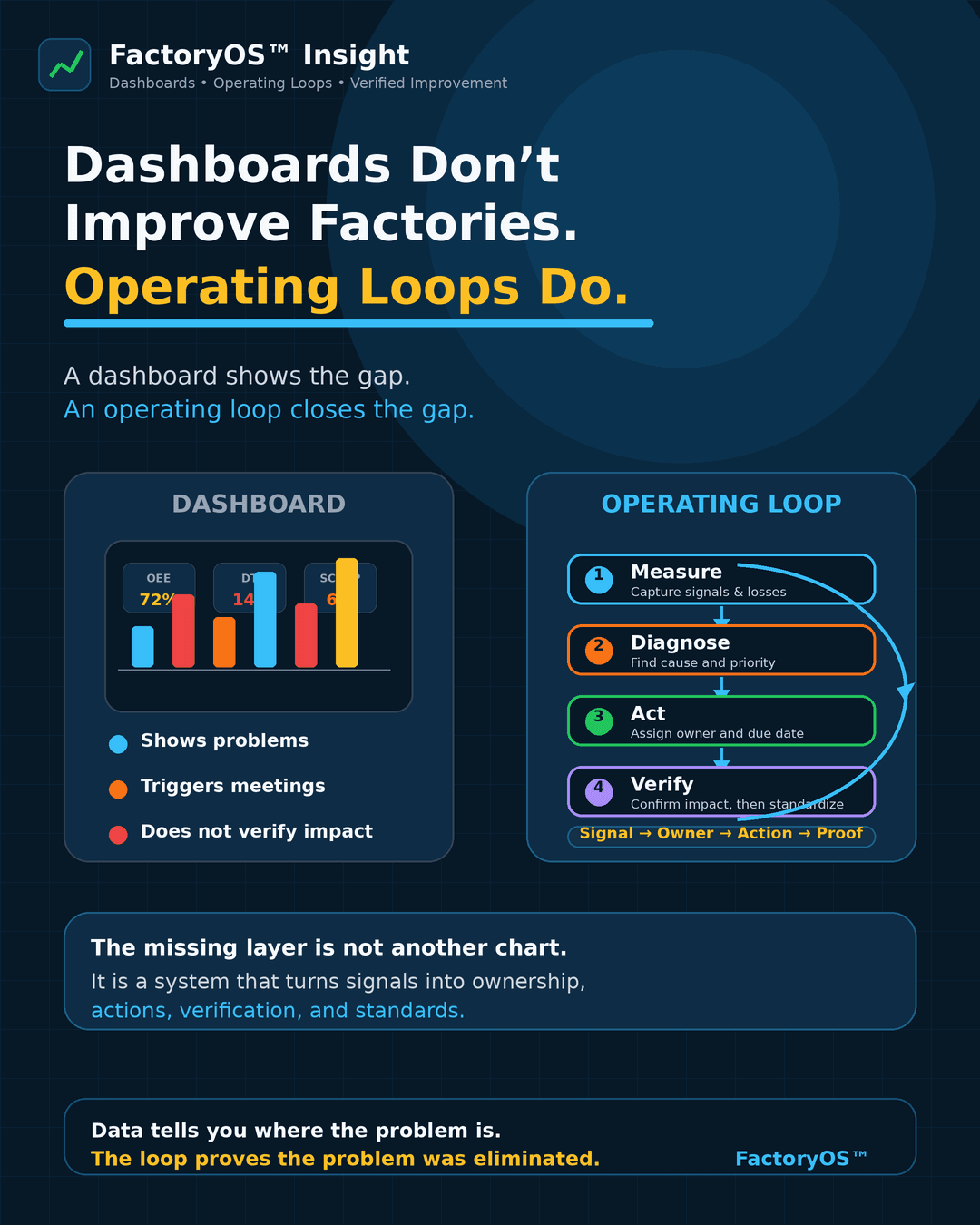
Most factories already have dashboards.
OEE dashboards.
Downtime dashboards.
Quality dashboards.
Maintenance dashboards.
Production dashboards.
But the real question is not:
“Do we have visibility?”
The real question is:
“Does visibility turn into verified improvement?”
A dashboard can show that OEE dropped.
It can show downtime increased.
It can show scrap is rising.
It can show maintenance tasks are overdue.
But a dashboard cannot improve the factory by itself.
It only shows the gap.
The operating loop closes the gap.
This is where many factories get stuck.
They collect data.
They review KPIs.
They discuss charts.
They create meeting notes.
But the same losses return next week.
Why?
Because the missing layer is not another chart.
The missing layer is a system that connects:
Signal → Owner → Action → Proof
A strong operating loop should answer:
What happened?
Why did it happen?
Who owns the action?
When will it be completed?
What impact is expected?
Did the action actually reduce the loss?
Was the standard updated?
Without this loop, dashboards create awareness.
With this loop, dashboards create improvement.
That is the difference between reporting performance and managing performance.
A factory does not improve because it has more screens.
It improves when every important signal is connected to ownership, action, verification, and standardization.
This is the thinking behind FactoryOS™:
A lightweight MES-style operating layer that helps factories move from scattered dashboards and spreadsheets to a practical closed loop:
Measure → Diagnose → Act → Verify
Data tells you where the problem is.
The loop proves the problem was eliminated.
#OEE #ManufacturingDashboard #Manufacturing #LeanManufacturing #OperationalExcellence #ContinuousImprovement #FactoryOS #MES #LightweightMES #IndustrialEngineering #ProductionManagement #MaintenanceManagement #QualityManagement #TPM #RootCauseAnalysis #ProcessImprovement #FactoryPerformance #ManufacturingExcellence #DataDrivenDecisions #SixSigma