 Getly
Getly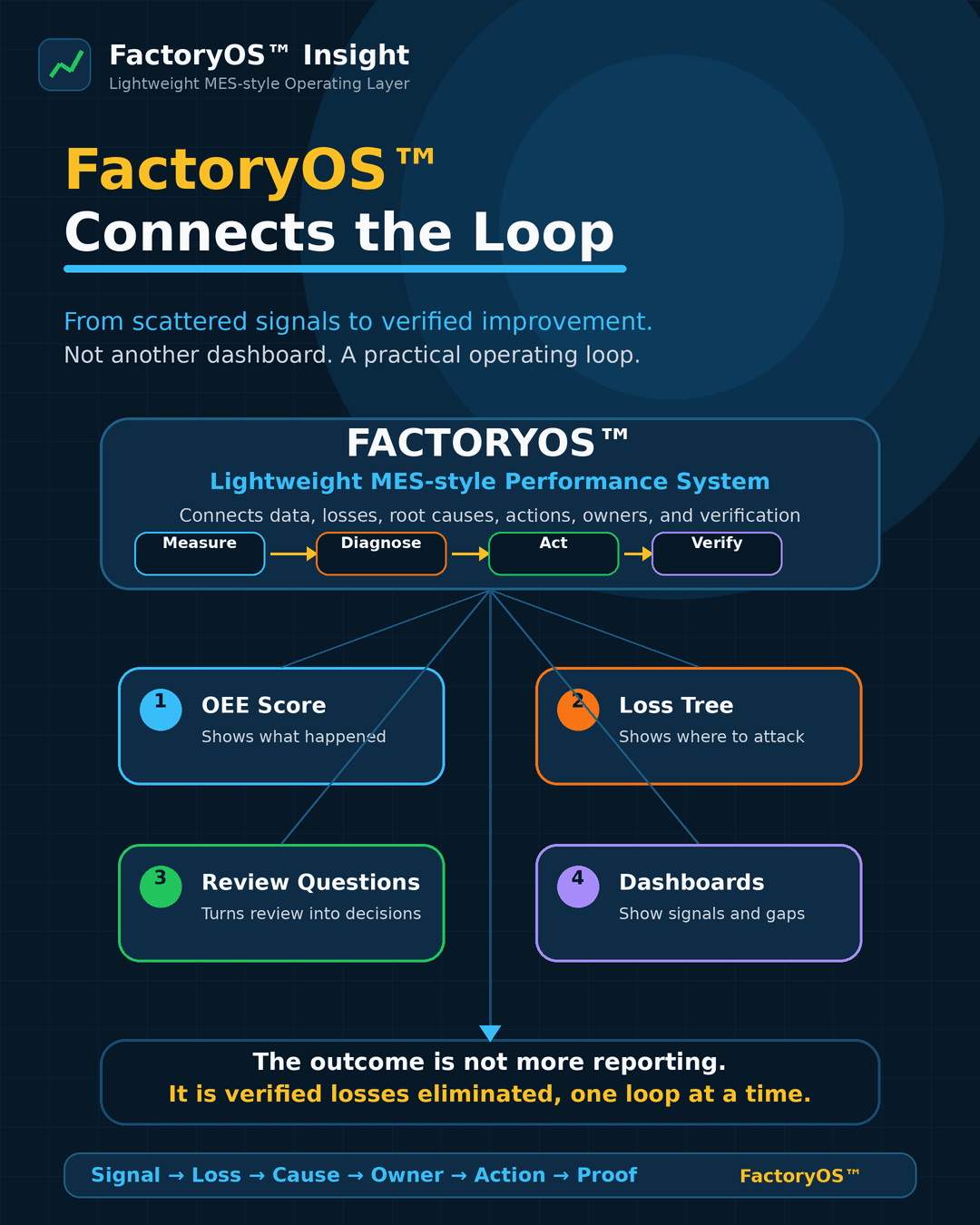
Over the last four posts, I shared one core idea:
OEE is not the problem.
Dashboards are not the problem.
Spreadsheets are not always the problem.
The real problem is the disconnected loop.
A factory may already have:
OEE scores
Loss trees
Review meetings
Dashboards
Action lists
Maintenance logs
Quality reports
But if these elements are not connected, the same losses keep coming back.
That is where improvement breaks down.
A signal appears:
OEE dropped.
Downtime increased.
Scrap went up.
A PM task became overdue.
A recurring issue appeared again.
The dashboard shows it.
But then what?
Who owns the action?
What is the root cause?
What loss are we targeting?
What impact do we expect?
Did the action work?
Was the standard updated?
Without this connection, data becomes noise.
With the right operating loop, data becomes improvement.
That is the thinking behind FactoryOS™.
FactoryOS™ is a lightweight MES-style operating layer designed to help factories connect:
Production data
OEE and downtime losses
Quality issues
Maintenance actions
Root causes
Action ownership
Follow-up
Verification
Standardization
Not as a replacement for every enterprise MES.
But as a practical starting point for factories that need operational discipline before heavy digital transformation.
The goal is simple:
Signal → Loss → Cause → Owner → Action → Proof
Because operational excellence is not created by collecting more data.
It is created by closing the loop between what the factory sees and what the team actually improves.
FactoryOS™ helps turn scattered signals into verified improvement.
Measure → Diagnose → Act → Verify
That is the loop.
That is the system.
#FactoryOS #OEE #MES #LightweightMES #Manufacturing #LeanManufacturing #OperationalExcellence #ContinuousImprovement #IndustrialEngineering #ProductionManagement #MaintenanceManagement #QualityManagement #TPM #RootCauseAnalysis #ProcessImprovement #FactoryPerformance #ManufacturingExcellence #DataDrivenDecisions #SixSigma #DigitalTransformation