 Getly
Getly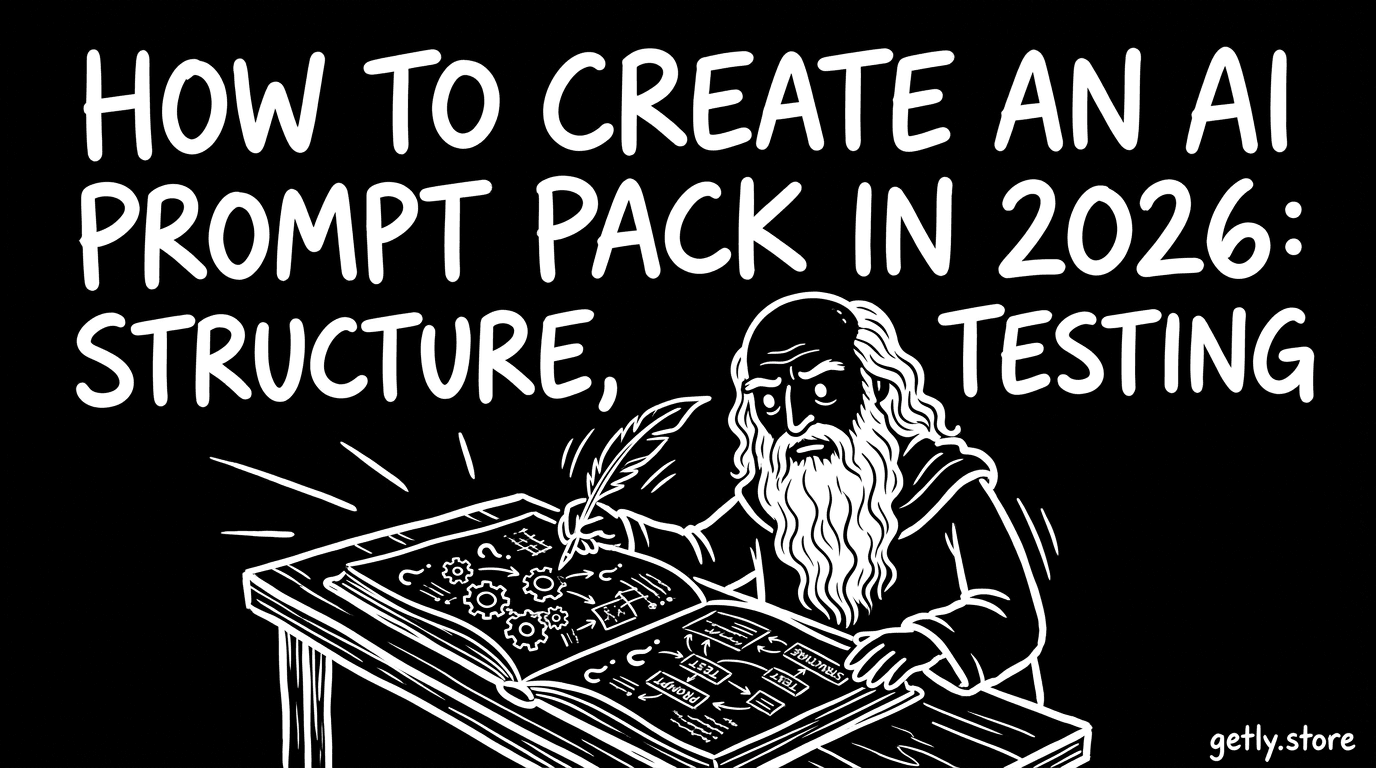
AI prompt packs are one of the fastest ways to package your expertise into something people can buy, download, and reuse instantly. In 2026, the best prompt engineering business doesn’t just write prompts-it ships a complete system: structure, testing proof, and clear pricing. Here’s a practical blueprint you can follow to create an AI prompt pack that’s ready to sell on an AI prompts marketplace.
TL;DR
- Start with a repeatable template: role, inputs, constraints, output format, and quality checks.
- Test prompts with realistic scenarios, not generic examples-track failure cases.
- Bundle prompts by job-to-be-done (JTBD) and license tier (personal, commercial, team).
- Price based on usability + outcomes: time saved, coverage, and how “plug-and-play” it feels.
- Package “GPT prompt templates” with usage notes so buyers get results faster.
What is an AI prompt pack in 2026 and why it sells
An AI prompt pack is a curated set of prompts designed to solve a specific kind of task-like writing product descriptions, planning content calendars, or generating design feedback-using consistent inputs and predictable output formats. In 2026, buyers don’t just want prompts; they want reliability, structure, and a fast path to results.
What makes a prompt pack commercially valuable is repeatability. A single “good prompt” is often a one-off win. A prompt pack is a workflow: it standardizes how a user provides context, how the model responds, and how the user verifies the output. That workflow thinking is the core of a prompt engineering business.
What buyers typically expect from a “pack,” not a single prompt
A strong prompt pack usually includes more than copy-paste text. Buyers expect guidance-what to provide, what to ask next, and how to handle edge cases.
Use this checklist to align your deliverable with buyer intent:
- Clear purpose (the JTBD your pack solves)
- Prompt variants (starter, advanced, and edge-case prompts)
- Input fields (so the user knows what to fill in)
- Output formats (so results are consistent)
- Quality checks (how to verify or improve the output)
- Short documentation (how to use the pack end-to-end)
Examples of prompt packs people keep reusing
In practice, prompt packs tend to outperform single prompts when they map to a real routine: weekly posting, quarterly planning, iterative editing, or repetitive content operations. The best packs feel like “automation for thinking.”
For example, a pack may include prompts for:
- Research → outline → draft → revise loops
- Brand voice calibration
- Content repurposing across formats
- SEO briefs to first drafts
- Creative direction and iteration for ad concepts
How to structure a GPT prompt templates pack that’s plug-and-play
The best way to create AI prompt pack assets is to standardize structure so every prompt in the pack behaves consistently. When your prompts share a common “contract” (inputs, constraints, and output format), users get fewer surprises and better outcomes.
Think of your pack like a mini productized workflow. The goal isn’t just to write prompts-it’s to design an experience.
A proven prompt structure you can reuse across niches
Use this “Prompt Contract” as your backbone. You’ll adapt the wording per niche, but keep the structure stable.
- Role: Define the model’s job (e.g., “You are a senior marketing strategist”).
- Context: Provide what the model should know (user’s background, audience, constraints).
- Task: State the deliverable clearly (what to produce).
- Inputs: Ask for specific fields from the user (tone, target audience, examples).
- Constraints: Rules that prevent off-target output.
- Process: Optional but helpful steps (plan first, then write, then verify).
- Output format: JSON, bullet list, sections, or a table-whatever you need.
- Quality checks: “Before finalizing, ensure X and Y.”
Design prompt variants for different user confidence levels
Many buyers are not prompt engineers. Your pack should still work for them. That’s why you should include multiple prompt levels: quick-start, guided, and specialist.
Here’s a practical variant set you can include in almost any pack:
- Quick-start prompt (minimal inputs; model asks clarifying questions)
- Guided prompt (user fills a structured form)
- Direct prompt (user already knows inputs; output requested immediately)
- Critique prompt (review + improvements)
- Edge-case prompt (handles missing info, conflicting goals, low-quality source text)
Pro tip: Keep your “output format” consistent across prompts in the pack. Consistency makes the results easier to edit and reuse-and buyers feel that polish.
How to test AI prompts before you sell AI prompt packs
Testing is where prompt engineering becomes a business discipline. The difference between a pack that sells once and a pack that gets repeat downloads is whether it performs across real scenarios.
In 2026, buyers expect practical reliability-so test for variability: different inputs, different time constraints, and messy source material.
Create a test suite that mirrors buyer reality
Don’t validate with one perfect example. Build a small library of scenarios that represent how users will actually use your prompts.
Start with 6–12 test cases, such as:
- Short input vs. long input
- Conflicting goals (e.g., “sound premium” + “keep it casual”)
- Missing info (no target audience details)
- Different brand voices (strict vs. playful)
- Low-quality source text (typos, informal notes)
- Different output requirements (length, tone, format)
Score outputs with simple, repeatable metrics
To make testing actionable, define what “good” means before you run prompts repeatedly. You don’t need complex analytics-just a scoring rubric you apply consistently.
Use a scoring sheet like this:
| Criteria | What to check | Score (1–5) |
|---|---|---|
| Instruction adherence | Did it follow constraints and output format? | |
| Usefulness | Would you actually use this output as a draft? | |
| Clarity | Is it readable and structured? | |
| Specificity | Does it include concrete details vs. generic filler? | |
| Edge-case recovery | Does it ask for missing info or adapt? |
Common mistake: Testing only with “happy path” inputs. If your pack fails when the user provides incomplete context, buyers will assume the prompts are low-quality-even if the perfect-case version is great.
How to create a pricing strategy for an AI prompts marketplace
Pricing your pack is not just about covering effort-it’s about matching perceived value. In an AI prompts marketplace, buyers pay for time saved, workflow completeness, and the confidence that results will be usable.
The most effective prompt engineering business pricing strategies treat your pack like a tool, not a text file.
Decide what your pack “includes” and what it excludes
Before you set a number, define the product boundaries. Buyers want clarity about what they get and what they’re responsible for.
Common include/exclude patterns:
- Include: prompt text, usage instructions, example inputs, output format rules
- Include: variant prompts (starter/guided/critique)
- Include: limitations section (what the prompts are not designed for)
- Exclude: unrelated templates (keeps value focused)
- Exclude: platform-specific customizations you can’t support
Use tiering with multi-license thinking (personal → commercial)
Even if you’re selling “just prompts,” usage rights matter. Tiered licensing helps buyers choose the level of access that fits their work: personal experimentation, client work, or team usage.
A practical tier structure you can adapt to your audience:
- Personal: for individual learning and personal projects
- Commercial: for client deliverables or monetized work
- Team: for internal use across members (if you want a higher tier)
Once your licensing tiers are clear, your pricing becomes easier to justify because buyers understand the difference between levels of use.
Success pattern: Prompt packs that include example inputs + “what good looks like” tend to reduce buyer confusion. That usually leads to fewer refunds and more positive engagement.
How to build an offer page that converts for selling AI prompts
A high-quality offer page is a prompt pack’s “sales system.” People don’t want to guess how to use your prompts-they want to see the workflow, expected outputs, and where the pack fits into their routine.
If you can communicate structure clearly, you can sell even without shouting.
Write the product description like a mini-spec
Use a spec-style description so buyers can self-qualify. That reduces mismatched purchases and increases trust.
Your description should cover:
- Who it’s for (role, skill level, typical use case)
- Problem it solves (time drain, inconsistent output, unclear direction)
- What’s included (number of prompts, variants, formats)
- How to use it (workflow steps)
- Example results (short excerpts or structured output samples)
- Limitations (what inputs are needed for best results)
Create a “sample workflow” section to show plug-and-play value
Instead of listing prompts only, show how a buyer uses them in sequence. Even a 5-step flow can increase conversions because buyers immediately imagine themselves using the pack.
For example, your workflow section might look like:
- Buyer fills a structured input form (or provides notes).
- They run the starter prompt to generate a first draft.
- They run the critique prompt to improve clarity and alignment.
- They run an edge-case prompt if any constraints are missing.
- They export the output in the requested format.
If you sell in a broader digital goods style, you can draw inspiration from other creator workflows-turning knowledge into step-by-step systems. For instance, workflow-style resources like The Signal Architect show how valuable “turn X into Y” positioning can be when packaging expertise.
How to package and distribute your AI prompt pack (formats & bundles)
Distribution is part of the product. A prompt pack should download cleanly, open easily, and help buyers start in minutes-not hours.
In 2026, buyers also like options: bundles for broader needs and different license tiers for different use levels.
Pick deliverable formats that reduce friction
Your pack should support fast copy/paste and clear editing. Common, practical formats include:
- Markdown or TXT for copy/paste friendly prompts
- PDF for a clean “spec + examples” layout
- Doc versions for readability (if you prefer)
- Example input sheets buyers can fill
Make sure each prompt has a short label and an “intended use” note (e.g., starter, critique, edge case). That’s the difference between a “collection of prompts” and a usable pack.
Bundle prompt packs to build a bigger prompt engineering business
Bundles work best when the packs serve a connected workflow. For example, “research prompts” + “draft prompts” + “refinement prompts” is easier to sell as a set than unrelated topics.
When bundling, keep your internal logic consistent. If buyers buy Bundle A, they should feel the same contract across every included pack.
Pro tip: If your niche is crowded, bundle by outcome rather than by platform. “From brief to final draft” sells better than “12 prompts for X tool.”
Where to sell your AI prompt pack without losing control
When you sell in an AI prompts marketplace, you’re not only listing text-you’re offering a digital product experience. Marketplaces that support visual discovery, marketplace requests, and different purchase options help buyers find and access your work quickly.
Getly also supports AI-powered search and visual search, plus multi-currency display, which can matter if your audience is international. It’s an example of the kind of infrastructure prompt sellers often care about when they scale from a one-off sale to a repeatable prompt engineering business.
If you want to learn how to position and distribute digital goods more broadly, you can browse listings for patterns in how creators package outcomes-start from the main browse page: Getly browse.
FAQ: AI prompt packs, GPT prompt templates, and pricing
How many prompts should be in an AI prompt pack?
There’s no single magic number, but the pack should cover a workflow: quick-start, guided/structured, critique, and at least one edge-case prompt. Buyers want enough variety to handle real situations without cobbling together prompts from different sources.
What makes a prompt pack better than a single prompt?
A prompt pack standardizes inputs, constraints, and output formats across multiple steps. That consistency reduces “prompt roulette,” making it easier for users to get usable outputs repeatedly.
Should I test prompts before pricing them?
Yes-because testing across messy, incomplete, or conflicting inputs is where you uncover the failure modes that affect trust. A simple scoring rubric makes improvements measurable and helps you justify your pricing based on reliability.
How do I justify premium pricing for GPT prompt templates?
Premium pricing is justified by completeness (workflow coverage), clarity (examples + usage notes), and reduced buyer effort (plug-and-play structure). If your pack consistently produces usable drafts, buyers perceive it as a time-saver.
Can I sell AI prompt packs for different niches together?
You can, but you’ll convert better when bundles are outcome-based and logically connected. Separate niches often require different instructions, tone, constraints, and output formats-so keep your packs cohesive around a single job-to-be-done.
- Structure your prompts with a consistent contract: role, inputs, constraints, output format, and quality checks.
- Test with realistic scenarios and score outputs so you fix the prompts that fail in real life.
- Price your pack by usability and workflow completeness, then support tiered licensing for clarity.
- Sell the experience (sample workflow + examples), not just the text.
Creating an AI prompt pack in 2026 is a product-design problem disguised as a writing task. When you ship structure, testing evidence, and a clear path from input to output, your “prompts” become a dependable system people want to buy and reuse. If you want to start with one niche, build one workflow pack end-to-end-then iterate based on your test results and buyer feedback.
Soft next step: Pick one job-to-be-done you already know well, draft a prompt contract, and run your first 6 test scenarios before you finalize your offer.
- Getly Content Team