 Getly
Getly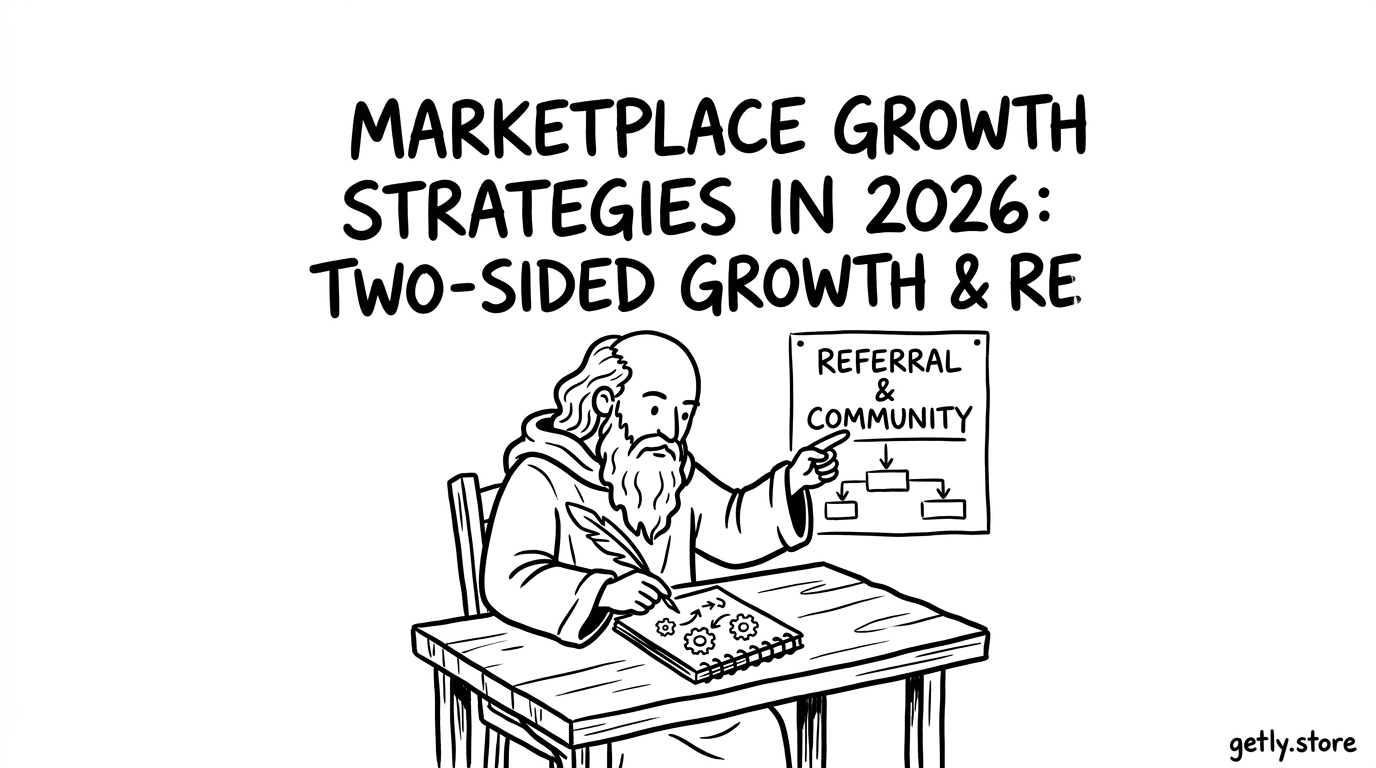
In 2026, marketplace growth isn’t just about getting more clicks-it’s about building a flywheel where buyers and creators reinforce each other. The strongest platforms treat referrals as a growth channel and community as retention, so supply and demand scale together.
This guide breaks down practical marketplace growth strategies for a two-sided marketplace-using referral program mechanics, creator network building tactics, and digital product community playbooks you can apply immediately.
- Two-sided marketplace growth works when you pair supply incentives with buyer trust and discovery.
- Referrals convert existing community members into distribution partners-especially when rewards are tied to first purchases.
- Digital product community retention improves when creators feel supported and buyers feel confident.
- Use content systems that lower friction: templates, workflows, and “start fast” learning paths.
What is two-sided marketplace growth in 2026?
Two-sided marketplace growth is the disciplined process of increasing value for both sides of a platform: creators (supply) and customers (demand). In 2026, the best growth plans don’t optimize one side in isolation-because imbalanced supply or demand breaks the feedback loop.
For digital goods, this is especially true. If your creator network building is strong but discovery is weak, buyers churn. If demand is high but creators don’t get clear positioning, buyers eventually stop finding what they need.
Why “supply then demand” isn’t a complete strategy
A common myth is that you only need creators first, and demand will “arrive.” In reality, the marketplace must make buying feel safe and easy from day one. That means clear product presentation, reliable payment options, and fast search/visual discovery so customers can actually convert.
Conversely, focusing only on demand acquisition without onboarding creators often leads to low variety. Digital product ecosystems thrive on breadth-different styles, formats, skill levels, and licensing needs.
The flywheel that keeps compounding
The flywheel looks like this: better discovery → higher buyer conversion → better sales for creators → more creators join → more catalog depth → better discovery. Referral programs amplify the loop by bringing in new participants who already have a reason to trust you.
When your growth tactics treat referrals as distribution and community as retention, you reduce the cost of repeated acquisition and increase the chance that new users stick around.
Pro tip: When you evaluate growth, look for compounding indicators (repeat browsing, category exploration, creator submissions) rather than only one-time signups. Two-sided marketplaces win when both sides become “active,” not just present.
How to design marketplace growth strategies that balance both sides?
The best marketplace growth strategies in 2026 balance creation and conversion. Your supply side needs incentives and clarity; your demand side needs trust, discovery, and good fit.
Think of it as building two parallel pipelines: one that grows creator output and another that grows buyer success. The bridge between them is matching-search, recommendation, and licensing clarity.
Supply-side tactics for creator network building
Start by helping creators ship faster and position better. Digital creators often have the talent, but not always the workflow, assets, or confidence to package and publish products.
Practical supply levers include:
- Clear product templates (what formats you want, how to structure deliverables, naming conventions).
- Multi-license tiers so different buyer types (personal, commercial) can choose confidently.
- Bundles to raise average order value while making “complete solutions” easier to buy.
- Creator feedback loops (what buyers search for, what converts).
If you sell tools for specific outcomes-like onboarding workflows, learning paths, or ready-to-use assets-your creators can reduce buyer uncertainty simply by packaging the result.
Demand-side tactics for buyer trust and discovery
On the demand side, your goal is to lower the time-to-value. Buyers should quickly find what solves their problem, understand what they’re buying, and feel safe paying.
Effective demand levers include:
- AI-powered search to improve intent matching (especially for creators who use varied terminology).
- Visual search to support design and media-related browsing.
- Multi-currency display to reduce friction for international buyers.
- Automated invoices that simplify record-keeping for professional customers.
When discovery improves, buyers buy more often and creators get more signal, which strengthens the marketplace flywheel.
Important note: “More traffic” is not the same as “more buyer success.” A two-sided marketplace must track whether buyers can find, evaluate, and download products without confusion.
How do referrals grow a digital product community?
Referrals turn satisfied users into your distribution engine. In referral programs, the best incentive structure focuses on the moment trust converts-often a friend’s first purchase-because that’s the highest-signal action for new customers.
Getly supports a referral program where the referrer earns 15% of their friend’s first purchase. That structure is built for marketplace dynamics: it encourages your existing community to share, while still creating momentum for the friend to become an active buyer.
What makes referral programs work in 2026
In a crowded creator economy, referrals outperform generic affiliate links because the referral feels personal. That’s especially true for digital products where outcomes matter (time saved, quality improved, a workflow mastered).
Strong referral mechanics usually include:
- Simple sharing so members can invite without extra steps.
- Reward timing aligned with a meaningful action (e.g., first purchase).
- Fairness so referrers feel confident recommending your marketplace.
- Community context so invitations are relevant (same interests, same workflows).
For digital product communities, relevance is everything. A referral from a designer to another designer converts better than a referral sent to a random broad audience.
Referral content that doesn’t feel spammy
The easiest way to generate quality referrals is to give people “shareable reasons.” Instead of asking for invites, share specific outcomes: “I used this to solve X,” “here’s my workflow,” or “this saved me hours.”
For example, creators in niches like design, audio, and video can share a short before/after or a mini tutorial. If the product helps achieve a visible transformation, referrals become natural.
Consider how these kinds of products map to shareable moments:
- Ready-to-use assets that speed up production (e.g., Professional Original VST Plugin - Ready-to-Use for Any DAW).
- Workflow guides for specific platforms and timelines (e.g., Instagram Growth Blueprint: A Beginner-Friendly Guide to Growing on Instagram in 2026).
- Converters for migration pain points (e.g., Unreal to Unity Material Converter).
Common mistake: Running referrals without a clear reason to recommend. If your listing quality is inconsistent or buyers can’t find what they need, referrers will stop sharing even if rewards exist.
What platform growth tactics build an engaged creator network?
Creator networks don’t scale by waiting for submissions-they scale when you actively reduce creator friction and increase creator confidence. Your platform growth tactics should help creators publish, market, and iterate.
In 2026, creators expect more than a storefront. They want tooling, feedback, and community mechanisms that make their output sustainable.
Use community + support as onboarding accelerators
Think about onboarding as “time to first win.” A creator should experience value quickly: their first product can be published, discovered, and purchased. If you can shorten that loop, creators stay.
Getly supports features that align with creator onboarding and ongoing growth, including multi-license tiers, bundles, and automated DMCA protection. While these don’t replace community, they improve the practical environment creators operate in.
Turn your creator network into an education engine
Creators grow faster when buyers understand how to use what they buy. One of the most effective platform growth tactics for digital goods is education: show workflows, demonstrate outcomes, and reduce “evaluation anxiety.”
That’s where creator blogs with paid subscriptions can matter. Even if you don’t implement the same model, the underlying idea is consistent: monetize expertise while strengthening marketplace trust.
Success pattern: When creators publish repeatable lessons (“how to do X”), they naturally earn qualified referrals because buyers share resources that helped them achieve outcomes.
How to run two-sided experiments without breaking trust?
Marketplace growth strategies in 2026 should be test-driven-because two-sided systems are sensitive. A tweak that improves conversion for buyers could lower perceived value for creators, and vice versa.
That’s why experimentation must track both sides. Use A/B tests to isolate changes and measure how they affect discovery, conversion, and creator behavior.
What to test first (high signal, low risk)
Start with experiments that don’t require changing core trust mechanics. The best early tests typically focus on presentation, routing, and clarity-areas that affect both sides quickly.
Good first experiment categories:
- Product comparison formatting (does it help buyers decide faster?).
- Search relevance prompts (do buyers land on the right items?).
- Bundle visibility (do bundles improve perceived value?).
- License tier clarity (does it reduce purchase hesitation?).
- Checkout experience messaging (does it reduce friction?).
Measure outcomes for both sides
Two-sided marketplace growth tactics succeed when your dashboard covers both supply and demand. If you only measure buyer click-through, you’ll miss creator dissatisfaction and catalog degradation.
A balanced measurement plan includes:
- Buyer metrics: search-to-product selection, add-to-cart/download rate, repeat browsing.
- Creator metrics: product impressions per listing, sales per listing, time-to-first sale after publishing.
- Marketplace metrics: catalog depth growth, category coverage, and churn signals (refunds/support load).
Keep experiments bounded. In marketplaces, too many simultaneous changes make it impossible to learn-especially when you rely on referrals, where trust and relevance matter.
Warning: Avoid running referral incentive changes at the same time as major UI discovery changes. If results move, you won’t know whether it was the incentive or the discovery experience.
How do marketplace growth tactics vary by creator niches?
The best marketplace growth strategies adapt to how creators produce and how buyers evaluate. Digital niches differ-audio workflows aren’t judged like print templates, and shader tools aren’t evaluated like beginner social growth guides.
That means your platform growth tactics should match buyer intent: what buyers need to believe, understand, and successfully use.
Match discovery to the way buyers search
Some buyers search by keywords (“VST plugin”), others browse visually (materials, thumbnails), and many mix approaches. This is where visual search and AI search become practical growth infrastructure for marketplaces.
To operationalize this, define “intent buckets” and align your categories, tags, and examples to those buckets. Then build referral and education content for each bucket.
Examples: community-building angles by product type
Here are product-type angles that naturally support referral and community participation:
| Creator niche | Buyer evaluation style | Community hook | Referrals angle |
|---|---|---|---|
| Audio tools | Sound quality + compatibility | Demo clips + DAW workflow notes | “Try it in your setup” recommendations |
| Video & viral formats | Outcome templates + examples | Short-form creation walkthroughs | Shareable before/after video results |
| 3D materials & converters | Visual fidelity + accuracy | Real scene conversions + comparisons | Migration success stories |
| Growth education | Clarity + step-by-step plan | Beginner pathways + checkpoints | “Follow this and see progress” sharing |
Notice how each row includes a community hook: not “here’s a product,” but “here’s a repeatable path.” That’s how creator network building turns into a system, not a one-off.
If you want a product reference point, look at how ready-to-use, workflow-driven products are easier to recommend because they reduce uncertainty (e.g., The SIGNAL ARCHITECT The AI-Powered Workflow to Turn 100 Sources into 1 Master Insight).
FAQ: Marketplace growth strategies, referrals, and community
What are the best marketplace growth strategies for 2026?
The best marketplace growth strategies combine two-sided marketplace growth with trust-building discovery. In practice, that means improving how buyers find and evaluate products while improving how creators package, license, and ship deliverables.
Referrals should be treated as a distribution channel that brings in high-intent participants who already trust the recommendation.
How do you increase two-sided marketplace growth without hurting quality?
Increase two-sided marketplace growth by running small, measurable experiments and tracking both sides. Focus on clarity (product presentation, licensing tiers, comparisons) before changing core marketplace economics or trust systems.
When discovery improves, conversions rise; when creator onboarding improves, catalog depth rises.
How do referral programs fit into digital product community growth?
Referral programs fit naturally because digital products are “outcome-recommendable.” When a user has a workflow win, sharing becomes less spammy and more like knowledge transfer.
Getly’s referral program rewards 15% of a friend’s first purchase, which aligns incentives with meaningful marketplace activity.
What should creators do to support creator network building?
Creators should invest in packaging and education: demos, examples, and step-by-step guidance reduce buyer uncertainty and increase conversion.
When buyers understand how to use products, they’re more likely to recommend them-supporting community growth.
Which metrics matter most for platform growth tactics?
For two-sided marketplace growth, track both buyer success and creator activity. On the buyer side: discovery-to-selection and repeat browsing; on the creator side: impressions, sales velocity, and time-to-first sale after publishing.
That’s how you avoid optimizing only one side of the system.
- Two-sided growth requires parallel improvements for creators and buyers.
- Referrals are most effective when tied to first purchases and community relevance.
- Education and workflow packaging turn products into “shareable wins.”
- Experiment carefully: test discovery and clarity before changing trust mechanics.
Marketplace growth in 2026 is a system, not a campaign: build discovery that converts, creator workflows that scale, and referral loops that make sharing feel valuable. If you’re planning your next growth sprint, start by picking one two-sided bottleneck (search relevance, licensing clarity, or creator onboarding) and run a focused experiment.
Soft call-to-action: If you’re exploring how specific digital products solve real workflow problems, browse the catalog and choose one niche where you can create both an education angle and a referral-worthy outcome.