 Getly
Packs de prompts de IA para programar
A Practical AI-Assisted Workflow for Safely Refactoring Legacy C++
Este anuncio se muestra en su idioma original (inglés).
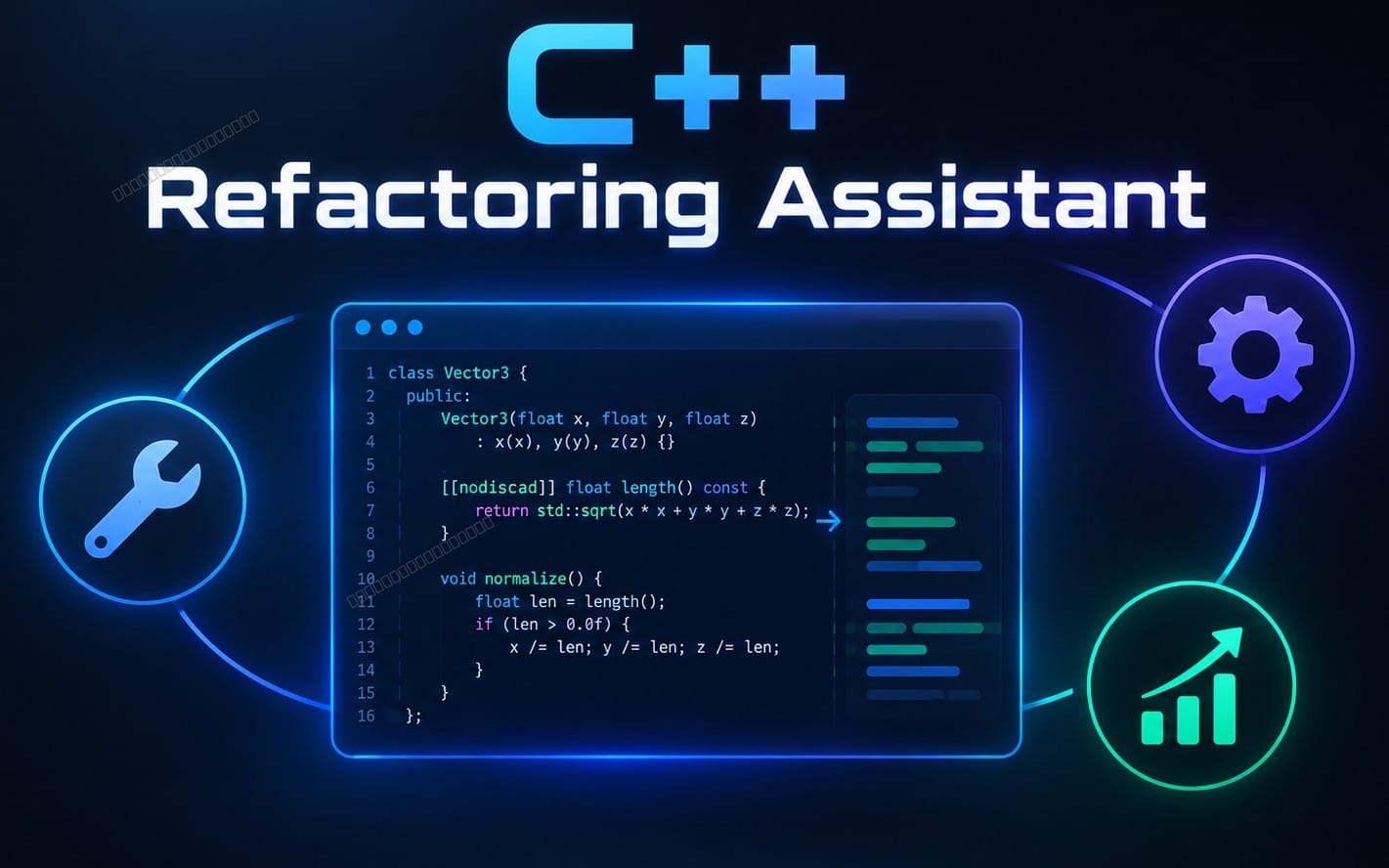
Safely analyzing, testing, modernizing, and refactoring legacy C++ code. Get 30 structured prompts, a master system prompt, workflows, checklists, and guardrails for using AI coding assistants without blindly rewriting unfamiliar C++.
Qué recibes: 1 archivo · 45.04 KB · MD
Ver opciones de compraDescripción del producto
The AI-Assisted Legacy C++ Refactoring Toolkit is a comprehensive prompt library and workflow framework designed for software engineers working with legacy C++ codebases. It provides a disciplined methodology for leveraging AI language models as engineering assistants while maintaining developer control over every change.
The toolkit addresses a common challenge in software maintenance: large, unfamiliar codebases where full rewrites are impractical. It offers a structured approach to understanding, testing, and incrementally improving such systems without introducing regressions or compromising stability.
Target Scenarios
The toolkit is applicable to codebases facing challenges such as:
Inherited or undocumented legacy C++ code
Migration from C++03/11/14 to newer standards
Unclear pointer ownership and manual memory management
Macro-heavy code and complex template metaprogramming
Fragile APIs and ABI-sensitive libraries
Insufficient test coverage and suspected undefined behavior
Concurrency hazards and performance bottlenecks
CMake and build system modernization
Review of AI-generated code changes
Core Methodology
The workflow follows a defined progression:
text
Recon → Understand → Assess → Test → Plan → Refactor → Verify → ReviewThis sequence emphasizes understanding before modification, characterization before refactoring, and verification after every change. The toolkit contains 30 structured prompts organized across seven sections: reconnaissance, architecture, modernization, quality and safety, performance, testing, and execution.
Key Principles
The toolkit operates on several foundational principles:
Incremental change over rewrites. Each modification should be small, independently verifiable, and reversible.
Evidence-based analysis. AI output is treated as a proposal requiring verification through compilation, testing, sanitizers, and human review.
Behavior preservation. Observable behavior remains unchanged unless explicitly intended.
Context awareness. Recommendations respect the current C++ standard, toolchain, platform, ABI, and performance constraints.
Uncertainty disclosure. The system prompt instructs models to mark uncertain claims and request missing context rather than fabricate details.
Included Components
Master System Prompt — establishes the AI's role, constraints, and output format
30 Task-Specific Prompts — covering ownership analysis, dependency mapping, modernization planning, concurrency review, performance investigation, test generation, and patch proposal
Variable Glossary — standardized input placeholders for consistent prompt construction
Pre-Flight Checklist — preparation steps before risky refactoring
Quick Reference Tables — situation-based and goal-based prompt selection
Recommended Chains — predefined prompt sequences for common workflows
Worked Example — demonstrating ownership analysis with correct and incorrect reasoning
Session Template — for long-running refactoring efforts requiring audit trails
Compatibility
The toolkit is designed for use with capable instruction-following language models including ChatGPT, Claude, Gemini, Copilot, DeepSeek, Grok, Qwen, Llama, and Mistral. It supports C++ standards from C++11 through C++23 and accommodates various build systems, compilers, and platforms.
Intended Use
This toolkit is intended for professional software engineers, technical leads, and architects engaged in maintaining or modernizing C++ systems. It assumes familiarity with C++ semantics, build systems, testing practices, and software design principles. The developer remains responsible for reviewing, validating, and approving all generated recommendations and code changes.
Qué recibes
1 archivo · 45.04 KB
- ai_workflow_refactoring_legacycpp_toolkit.mdMD · 45.04 KB
Packs de prompts de IA para programar
A Practical AI-Assisted Workflow for Safely Refactoring Legacy C++
Este anuncio se muestra en su idioma original (inglés).
Safely analyzing, testing, modernizing, and refactoring legacy C++ code. Get 30 structured prompts, a master system prompt, workflows, checklists, and guardrails for using AI coding assistants without blindly rewriting unfamiliar C++.
Etiquetas
Preguntas frecuentes
¿Tengo acceso al instante?
Sí. Es un producto digital: puedes descargarlo justo después del pago, directamente desde tu biblioteca.
¿Puedo usarlo en proyectos comerciales?
Sí. Se permite el uso comercial: úsalo en tu propio negocio y en cosas que vendas. No puedes revender ni redistribuir el archivo en sí.
¿Cuál es vuestra política de reembolso?
Puedes pedir un reembolso dentro de 30 días. Si algo no va bien, solicítalo desde tu pedido y el equipo de Getly lo revisa.
¿Qué formatos y tamaños de archivo recibiré?
Descargarás 1 archivo - MD - 45.04 KB en total.
¿Recibo actualizaciones gratis?
Sí: cuando el vendedor publica una versión nueva, puedes volver a descargar los archivos más recientes desde tu biblioteca sin coste extra. Mira el registro de cambios para ver las últimas actualizaciones.
Precio
$32.00