 Getly
Getly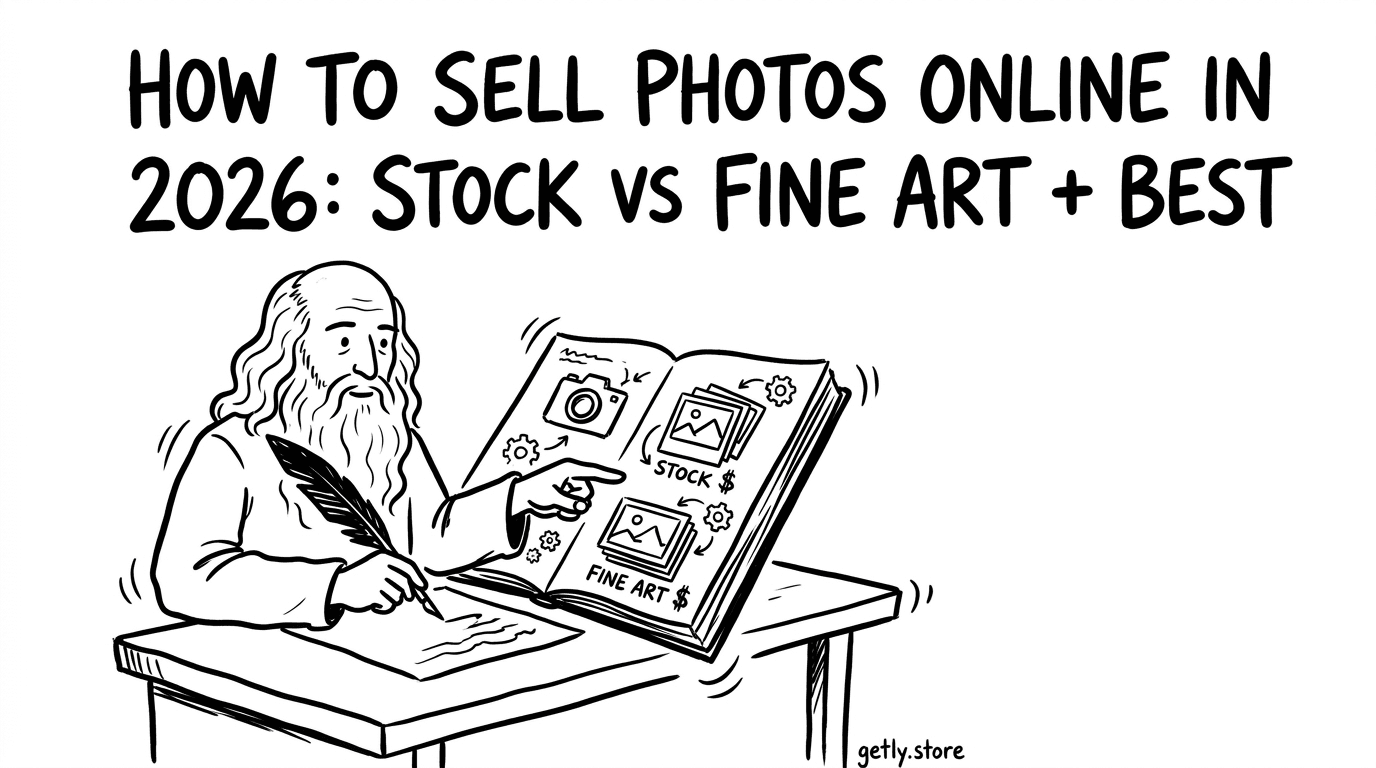
Want sell photos online in a way that actually pays-without burning months on marketing? In 2026, photographers make money through two main channels: stock photography income (high-volume licensing) and fine art (fewer sales, higher margins, stronger brand). This guide breaks down both paths and helps you choose the best photo marketplace for your style.
We’ll also cover practical workflows, pricing, licensing, and how to think about photographer passive income realistically-so you can build a portfolio that compounds over time.
- Stock licensing is a “portfolio math” game: volume + keywording + consistency drive long-term results.
- Fine art is a “brand and story” game: scarcity, curation, and print quality drive premium pricing.
- In 2026, the best photo marketplace is the one that matches your licensing goals and your buyer type.
- Use a repeatable production pipeline and AI-assisted editing to scale without sacrificing quality.
What is the best way to sell photos online in 2026?
The best way to sell photos online in 2026 is to pick a revenue model first-then build your workflow and portfolio around it. Most creators either chase stock licensing (many small payouts) or fine art sales (fewer, premium payouts). Trying to do both without a plan usually leads to inconsistent results.
In practice, the “best” approach depends on how you want customers to buy your work: through automated downloads and licenses (stock/photo marketplace) or through curated purchases (sell prints online or original art sales). Your choice also impacts how you price, keyword, and package files.
Start with your goal: passive income vs brand income
If you want photographer passive income, stock photography income is typically the most scalable model-because buyers license images directly and repeatedly over time. Fine art can also be semi-passive once your inventory and marketing assets are built, but the sales cycle is usually more relationship-driven.
If you want brand growth and higher-per-sale revenue, fine art is often stronger. You’ll benefit from consistent aesthetics, a recognizable body of work, and a sales funnel for prints, licensing, and collectors.
Choose buyers: designers vs collectors
Stock buyers are often designers, marketers, editors, and agencies who need images quickly and legally. Collectors and print buyers look for meaning, craft, and emotional impact. That difference changes everything-from what you shoot to what you metadata-tag.
So before you upload anything, map your photo style to a buyer: “Who will search for this?” and “What problem does it solve?”
How does stock photography income work?
Stock photography income is earned when customers license your images for use-typically paying per download, per license tier, or through subscription models. Over time, stock becomes a compound asset: each upload can generate future sales as long as it remains relevant and well-described.
In 2026, successful stock contributors treat their portfolio like a system: they shoot targeted subjects, produce consistent quality, and use metadata that helps search engines (and photo marketplace internal search) understand the image.
Stock vs subscription platforms: what changes for creators
Some platforms prioritize subscription buyers, where customers download many images under a single plan. Others rely on credits or per-license purchases. Either way, your earnings depend on: (1) the license model, (2) how often your images are discovered, and (3) your file’s commercial relevance.
A practical rule: don’t optimize only for aesthetics. Optimize for “commercial usefulness” (clarity, variety, negative space, universal concepts). A technically perfect but non-searchable image usually underperforms.
What sells in stock: patterns you can follow
Stock is not just “generic photos.” It’s targeted imagery for specific design needs. You can increase your odds by producing sets that match common use cases: website hero images, ad backgrounds, social posts, and editorial layouts.
- Concept clarity: images that communicate one idea instantly (teamwork, productivity, nature calm).
- Wide usability: fewer branded elements; more general settings.
- Variety within a theme: shoot the same subject in multiple compositions.
- Seasonal readiness: evergreen + controlled seasonal sets (holidays, weather, events).
- Technical standards: sharp focus, correct exposure, clean backgrounds when possible.
Pro tip: Create “micro-collections.” For example, if you shoot coffee, don’t only upload one style-upload 15–30 images across mugs, latte art, hands pouring, workspace scenes, and close-ups. Micro-collections perform better because buyers can find a set, not just a single photo.
How does fine art selling differ from stock?
Fine art selling is centered on the emotional and aesthetic value of your work, not just its usability. You’re not mainly earning per license; you’re earning through prints, originals, or limited editions-often with higher margins if your audience trusts your taste.
Unlike stock, fine art thrives on curation. A cohesive series can outperform a large but random set of images, because collectors buy the narrative and the feeling of the work.
Sell prints online with a pricing strategy
When you sell prints online, your pricing needs to reflect both craftsmanship and market positioning. In 2026, buyers expect transparent details: paper type, size, finishing, edition number, and how the print matches your photography style.
Start by determining your “floor cost” (printing, packaging, taxes, platform fees). Then add a margin that fits your brand. Fine art buyers pay for quality and confidence, so don’t underprice-especially if you’re using archival materials.
Why editioning matters for fine art
Limited editions create scarcity. Scarcity doesn’t replace marketing, but it can help you convert interest into purchase faster. You can do editioned prints (e.g., 25 or 50) or open editions for broader accessibility-just keep the offer structure consistent.
In most cases, a clear edition policy makes your work easier to buy because the buyer knows what they’re getting.
Success pattern: Many photographers build fine art income by launching one well-curated series per quarter-then selling prints from that series for 8–12 months. That cadence reduces decision fatigue and gives your audience a consistent reason to follow.
Which photo marketplace is best for your style?
The best photo marketplace is the one that matches your licensing model, payout expectations, and target buyer behavior. In 2026, markets differ by discovery engine (search vs browse), licensing formats (single/multi-license), and how easily buyers can purchase or download.
Before you commit, compare marketplaces by how they handle: licensing clarity, discoverability, creator royalties, payment options, and how your work will be presented (thumbnails, collections, or licensing pages).
Stock-first marketplaces: optimize discovery and metadata
If your plan is stock photography income, prioritize platforms where search and tagging matter. Buyers often find images through keywords and category browsing, so your titles and descriptions are part of your business-not admin work.
Look for features like multi-currency display, automated downloads, and clear license tiers. The more friction removed from purchase, the more sales you can earn per hour spent producing.
Fine art marketplaces: optimize brand presentation
If you’re building fine art, your biggest advantage is presentation. Buyers care about how your photos look in a series, not just as isolated files. Choose marketplaces with clean galleries, edition/print handling support, and ways to describe your story.
Also consider platforms that support bundles or multi-license tiers-because fine art collectors sometimes license images too (for publications, branding, or editorial use).
| Goal | Best strategy | What to prioritize | Typical sales pattern |
|---|---|---|---|
| Sell stock licenses | Upload targeted sets consistently | Discovery + metadata + license clarity | Many small purchases over time |
| Sell prints online | Curate series and sell editions | Presentation + product details + trust | Fewer sales, higher average revenue |
| Build hybrid passive income | Use the same shoot to feed both paths | Workflow efficiency + packaging | Stock runs continuously; prints peak around launches |
Common mistake: Uploading only “pretty” photos to stock without commercial context. Stock customers buy to solve a design problem. If the image doesn’t communicate a clear use-case, it won’t rank-no matter how beautiful it is.
How to build a portfolio that sells (stock + fine art)
If you want to sell photos online consistently, your portfolio must be designed for search and buyer intent. That means building collections, not just a folder of good images. The fastest way to improve results is to analyze which photos generate views and convert into licenses or purchases.
In 2026, AI-assisted discovery and visual search are more common, but the fundamentals remain: strong composition, consistent style, accurate metadata, and repeatable production.
Create collections around buyer needs
Think like a buyer. If someone needs an image for a blog hero about “productivity,” what would they type or look for? Create sets that match those mental keywords-then upload multiple variations that cover different angles and compositions.
- Business productivity: laptops, focused work, team collaboration, calendars.
- Wellness: morning light, calm landscapes, gentle routines.
- Technology: close-ups of devices, hands interacting with screens.
- Food & lifestyle: ingredient shots, prep scenes, clean branded-free table scenes.
Keywording: make it readable and specific
Keywording isn’t stuffing; it’s translation. Convert visual elements into searchable language: subject, setting, lighting, and vibe. For stock, prioritize phrases that match likely search queries (e.g., “woman using laptop in home office,” not only “laptop”).
Keep your metadata consistent across uploads-this improves your portfolio’s internal coherence and makes it easier for buyers to browse your work.
How to price photos, licenses, and prints in 2026
Pricing is where many photographers stall: they underprice early, then struggle to raise rates later. In 2026, you should set pricing based on model fit-stock licenses for repeatable usage, fine art prints for scarcity and craftsmanship.
Your goal is simple: make your pricing understandable. Buyers should instantly see what changes at each license tier or print size.
Stock pricing: tiers based on usage
Stock platforms often handle tiering automatically (small vs extended usage), but creators can still influence value through licensing clarity, file quality, and the relevance of the set you upload. High-performing stock contributors upload larger sets of complementary images for the same concept.
If your platform offers multi-license tiers, price for fairness: broad usage should cost more, but don’t confuse customers with unclear differences.
Fine art pricing: cost + perceived value + demand
Print pricing should start with your cost structure (print, paper, packaging, platform fees, returns risk). Then add perceived value: your brand, your series coherence, and your buyer’s willingness to pay for scarcity and story.
Use demand signals. If a series sells out quickly, you can raise future editions or increase sizes. If it doesn’t move, adjust your offer (edition count, size mix, shipping options, or presentation).
Pro tip: For fine art, test 2–3 sizes first (e.g., 8x10, 12x16, 18x24). Buyers often choose from what they can imagine in their space. Too many sizes at launch increases friction and decision drop-off.
How to scale your workflow for passive income
Scaling in photography isn’t about taking more photos-it’s about making your end-to-end process faster without lowering quality. To build photographer passive income, you need a workflow that turns shoots into sale-ready assets: curated edits, consistent exports, metadata, and product-ready versions.
In 2026, creators combine camera skills with efficient editing and content pipelines. Even small improvements (batch export templates, standardized naming, repeatable keyword templates) can compound into hundreds of extra uploads per year.
Use an AI-powered editing + quality checklist
AI can help with selection, denoise, sharpening, and masking-so you spend less time on repetitive steps. But you still need a consistent quality checklist to avoid “AI artifacts” or unrealistic skin tones for portraits.
Implement a three-pass review: (1) composition and subject clarity, (2) technical quality (focus, exposure, noise), (3) commercial suitability (no confusing branding, readable space, consistent color).
Systemize sourcing, shoots, and repurposing
The easiest path to scale is repurposing. A single photoshoot can produce: stock-ready variations, fine art candidates, and print-friendly crops. You can also turn your behind-the-scenes and story into marketing content that drives buyers back to your shop.
Many creators pair workflow training with productivity systems. For example, a structured AI workflow guide can help you turn inspiration into output faster-like The Signal Architect - The AI-Powered Workflow to Turn 100 Sources into 1 Master Insight, which is the same mindset as building a repeatable creative pipeline.
Platforms can also support your automation
When you upload digitally, automation reduces overhead: license pages, file delivery, invoices, and reporting. That matters because your time is the bottleneck. The more you automate the business side, the more you can invest in shooting and improving craft.
Some marketplaces also support multi-currency payments and crypto settlement. That can expand your global reach-especially if your audience is distributed across regions.
- Stock requires volume + metadata consistency; fine art requires curation + story.
- Build portfolios in collections that match buyer intent, not random uploads.
- Price stock by license usage tiers; price prints by cost + perceived value + demand.
- Scale through workflow systems: batch edits, export templates, and quality checklists.
FAQ: sell photos online, stock vs fine art
How much can you make selling photos online in 2026?
It depends on volume, niche demand, and how you package your offer. Stock can produce steady earnings as your portfolio grows, while fine art tends to produce higher revenue per sale but less frequency. Most successful sellers diversify: stock for compounding and fine art/prints for premium revenue.
Is stock photography income really passive?
Stock is “passive” in the sense that licenses can keep generating revenue after upload. However, it’s not fully passive-performance improves when you continue to add relevant images, refine keywords, and maintain quality over time. Think of it as a long-term asset, not a one-time post.
What’s better in 2026: sell prints online or license photos?
“Better” depends on your audience and production strengths. If you love building collections and want repeat sales, licensing usually fits well. If you enjoy curating series and connecting with collectors, selling prints online often matches your natural advantages.
How do I choose a photo marketplace?
Choose based on discovery and buyer intent. For stock, prioritize strong search visibility and clear licensing. For fine art, prioritize presentation, edition handling, and trust-building product pages. If you’re unsure, start with one primary goal for 60–90 days and evaluate results.
What should I upload first if I’m new?
Start with a small but coherent collection: 20–40 images around one theme, shot with consistent lighting and style. Write metadata that clearly describes subject and use case. If your goal is fine art, select a tighter series (10–20) where prints will look cohesive.
Soft next step: If you want a simple plan for your first 30 days of uploads, pick one revenue model (stock or fine art), choose one niche theme, and build a micro-collection you can expand-then iterate based on what actually sells.