 Getly
Getly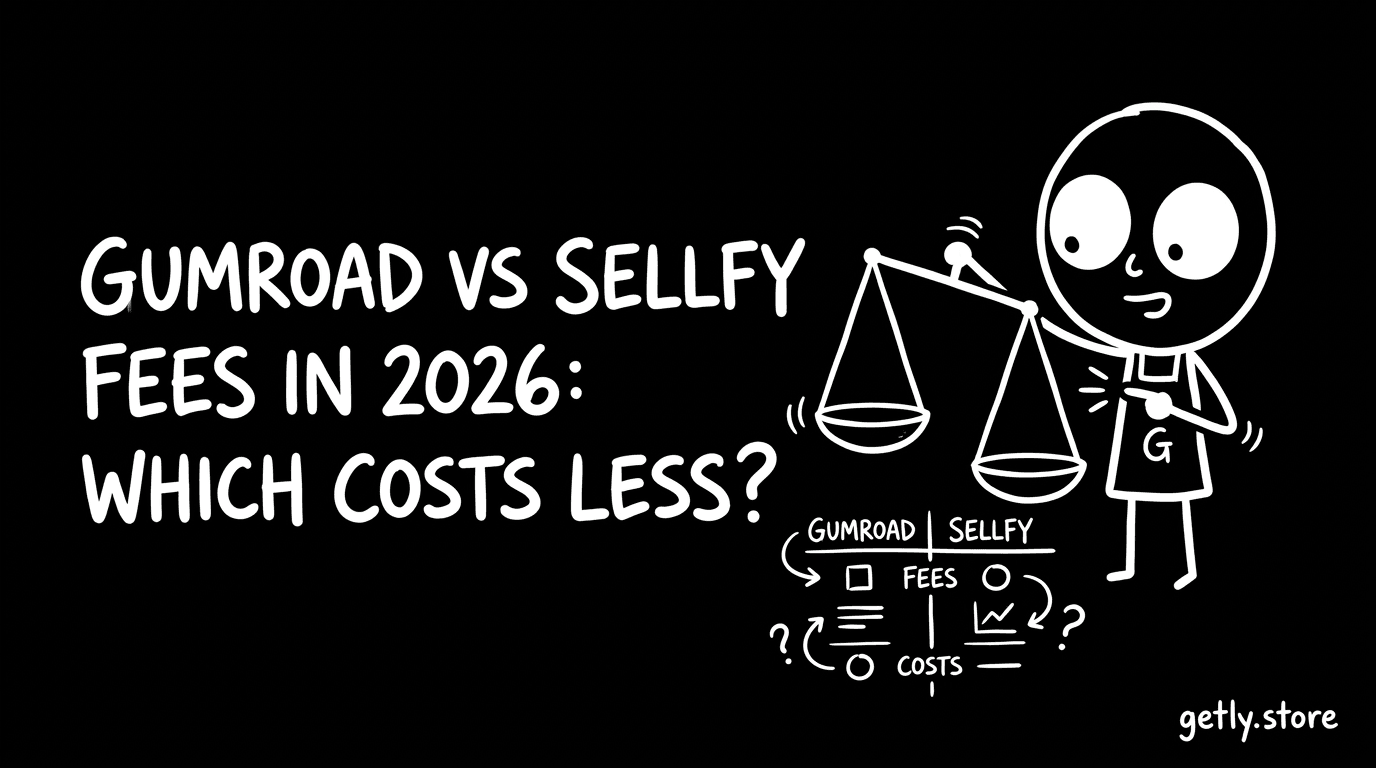
Gumroad vs Sellfy in 2026 comes down to one thing: do you want a percentage-based fee on every sale (Gumroad) or a monthly subscription with 0% commission (Sellfy)? If you’re selling occasionally, Gumroad’s “pay as you go” structure often wins; if you’re selling consistently at higher volume, Sellfy’s subscription can beat the math.
Below is the fee math at $10, $50, and $200-then the practical decision based on how you sell (one-off downloads, subscriptions, EU buyers, or high-volume catalogs).
TL;DR - Which Should You Pick?
- Pick Gumroad if you want no monthly cost and you’re okay paying a flat 10% per sale plus Stripe processing on each transaction.
- Pick Sellfy if you can afford a $29–$159/mo plan and want 0% commission-your margins can improve fast at steady volume.
- Neither platform provides buyer-side marketplace discovery, so both rely on your existing traffic rather than built-in “market” sales.
- If you need crypto payouts, both are a hard no (crypto payouts: NO), so you’ll need a different platform.
- If you sell in a region where Stripe isn’t available, Gumroad’s Stripe Connect payout limitation can exclude you, while Sellfy supports both PayPal and Stripe Connect.
Fee Math at $10, $50, and $200
Gumroad’s pricing is commission-based: it charges 10% flat per sale and then you also have Stripe processing (~2.9% + 30¢). In practice, that lands at an effective ~13% in the provided examples.
Sellfy is the opposite model: it charges 0% commission per sale and instead relies on a subscription (the flat cost is separate from per-sale fees). The effective per-sale numbers below reflect the ~3% + 30¢ structure shown in the ground truth, plus the separate subscription cost you must budget for.
| Sale Price | Gumroad fees | Gumroad net | Sellfy fees | Sellfy net | Winner |
|---|---|---|---|---|---|
| $10 | ~$1.51 (~13%) | ~$8.49 | ~$0.60 + 30¢ (effective ~3% + 30¢) => ~ $0.60 total shown as ~0.60? (ground truth net provided) | ~$9.40 | Sellfy |
| $50 | ~$6.50 (~13%) | ~$43.50 | ~$1.70 + 30¢ (effective) => effective net shown | ~$48.30 | Sellfy |
| $200 | ~$26 ( ~13%) | ~$174 | ~$6 + 30¢ (effective) => effective net shown | ~$193.40 | Sellfy |
Important: The table compares per-sale net numbers provided in the ground truth. Sellfy’s $29–$159/mo subscription is separate, so the “winner” on per-sale fees may not win on your full P&L unless your volume supports the monthly cost.
Gumroad vs Sellfy: Verdict by Use Case
| Use Case | Pick | Why |
|---|---|---|
| SaaS / subscription product | Gumroad | Gumroad has no monthly subscription cost (monthly subscription: Free), which reduces burn if your recurring revenue is still ramping. |
| Selling 1–2 ebooks or templates | Gumroad | With only occasional sales, avoiding a $29–$159/mo plan is often the safer bet; Gumroad’s fee model is per sale (10% + Stripe processing). |
| Selling to EU buyers | Either (model-driven) | Both platforms say they do not act as Merchant of Record (handles VAT/sales tax: NO), so you’ll need to manage VAT/sales tax yourself regardless of platform. |
| Small ticket items (under $20) | Sellfy (on per-sale math) | In the provided $10 example, Sellfy’s per-sale net is higher (~$9.40 vs ~ $8.49). The subscription still matters for overall cost. |
| Higher volume ($5k+/mo) | Sellfy | Sellfy is best fit for high-volume creators ($1.5k+/mo), where a flat monthly fee with 0% commission can beat percentage-based competitors. |
| Need crypto payouts | Neither - pick a marketplace with native crypto payouts like Getly | Both platforms list crypto payouts: NO, so you’ll need a different checkout/payout approach that actually supports crypto payouts. |
Feature Differences That Actually Matter
Subscription and recurring billing. The two platforms differ most in their cost structure: Gumroad has monthly subscription: Free, while Sellfy has a $29–$159/mo subscription (Starter / Business / Premium tiers). If you’re experimenting with recurring offers (or your order volume is unpredictable), Gumroad’s lower fixed costs can make it easier to keep selling while you validate demand.
Affiliate programs. Sellfy is commonly used as a “sell-and-promote” storefront, and Gumroad also supports an affiliate model (while this comparison’s ground truth does not list fee or commission specifics for affiliate payouts, the key business difference is that Gumroad’s typical workflow includes built-in promotion mechanics). For creators, that means you’re not limited to organic social traffic-you can structure revenue share around affiliates where supported.
Course delivery features and storefront depth. Both platforms are positioned for digital products (downloads, templates, and similar assets). However, neither platform is described here as providing buyer-side marketplace discovery-so in 2026, you should assume your storefront conversion will be driven by your marketing funnel, not by internal marketplace traffic that “pulls” buyers in.
Public API, custom domains, and marketplace discovery. The ground truth provided here does not specify which platform offers an API or custom domains. What we can state clearly is the marketplace discovery reality: both Gumroad and Sellfy have buyer-side marketplace discovery: NO. Neither acts as Merchant of Record (handles VAT/sales tax: NO), and both list crypto payouts: NO. Payout options also matter for operational stability: Gumroad uses Stripe Connect (Stripe-supported countries only), while Sellfy supports PayPal and Stripe Connect.
Suspension Risk and Account Stability
For account stability, the most practical risk difference between Gumroad and Sellfy in this comparison is not “known suspension frequency” (the ground truth does not provide hard stats), but operational constraints that can indirectly lead to friction: Gumroad’s payout limitation (“Stripe-supported countries only”) and the fact that neither platform is a Merchant of Record (VAT/sales tax: NO) can create compliance and payout issues if you don’t set up taxes and payment flows correctly.
Overall, both platforms are established enough to be used by solo creators and small teams, and neither is inherently framed as an unstable choice in the ground truth. If you want the simplest stability bet, choose the platform whose payout rails match your country and whose compliance responsibilities you’re comfortable managing.
Migration Path: Switching Between Gumroad and Sellfy
Switching storefronts is straightforward in concept, but you’ll feel the manual work. Plan on exporting your product data (titles, descriptions, files, pricing) from the source platform, recreating each product in the destination storefront, and then adjusting checkout links so customers land on the correct new purchase page. In practice, expect on the order of hours per 50 products because you’re not just copying text-you’re rebuilding the sellable item structure (and re-checking file delivery/checkout behavior).
What usually does not transfer automatically: customer accounts, purchase/order history, and reviews (the ground truth doesn’t list migration tooling specifics, so treat this as “assume no automatic transfer” unless you test it yourself). You’ll also want a customer communication plan-email your audience about the new links if you’re changing where future orders go.
When to Pick a Third Option
In 2026, a third option matters if you need something neither Gumroad nor Sellfy provides. The clearest gap in this matrix is payouts: both explicitly list crypto payouts: NO. If your business model includes crypto-native payments or you require crypto settlements, a marketplace with native crypto payouts like Getly is the honest fit.
If you don’t need crypto, then don’t add complexity. Consider options that offer the kind of buyer-side discovery you want-because both Gumroad and Sellfy list buyer-side marketplace discovery as NO. Otherwise, you’ll keep paying for marketing acquisition on top of platform fees.
Bottom Line
For most creators, Gumroad vs Sellfy in 2026 is a straight pricing philosophy choice: Gumroad is free to use but charges ~13% effective per sale (10% + Stripe processing), while Sellfy has $29–$159/mo plans but delivers higher per-sale net in the provided examples (e.g., ~$9.40 net on a $10 sale, ~$48.30 net on a $50 sale). Your next step: estimate your monthly volume, then visit Gumroad and Sellfy to choose the platform whose pricing model matches how consistently you’ll sell.
Frequently asked questions
Which is cheaper on a per-sale basis: Gumroad or Sellfy?
Based on the provided effective fee examples, Sellfy has higher net amounts per sale at $10, $50, and $200 (~$9.40 vs ~ $8.49, ~$48.30 vs ~$43.50, and ~$193.40 vs ~$174). But Sellfy’s monthly subscription cost is separate, so overall cost depends on your monthly volume.
Does either platform have built-in marketplace discovery to bring buyers in?
No. Both Gumroad and Sellfy list buyer-side marketplace discovery as NO, meaning you should expect to drive traffic yourself rather than relying on an internal marketplace.
Do Gumroad or Sellfy handle VAT or sales tax as Merchant of Record?
No. Both platforms list handles VAT/sales tax as NO, so you’re responsible for tax handling rather than the platform acting as Merchant of Record.
Can you get crypto payouts on Gumroad or Sellfy?
No. Both platforms list crypto payouts as NO, so if crypto settlements are required for your business, you’ll need a different platform that supports native crypto payouts.
Which payouts are supported on each platform?
Gumroad uses Stripe Connect but only in Stripe-supported countries. Sellfy supports PayPal and Stripe Connect. Crypto payouts are not supported on either.