 Getly
Getly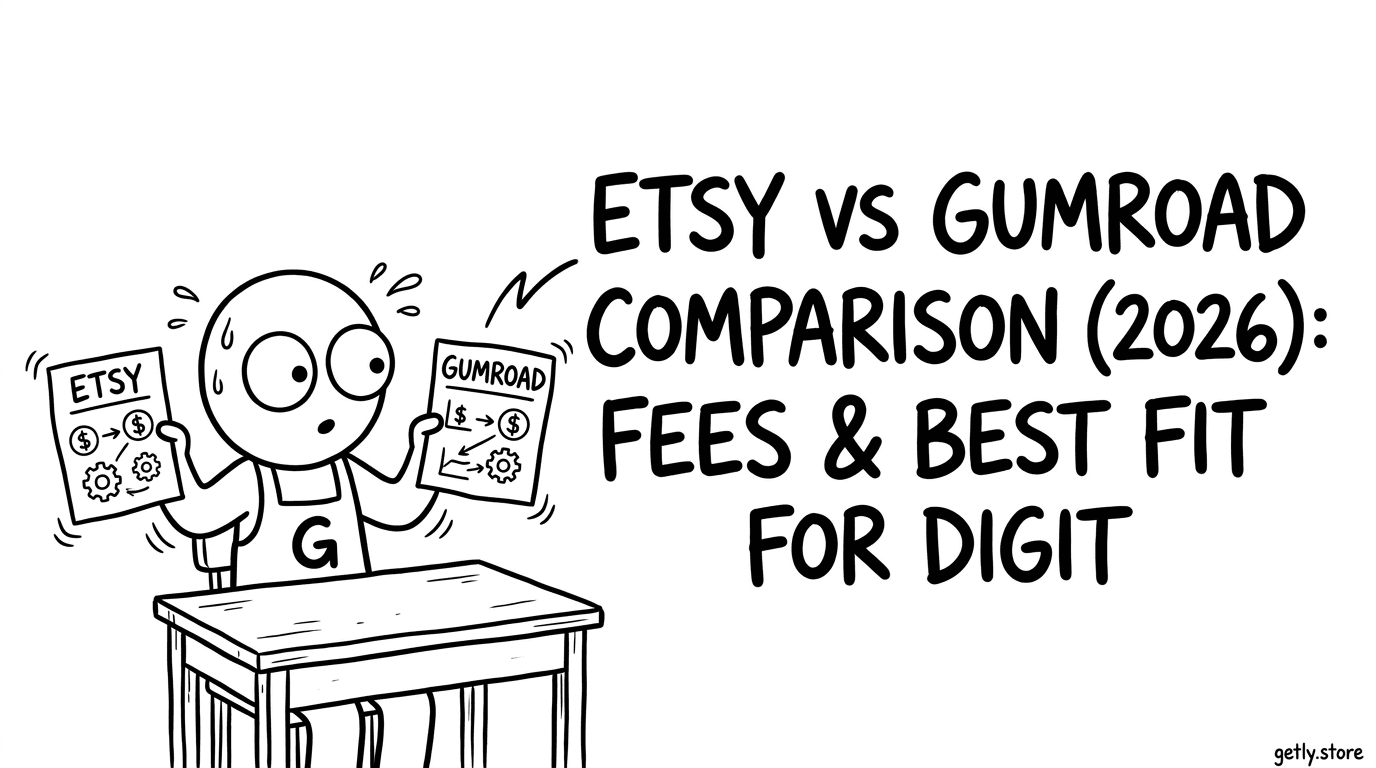
If you’re selling digital products in 2026, the right question isn’t “Which platform is cheaper?”—it’s “Which platform matches my buyer behavior and payout reality?” This etsy vs gumroad comparison breaks down where each platform fits best and how the fees stack up at common price points.
TL;DR — Which Should You Pick?
- Pick Etsy if you want buyer-side marketplace discovery and your digital products fit a craft/handmade-adjacent audience.
- Pick Gumroad if you already have an audience and want the lowest-friction storefront with a simpler fee structure.
- Gumroad is typically cheaper on the headline fee rate for digital sales, but it offers no built-in marketplace discovery and payouts are Stripe-supported-country limited.
- Etsy can deliver exposure from established traffic, but its fee stack (listing + transaction + payment processing + possible offsite ads) can compound and increase effective cost.
- If you need crypto payouts, neither option fits your requirement because both state crypto payouts are NO.
Fee Math at $10, $50, and $200
Both platforms take a cut of each sale, but they calculate it differently. Etsy combines listing and transaction fees plus payment processing, which results in a higher effective percentage at small and mid price points.
Gumroad uses a flat 10% per sale, then relies on Stripe processing for the remaining portion. Ground-truth “effective fee” lines show Gumroad’s effective rate is consistently ~13% across the three example price points.
| Sale Price | Etsy fees | Etsy net | Gumroad fees | Gumroad net | Winner |
|---|---|---|---|---|---|
| $10 | ~17% (~$1.70) | ~$8.30 | ~13% (~$1.30) | ~$8.49 | Gumroad |
| $50 | ~15% (~$7.50) | ~$42.30 | ~13% (~$6.50) | ~$43.50 | Gumroad |
| $200 | ~16% (~$32.00) | ~$167.00 | ~13% (~$26.00) | ~$174.00 | Gumroad |
Etsy vs Gumroad: Verdict by Use Case
Use-case fit matters more than fee headlines. The buyer behavior on Etsy (marketplace discovery) is fundamentally different from Gumroad’s model (you bring the audience).
| Use Case | Pick | Why |
|---|---|---|
| SaaS / subscription product | Gumroad | Etsy’s honest weakness notes strict policies around digital-only listings and a weak fit for SaaS/developer tools, while Gumroad is built for direct creator selling. |
| Selling 1–2 ebooks or templates | Either (usually Gumroad) | For simple direct sales, Gumroad’s lower effective fee rate helps; however, if your audience overlaps strongly with Etsy’s craft/digital buyers, Etsy’s discovery can offset its higher fee stack. |
| Selling to EU buyers | Either (evaluate local payout options) | Neither platform states they act as Merchant of Record (handles VAT/sales tax: NO for both). So you’ll need to manage tax/VAT yourself regardless of marketplace—choose based on discovery vs direct sales. |
| Small ticket items (under $20) | Gumroad | Ground-truth effective fees show Gumroad is ~13% at $10, while Etsy’s effective fee is ~17% at $10. That gap can matter more on lower-priced products. |
| Higher volume ($5k+/mo) | Gumroad | At scale, the effective fee gap persists across $10/$50/$200 examples, and Gumroad avoids Etsy’s additional fee stack (listing + transaction + payment + possible offsite ads) compounding. |
| Need crypto payouts | Neither — pick a marketplace with native crypto payouts like Getly | Both platforms list crypto payouts as NO, so you’ll need a third option that explicitly supports crypto payouts natively. |
Feature Differences That Actually Matter
Subscription/recurring billing support. Both platforms’ fee and discovery models differ, but the most practical lever here is whether you can sell recurring access cleanly. The ground-truth “best fit” guidance flags Etsy as a weaker match for SaaS/developer tools, while Gumroad is positioned for solo creators setting up a direct storefront. If your product is fundamentally subscription-driven, Gumroad’s direct approach tends to align better with the use-case.
Built-in affiliate programs. The ground-truth provided does not include affiliate program availability for either platform. So rather than guessing, treat affiliate capability as “verify in the platform’s current seller docs” if it’s a core part of your go-to-market.
Course delivery features (and content types). The key question is not “can I upload a file,” but “will the platform match how your buyers evaluate content.” Etsy’s buyer base is strongly tied to established marketplace habits and the craft/digital-adjacent ecosystem (and it has strict policies around digital-only listings). Gumroad is designed for direct creator selling, so if your course or learning product relies on audience-driven conversion, Gumroad generally fits the creator workflow better.
API, custom domains, and marketplaces. The ground-truth data you provided does not specify API access or custom domain support for either platform. The one feature that is explicitly stated and matters for acquisition is buyer-side marketplace discovery: Etsy has it (YES), Gumroad does not (NO). That single flag changes how you should forecast sales. Etsy can bring demand to you; Gumroad assumes you generate demand and then convert it via your storefront.
Suspension Risk and Account Stability
Platform stability and suspension risk are hard to quantify from first principles—public reports vary by niche and policy enforcement. What you can control is alignment: Etsy’s strict policies around digital-only listings and its “best fit” guidance for handmade/craft buyer bases suggest you should be conservative with how you categorize, title, and present digital products if you want lower friction.
On Gumroad, the grounds-truth emphasis is more about payout availability (Stripe-supported countries only) and the “no built-in marketplace discovery” reality. That can affect revenue stability indirectly: your sales depend more on your own audience than on marketplace algorithms.
Migration Path: Switching Between Etsy and Gumroad
Migration is mostly a content + storefront rebuild. In practice, you’ll export your product details (titles, descriptions, file assets, and pricing) from your current platform and then recreate your listings in the new one. For each product, verify delivery settings and confirm your payout destination setup (Etsy Payments to a bank account in supported countries; Gumroad via Stripe Connect in Stripe-supported countries only).
Time-wise, plan around several hours per 50 products once you account for formatting, uploads, policy review, and testing delivery. What won’t transfer automatically: customers, reviews, and order history. You should also prepare a customer communication plan—redirect buyers to the new store for future purchases, because marketplace-driven reputation (like Etsy’s buyer reviews) won’t carry cleanly over.
When to Pick a Third Option
If you discover you need features that both Etsy and Gumroad explicitly don’t support in your requirements—especially crypto payouts—then a third platform becomes mandatory. In this case, the matrix is clear: both list crypto payouts as NO, so “etsy or gumroad” won’t cover your needs.
Separately, if what you really need is a true buyer marketplace with native discovery and direct digital selling, you may find a closer fit elsewhere than forcing a compromise. Consider a third option based on the specific gap: native crypto payouts or a real marketplace discovery layer.
Bottom Line
In 2026, pick Etsy when you want marketplace discovery and your digital products match a craft/digital buyer base; pick Gumroad when you already have an audience and want lower effective fees (about ~13% in the ground-truth examples) with simpler direct selling. Your next action: visit https://www.etsy.com and https://gumroad.com, then choose based on whether you’re relying on native discovery or your own traffic.
Frequently asked questions
Is Gumroad cheaper than Etsy for digital products in 2026?
Based on the provided effective fee lines, Gumroad is cheaper at $10 (~13% / ~$8.49 net vs Etsy ~17% / ~$8.30 net), at $50 (~13% / ~$43.50 net vs Etsy ~15% / ~$42.30 net), and at $200 (~13% / ~$174 net vs Etsy ~16% / ~$167 net). The winner is Gumroad in all three examples.
Does Etsy or Gumroad provide built-in buyer discovery?
Etsy provides buyer-side marketplace discovery (YES). Gumroad does not provide buyer-side marketplace discovery (NO), so you should expect to bring your own audience to drive sales.
Do either Etsy or Gumroad act as the Merchant of Record for VAT/sales tax?
No. The ground-truth states that Etsy does not act as Merchant of Record (handles VAT/sales tax: NO), and Gumroad also does not (handles VAT/sales tax: NO).
Can I get crypto payouts from Etsy or Gumroad?
No. Both Etsy and Gumroad list crypto payouts as NO. If crypto payouts are required, you’ll need a third option that explicitly supports them.
What’s the main risk when switching from Etsy to Gumroad (or vice versa)?
Your revenue may change because you’re switching between marketplace discovery (Etsy: YES) and direct-audience selling (Gumroad: NO). Also, customers, reviews, and order history do not transfer automatically, so you’ll need a rebuild and a customer communication plan.