 Getly
Getly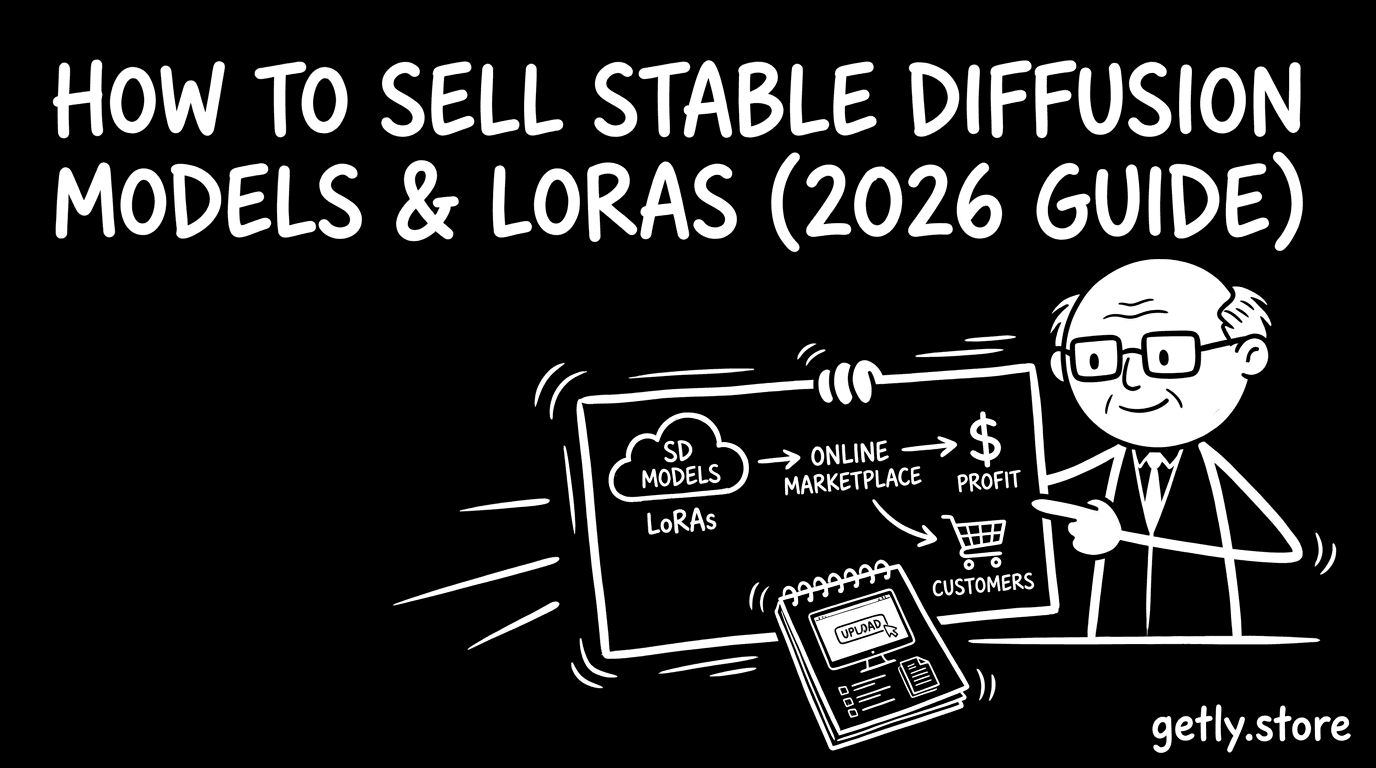
How to sell stable diffusion — a 2026 guide for creators. In this step-by-step guide, you’ll learn how to package Stable Diffusion checkpoints and LoRAs so buyers immediately understand what they’re downloading. You’ll also get a practical pricing playbook (including intro/mid/premium tiers), plus guidance on license tiers and bundling. Next, we’ll cover the marketing channels that reliably reach Stable Diffusion creators and asset buyers. Finally, you’ll see why Getly’s built-in buyer tools and payout setup can matter—especially if you’re outside Stripe-supported countries.
Who's selling stable diffusion right now?
Most successful sellers start as solo creators: artists who train LoRAs around a specific style, character, or product niche (e.g., anime linework, cosplay photography, product mockups). They’re not trying to “model everything”—they’re targeting a repeatable use case with consistent results.
Another common profile is the small agency or “pipeline” studio. These teams often bundle multiple assets (LoRAs + presets + prompts + workflows) and support buyers with example generations. Side-project creators also do well when they publish a clear content focus—one style, one training method, one target audience—so buyers can evaluate results quickly.
What buyers expect
Buyers want fast clarity: what the model/LoRA does, what it’s trained on, and how to get good outputs right away. Your quality bar includes predictable results, clean file organization, and documentation that explains recommended settings (or at least typical ranges) without making the buyer guess.
They also expect responsible distribution—especially for character/style claims—plus versioning so customers know whether they’re downloading something “v1” vs “v2.” When support is offered, it should be practical: how to troubleshoot common prompt/model issues, where to find the right weights, and what the license allows.
- Clear file formats and how to install/use them (at minimum for common Stable Diffusion setups)
- Preview assets (images) that match the training intent, not generic screenshots
- A README with prompt tips, recommended sampler/steps guidance (if applicable), and known limitations
- License terms stated plainly (what buyers can do commercially vs personally)
- Version notes when you update weights or improve training
Pricing playbook
For realistic pricing in this niche, many creators start LoRAs in the $15–$60 range, especially when the LoRA is style-specific or solves a narrow need. Full checkpoint models typically price higher, often around $80–$200 depending on quality, breadth, and buyer documentation.
Use tiering so buyers can “graduate” from experimentation to full access. A common approach is an intro tier (lower price, strong previews, clear use case), a mid tier (more variants, better docs, or more license flexibility), and a premium tier (bundles, commercial rights, or advanced presets/workflows).
- Intro LoRA: $15–$25 for one strong, consistent style/subject (fast to understand)
- Mid LoRA: $25–$45 for refined training + better examples + extra materials (where relevant)
- Premium LoRA: $45–$60 for higher consistency and/or commercial-friendly license option
- Checkpoint: $80–$200 for broader capability, with strong documentation and example outputs
Then set license tiers to match how buyers actually sell. Keep it simple: separate personal vs commercial licensing, and avoid ambiguity in your license text. If you sell bundles, bundle logically (e.g., “Style Pack: 3 LoRAs” or “Character + Outfit Variants”) so customers feel they’re buying a complete system, not random files.
Style-specific LoRAs earn $300–2k/mo for niche artists—so if your work is truly distinctive and repeatable, you can price for value while still staying inside the $15–$60 LoRA band.
Packaging your stable diffusion
Your packaging is the difference between “cool file” and “bought immediately.” Buyers judge you on how quickly they can get a great result, so make your materials self-explanatory—especially for first-time users who don’t want to read forums.
- Weights files (include the correct file names and clear version labels)
- Preview images showing the intended style/subject across multiple prompts/angles
- README/docs with setup notes and example prompts (even if brief)
- License file included in the download package (not just in the listing)
- Version notes (e.g., v1.0 → v1.1 changes, dataset adjustments, improved consistency)
- Recommended usage (typical settings guidance and any “works best with” notes)
- Changelog so customers trust updates
Marketing channels that actually work
Stable diffusion buyers often find assets in communities where they already discuss training, promptcraft, and generation results. You’ll get the best traction by sharing before/after samples, training intent, and practical “how to use” posts—not just download links.
Start with these channel types and tailor your posts to the platform’s culture:
- Reddit: r/StableDiffusion, r/LocalLLaMA (for workflows), and style/training-focused threads—post results + settings, not generic promos
- X (Twitter): join Stable Diffusion training circles and consistently share render comparisons, LoRA trigger words, and prompt examples
- Discord: server communities that focus on Stable Diffusion workflows and model training; participate in prompt challenges and share your usage notes
- YouTube: “How to use LoRAs” tutorial creators and compilation channels—offer a case study and include your download package details in the description
Also: build a repeatable content format. For example, “LoRA in 60 seconds” (prompt + result + short usage tip). In this niche, consistent demo posts outperform one-off announcements.
Why Getly?
With Getly, creators keep 80% of every sale—your platform fee is 20%. If you’re selling digital stable diffusion products and want predictable creator revenue share, that split is built into the marketplace model.
Getly supports Stripe Connect payouts plus crypto payouts (USDT/USDC on Tron, BSC, Polygon, Solana, Ethereum). This can be especially important for creators outside Stripe-supported countries, where most platforms can’t pay them through traditional card rails. Plus, Getly offers AI search/visual search, customer CRM, email marketing, A/B tests, bundles, and multi-license tiers—so buyers can find your assets and understand licensing faster.
Next step: pick one style or subject you can train consistently, package it with strong previews and a short README + license, then price the LoRA in the $15–$60 band using intro/mid/premium tiers. Publish it with clear license options and examples, and run focused outreach in Stable Diffusion communities with a repeatable “demo + usage tip” post format. After you get a first sale, iterate your previews and docs based on buyer questions.