 Getly
Getly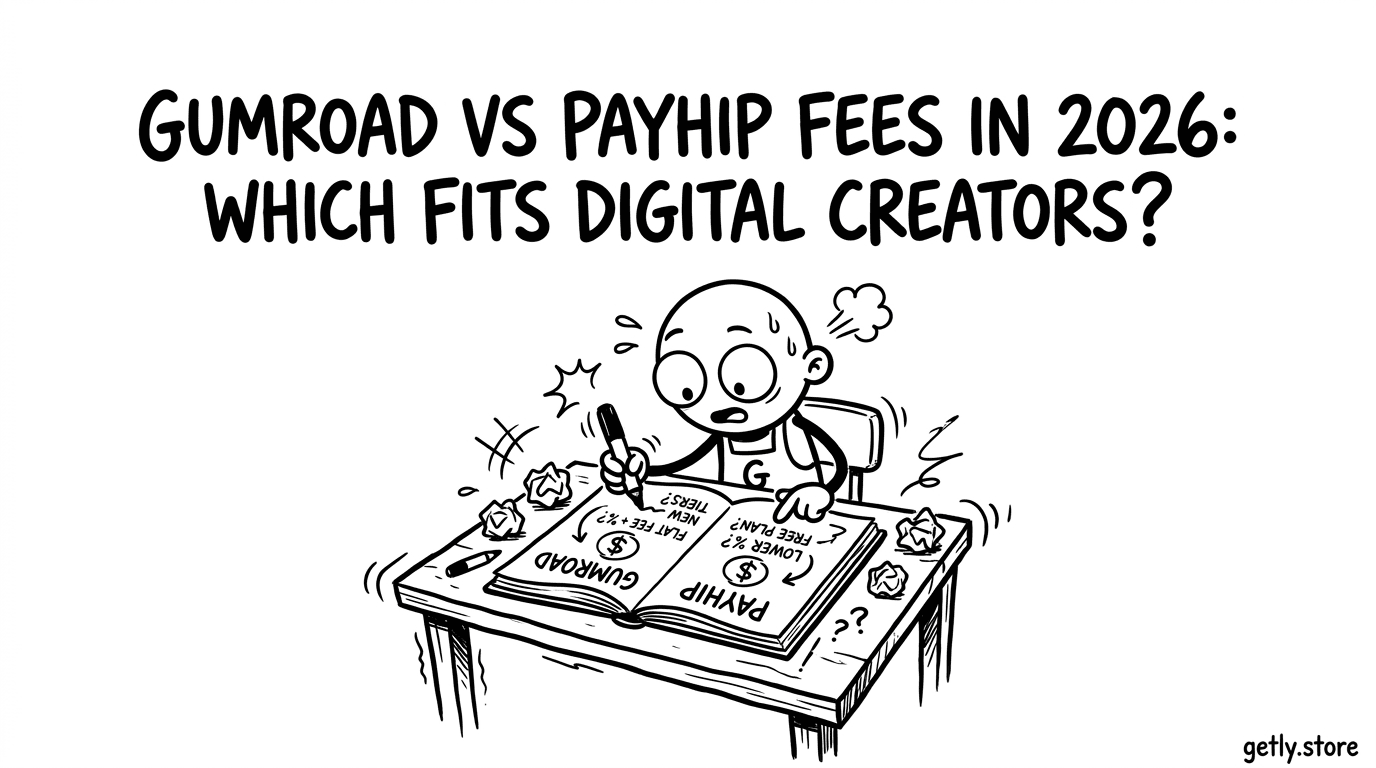
If you’re searching “gumroad vs payhip,” the deciding factor is usually fee math plus payouts. In 2026, both platforms can work well for creators with their own audience—but their per-sale cut and payout setup point you to different winners depending on your product and price.
TL;DR — Which Should You Pick?
- Pick Payhip on the free plan when you want the lowest headline per-transaction percentage (about 8% effective on $10/$50/$200).
- Pick Gumroad when you want the simplest “storefront + checkout” path with free monthly subscription and you’re already set up to receive payouts via Stripe Connect.
- If you sell to many regions, note Gumroad payouts are Stripe-supported countries only, which can exclude a large number of countries.
- Neither platform provides buyer-side marketplace discovery, so you’ll still need your own traffic plan.
- If you need crypto payouts, neither works—use a marketplace that supports native crypto payouts like Getly.
Fee Math at $10, $50, and $200
Both Gumroad and Payhip charge payment processing on top of their own percentage. The simplest way to compare is to use their published effective fee examples at common price points (which already combine the platform fee with Stripe-style processing).
Below, “fees” and “net” are taken directly from the effective fee lines: Gumroad is shown at ~13% effective, while Payhip on the free plan is shown at ~8% effective. Higher-priced products follow the same effective-fee pattern in the examples provided.
| Sale Price | Gumroad fees | Gumroad net | Payhip fees | Payhip net | Winner |
|---|---|---|---|---|---|
| $10 | ~13% (~$1.51) | ~$8.49 | ~8% (~$0.80) | ~$9.20 | Payhip |
| $50 | ~13% (~$6.50) | ~$43.50 | ~8% (~$3.80) | ~$46.20 | Payhip |
| $200 | ~13% (~$26.00) | ~$174.00 | ~8% (~$16.30) | ~$183.70 | Payhip |
Gumroad vs Payhip: Verdict by Use Case
| Use Case | Pick | Why |
|---|---|---|
| SaaS / subscription product | Gumroad or Payhip | Both are checkout/storefront tools for creators with their own audience; fee math matters more than “marketplace discovery,” which neither platform provides. |
| Selling 1–2 ebooks or templates | Payhip | Payhip’s best fit is creators using their own audience to sell simple downloads, with an effective ~8% fee on the free plan in the provided examples. |
| Selling to EU buyers | Payhip | Payhip supports PayPal and Stripe Connect as payout methods, and neither platform acts as Merchant of Record (so VAT/sales tax handling isn’t covered by the platform). |
| Small ticket items (under $20) | Payhip | Using the example at $10, Payhip’s effective fee is ~8% (~$9.20 net), while Gumroad is ~13% (~$8.49 net). |
| Higher volume ($5k+/mo) | Payhip | On the fee examples given, Payhip’s lower effective percentage translates into a consistent net advantage as price rises ($50 and $200 examples also favor Payhip). |
| Need crypto payouts | Neither | Both platforms explicitly have Crypto payouts: NO; if crypto payout support is required, pick a marketplace with native crypto payouts like Getly. |
Feature Differences That Actually Matter
Subscription / recurring billing: When you’re selling anything that looks like a subscription (SaaS, ongoing access, or repeatable deliveries), you care less about “marketplace discovery” and more about whether the checkout flow matches your product model. Both Gumroad and Payhip are positioned as checkout + storefront tools, not buyer-facing marketplaces—so your recurring-billing success still depends heavily on your own acquisition and retention.
Affiliate program: The biggest practical question is whether you can recruit affiliates and scale distribution. The most important takeaway for 2026 decision-making is that both platforms do not provide buyer-side marketplace discovery; affiliates (where available) can be your distribution layer instead. Choose the platform that best supports the marketing motion you already run.
Buyer-side marketplace discovery: Neither platform has buyer-side marketplace discovery. That means your customers don’t come from “the marketplace” finding you; they come from you. If you want a built-in buyer-facing catalog that drives organic inbound, you’ll need a different category of solution than Gumroad or Payhip.
Payout methods and operational fit: Gumroad uses Stripe Connect for payouts (with the constraint “Stripe-supported countries only”). Payhip offers PayPal and Stripe Connect. Neither platform provides crypto payouts. Also, neither acts as Merchant of Record, so VAT/sales tax handling isn’t done for you by the platform—plan for compliance outside the checkout.
Suspension Risk and Account Stability
Account stability is rarely just about one setting; it’s usually about policy enforcement, chargebacks, and what’s in your product catalog. Based on widely visible positioning, Gumroad emphasizes a creator-first storefront with Stripe Connect payouts, while Payhip is also a creator checkout tool with PayPal/Stripe options. Neither platform is described here as having a built-in marketplace traffic engine, which can reduce the “platform discovery” incentive—but it doesn’t automatically translate into lower risk.
If you’re concerned about suspension risk, the practical move in 2026 is to review payout constraints and compliance implications (since both say they do not act as Merchant of Record). Keep your product descriptions, refund policy, and billing/fulfillment expectations consistent to minimize disputes—especially if you sell internationally where tax handling isn’t assumed by the platform.
Migration Path: Switching Between Gumroad and Payhip
Switching is usually straightforward if your products are primarily digital files (ebooks, templates, downloadable assets). The typical workflow is: export your product list (titles, prices, file links, and any access-delivery configuration you can retrieve), create the matching products in the new platform, and then update your marketing links and checkout URLs. Expect this to take iterative testing so the delivery works correctly before you fully redirect.
In practical terms, plan around hours for every ~50 products for recreating listings and verifying delivery/checkout behavior. What generally does not migrate automatically includes customer relationships (emails/audiences), reviews, and historical order history. You can often preserve your own audience via your email list, but the storefront-specific “order timeline” and social proof may have to restart.
When to Pick a Third Option
If your requirement set doesn’t fit a checkout tool, move to a platform designed for that gap. The clearest mismatch for Gumroad vs Payhip is crypto payouts: both are “Crypto payouts: NO,” so a crypto-native payout marketplace is the most honest next step. In that specific case, Getly is the kind of option that matches the missing requirement—crypto payouts—without forcing you to compromise your business model.
If instead your core goal is buyer-side traffic discovery (you want a marketplace surface where buyers browse and discover products), then neither Gumroad nor Payhip is the right category because both state Has buyer-side marketplace discovery: NO. For that purpose, consider a marketplace-style platform (for example, Creative Market or itch.io) where inbound discovery is part of the product—not something you must build yourself.
Bottom Line
For 2026, Payhip usually wins the fee math on the free plan in the provided examples (~8% effective vs Gumroad’s ~13% effective), assuming you’re comfortable with PayPal/Stripe Connect payouts and you’ll handle compliance since neither is Merchant of Record. Your next action: compare your expected average price and payout country constraints, then test the checkout/delivery flow on the platform you expect to keep—most often Payhip for fee-sensitive digital sales.
Frequently asked questions
Which has lower fees in 2026: Gumroad or Payhip?
Based on the provided effective fee examples, Payhip’s free plan shows ~8% effective fees, while Gumroad shows ~13% effective fees. That difference shows up in the net proceeds at $10, $50, and $200 in the comparison above.
Do Gumroad or Payhip act as Merchant of Record for VAT or sales tax?
No. Both platforms are listed as not acting as Merchant of Record, so VAT/sales tax handling is not covered by the platforms.
Do either Gumroad or Payhip offer buyer-side marketplace discovery?
No. Both are described as not having buyer-side marketplace discovery, meaning you typically need your own traffic or distribution channel to drive purchases.
Can I receive crypto payouts on Gumroad or Payhip?
No. Both platforms explicitly list crypto payouts as NO.
What payout methods do these platforms support?
Gumroad uses Stripe Connect, and Payhip supports PayPal and Stripe Connect. Gumroad’s Stripe Connect is noted as available only in Stripe-supported countries.