 Getly
Packs de prompts IA pour le code
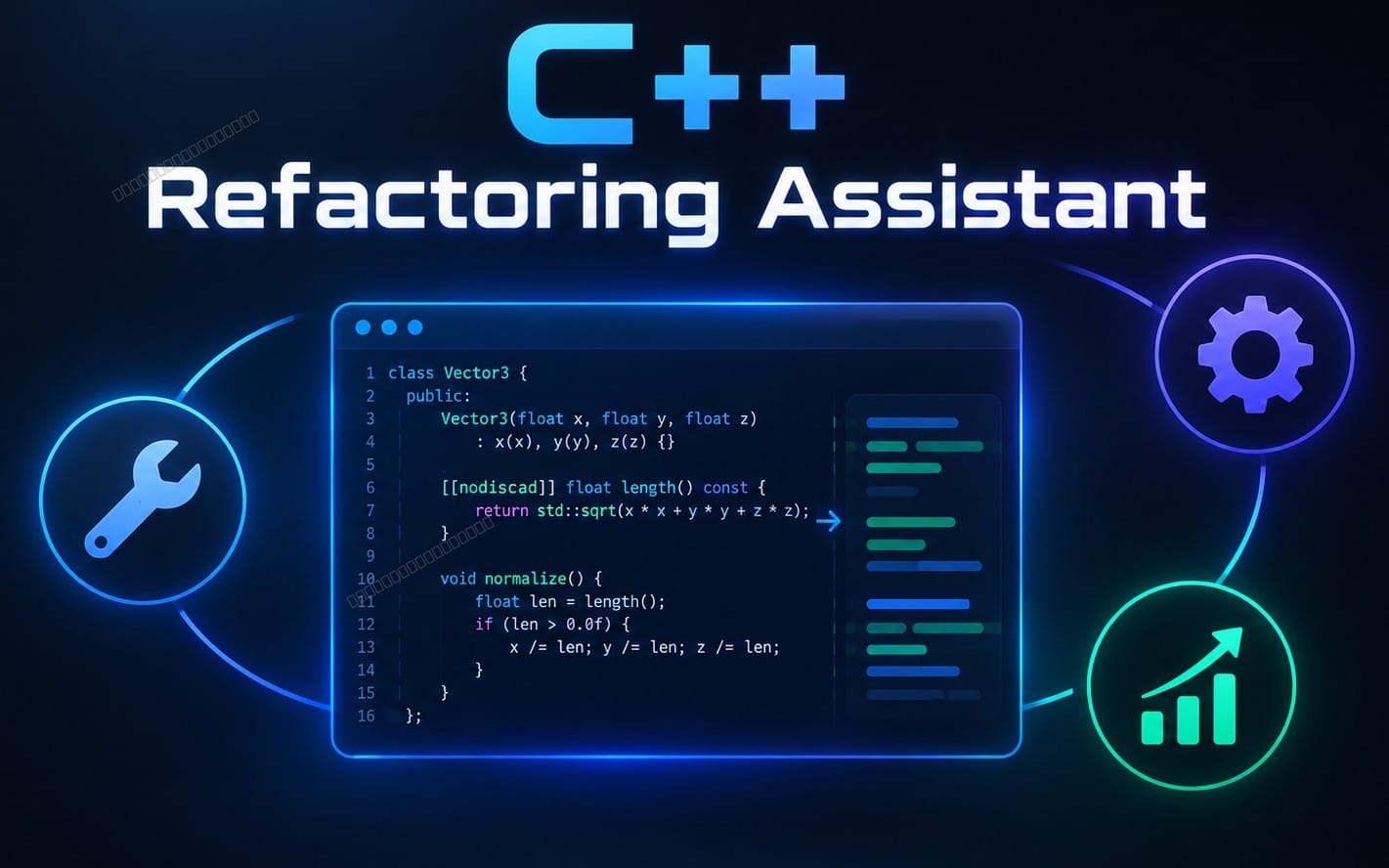
A Practical AI-Assisted Workflow for Safely Refactoring Legacy C++
Cette annonce est affichée dans sa langue d'origine (anglais).
Safely analyzing, testing, modernizing, and refactoring legacy C++ code. Get 30 structured prompts, a master system prompt, workflows, checklists, and guardrails for using AI coding assistants without blindly rewriting unfamiliar C++.
Ce que vous recevez : 1 fichier · 45.04 KB · MD
Voir les options d'achatDescription du produit
The AI-Assisted Legacy C++ Refactoring Toolkit is a comprehensive prompt library and workflow framework designed for software engineers working with legacy C++ codebases. It provides a disciplined methodology for leveraging AI language models as engineering assistants while maintaining developer control over every change.
The toolkit addresses a common challenge in software maintenance: large, unfamiliar codebases where full rewrites are impractical. It offers a structured approach to understanding, testing, and incrementally improving such systems without introducing regressions or compromising stability.
Target Scenarios
The toolkit is applicable to codebases facing challenges such as:
Inherited or undocumented legacy C++ code
Migration from C++03/11/14 to newer standards
Unclear pointer ownership and manual memory management
Macro-heavy code and complex template metaprogramming
Fragile APIs and ABI-sensitive libraries
Insufficient test coverage and suspected undefined behavior
Concurrency hazards and performance bottlenecks
CMake and build system modernization
Review of AI-generated code changes
Core Methodology
The workflow follows a defined progression:
text
Recon → Understand → Assess → Test → Plan → Refactor → Verify → ReviewThis sequence emphasizes understanding before modification, characterization before refactoring, and verification after every change. The toolkit contains 30 structured prompts organized across seven sections: reconnaissance, architecture, modernization, quality and safety, performance, testing, and execution.
Key Principles
The toolkit operates on several foundational principles:
Incremental change over rewrites. Each modification should be small, independently verifiable, and reversible.
Evidence-based analysis. AI output is treated as a proposal requiring verification through compilation, testing, sanitizers, and human review.
Behavior preservation. Observable behavior remains unchanged unless explicitly intended.
Context awareness. Recommendations respect the current C++ standard, toolchain, platform, ABI, and performance constraints.
Uncertainty disclosure. The system prompt instructs models to mark uncertain claims and request missing context rather than fabricate details.
Included Components
Master System Prompt — establishes the AI's role, constraints, and output format
30 Task-Specific Prompts — covering ownership analysis, dependency mapping, modernization planning, concurrency review, performance investigation, test generation, and patch proposal
Variable Glossary — standardized input placeholders for consistent prompt construction
Pre-Flight Checklist — preparation steps before risky refactoring
Quick Reference Tables — situation-based and goal-based prompt selection
Recommended Chains — predefined prompt sequences for common workflows
Worked Example — demonstrating ownership analysis with correct and incorrect reasoning
Session Template — for long-running refactoring efforts requiring audit trails
Compatibility
The toolkit is designed for use with capable instruction-following language models including ChatGPT, Claude, Gemini, Copilot, DeepSeek, Grok, Qwen, Llama, and Mistral. It supports C++ standards from C++11 through C++23 and accommodates various build systems, compilers, and platforms.
Intended Use
This toolkit is intended for professional software engineers, technical leads, and architects engaged in maintaining or modernizing C++ systems. It assumes familiarity with C++ semantics, build systems, testing practices, and software design principles. The developer remains responsible for reviewing, validating, and approving all generated recommendations and code changes.
Ce que vous recevez
1 fichier · 45.04 KB
- ai_workflow_refactoring_legacycpp_toolkit.mdMD · 45.04 KB
Packs de prompts IA pour le code
A Practical AI-Assisted Workflow for Safely Refactoring Legacy C++
Cette annonce est affichée dans sa langue d'origine (anglais).
Safely analyzing, testing, modernizing, and refactoring legacy C++ code. Get 30 structured prompts, a master system prompt, workflows, checklists, and guardrails for using AI coding assistants without blindly rewriting unfamiliar C++.
Tags
Questions fréquentes
Ai-je accès au produit immédiatement ?
Oui. C'est un produit numérique : vous pouvez le télécharger juste après le paiement, directement depuis votre bibliothèque.
Puis-je l'utiliser pour des projets commerciaux ?
Oui. L'usage commercial est autorisé : utilisez-le dans votre propre activité et dans ce que vous vendez. Vous ne pouvez pas revendre ni redistribuer le fichier lui-même.
Quelle est votre politique de remboursement ?
Vous pouvez demander un remboursement dans un délai de 30 jours. Si quelque chose ne va pas, demandez-le depuis votre commande et l'équipe Getly l'examine.
Quels formats et quelles tailles de fichier vais-je recevoir ?
Vous téléchargerez 1 fichier - MD - 45.04 KB au total.
Ai-je droit aux mises à jour gratuites ?
Oui : quand le vendeur publie une nouvelle version, vous pouvez retélécharger les derniers fichiers depuis votre bibliothèque sans frais. Consultez le journal des modifications pour les dernières mises à jour.
Prix
$32.00