 Getly
GetlyGumroad Alternatives (2026): Fees Compared
The strongest Gumroad alternatives in 2026 are Lemon Squeezy, Payhip, Sellfy and Getly. Lemon Squeezy charges 5% + 50¢ and handles EU VAT for you as merchant of record. Payhip takes 5% on its free plan. Sellfy takes 0% commission on plans from $29 a month. Getly is a marketplace that pays sellers in USDT or USDC to their own wallet, for creators whose country Stripe does not pay out to.
I run Getly - one of the alternatives in this article - so read this with that in mind. I am not going to tell you Getly is the best for everyone, because it is not. What I can tell you is the real fee math, the real platform tradeoffs, and the specific scenarios where each of the eight alternatives below genuinely beats Gumroad. The five axes I evaluate every platform on are simple: fee structure, payout options, marketplace discovery, EU VAT handling, and account-suspension risk. Gumroad is fine on two of those axes and weak on three, which is why creators are looking around in 2026. The right replacement depends on which weakness hurts you most.
Why creators are looking for alternatives in 2026
Let me start with what Gumroad does well, because the platform is not bad - it is just not the best fit for as many people as it used to be. Gumroad still has the lowest entry barrier of any digital storefront on the internet. You sign up with an email, paste a product description, drop in a file, set a price, and you have a working checkout in five minutes. For a creator who has never sold a digital product before and just wants to test if anyone will buy, that low friction is genuinely valuable. The platform also has reasonable payout reliability inside Stripe-supported regions and a clean, minimal buyer-side checkout that converts well. None of that is in dispute.
The problem is that the original Gumroad pitch - “creator-friendly fees and stay out of your way” - has eroded over the last two years, and the alternatives have caught up on the parts Gumroad was best at. Three triggers keep showing up in creator threads on Reddit, Twitter, and Indie Hackers when sellers explain why they are evaluating other platforms.
Trigger one is the 2024 fee restructuring. Gumroad moved from a tiered fee schedule (sellers who were doing volume paid a lower percentage) to a flat 10% commission across all sellers. For high-volume sellers this was effectively a fee increase of several percentage points overnight, with no grandfathering and limited communication. Even sellers who were happy with Gumroad in 2023 found themselves looking at the same product earning meaningfully less in 2024 - and the experience taught a lot of creators that platform fees are not stable, even on platforms that pitch themselves as creator-aligned.
Trigger two is that Gumroad is a storefront tool, not a marketplace. There is no internal discovery feed, no “related products” cross-promotion to another seller, no browse-by-category page that surfaces work from creators you have not heard of. Gumroad expects you to drive 100% of your own buyer traffic - from your Twitter, your newsletter, your YouTube channel, your podcast - and the platform takes 10% for processing the transaction. That math works if you already have an audience. It is brutal if you are starting from zero, because you are paying marketplace-tier fees while doing all the marketing yourself.
Trigger three is Stripe-only payouts. Stripe pays out to sellers in only about 50 countries. Outside that list are Argentina, Vietnam, Pakistan, Nigeria, Bolivia, most of the Caucasus, parts of Southeast Asia and, except in specific setups, Ukraine. A creator in any of those countries cannot receive a Gumroad payout at all without using a relative's account in a supported country, which is a violation of both Gumroad and Stripe terms. The world has more digital creators outside Stripe's supported list than inside it, and 2026 is the year a lot of them are realizing alternatives exist.
There is also a quieter fourth trigger that does not get talked about as much: account-suspension risk on a single-platform setup. Gumroad reserves the right to suspend any account that violates its terms, and the “violation” bar has shifted over the years as the platform has tightened its content policies and payment-risk thresholds. Creators selling AI-generated work, prompt packs, certain categories of adult content, hacking tools, or anything ambiguous have found themselves with frozen funds and a 6–8 week appeal cycle, with no second platform to fall back on. The fix is not to leave Gumroad - it is to stop treating any single platform as your only revenue rail. Running a parallel store on a different platform is cheap insurance against the moment a policy team somewhere decides your category is now risky.

The 8 alternatives ranked by use case
I am not putting Getly first. The honest top of the list depends on your specific situation, and for most casual sellers Lemon Squeezy or Payhip will be a better fit than Getly is. The table below is sorted by overall fit and honesty, not by which one I run.
| Platform | Creator keeps | Listing fee | Monthly fee | Marketplace | Crypto payouts | Best for |
|---|---|---|---|---|---|---|
| Lemon Squeezy | 95% (after 5% + 50¢) | Free | Free | SaaS / digital downloads with global VAT handling | ||
| Payhip | 95% | Free | Free | Cheapest commission, simple ebooks/PDFs | ||
| Sellfy | 100% | Free | $29–159/mo | High volume on a fixed monthly cost | ||
| Getly | 80% (90% first 90 days) | Free | Free | Marketplace discovery + crypto creators | ||
| Creative Market | 50–70% | Free | Free | Established design assets, exposure | ||
| Etsy (digital) | ~80% effective | $0.20/listing | Free | Handmade-adjacent digital, existing Etsy seller | ||
| Podia | ~95% (5% on Mover) | Free | $42–150/mo | Courses + memberships | ||
| Gumroad | ~85–90% (10% + 50¢) | Free | Free | Fastest setup, smallest catalog |
Gumroad, Lemon Squeezy, Payhip, Sellfy and Podia fees re-checked against each platform's own pricing page on October 12, 2026 (sources below); Etsy and Creative Market figures date from April 2026. Marketplaces change pricing, so verify on each platform before committing. “Creator keeps” figures exclude payment-processor fees unless stated; see the fee math section below for net take-home.
Pricing sources, checked October 12, 2026: Gumroad, Lemon Squeezy, Payhip, Sellfy, Podia
When Getly is the right choice - and when it isn't
This is the section where I am honest, because if I tell you Getly is always the answer, you will stop trusting the rest of the article. It is not. Here is the scenario-by-scenario breakdown of which platform genuinely fits best.
Choose Getly if:
- You are in a country where Stripe does not support seller payouts and you need USDT/USDC withdrawals to actually get paid.
- You are starting from a small audience and want a platform that contributes some buyer traffic through its internal browse and search, not just a checkout page.
- You sell creator assets - design files, code, 3D, fonts, templates - that benefit from a categorized marketplace and cross-product discovery.
- You want your payouts in USDT or USDC sent to your own wallet, with no bank or Stripe account needed, on a fixed 1st-and-15th calendar.
Choose Lemon Squeezy if:
- You sell to EU customers and do not want to deal with EU VAT yourself. Lemon Squeezy acts as merchant of record: it is the legal seller, so it collects and pays that tax for you.
- You sell a single SaaS product or downloadable tool and care about license-key delivery, subscriptions, and tax compliance more than marketplace discovery.
Choose Payhip if:
- You already have an audience driving 100% of your traffic and you just want the cheapest possible per-sale commission, no monthly fees, no extras.
Choose Sellfy if:
- You are doing $2,000+ per month in digital sales and the math on a flat $29-$159 monthly subscription with 0% per-sale commission beats every percentage-based competitor.
Stay on Gumroad if:
- You have a working channel that converts, you are in a Stripe-supported country, your monthly volume is comfortable for you, and the 10% fee genuinely does not bother you. There is real switching cost (audience update, link migration, review re-collection) that only pays back if you have a concrete reason - and “everyone is leaving” is not a concrete reason.
Real fee math: what creators actually take home
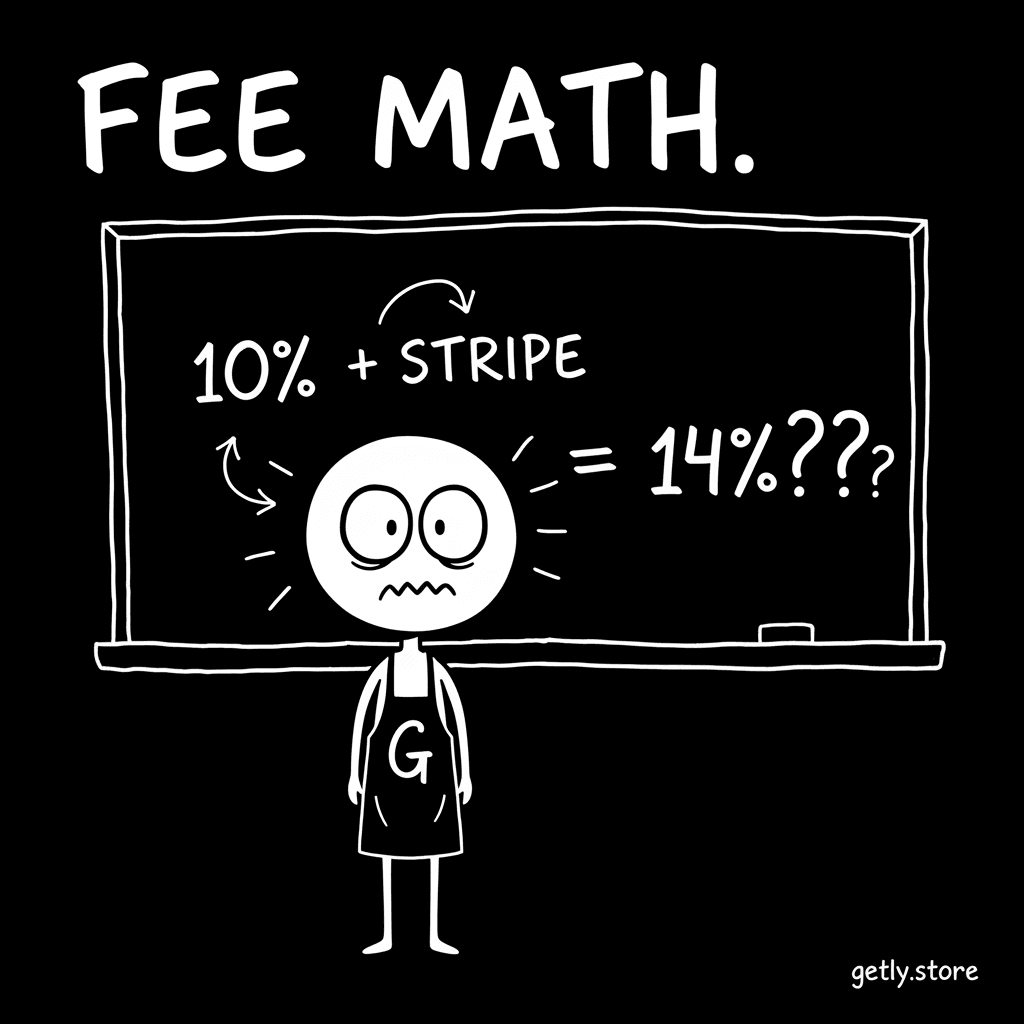
The single biggest piece of misinformation in this category is that “Gumroad takes 10%”. That sentence is technically true at the platform-fee layer and badly misleading at the bank-account layer. What actually happens on a $10 sale on Gumroad in 2026 is roughly: Gumroad takes its 10% + $0.50 platform fee ($1.50), Stripe takes its 2.9% + $0.30 processing fee ($0.59 on $10), and if your buyer paid in a non-USD currency or you are settling to a non-USD bank account there is a 1–2% currency-conversion fee on top. A creator who reads the “10%” pitch and expects $9 in their pocket on a $10 sale is going to find $7.91 instead, and the gap widens at smaller price points where the flat $0.50 and Stripe's flat $0.30 dominate the math. Gumroad does not hide this - Stripe's fee is disclosed in the help center - but it is also not on the homepage. Every platform on this list has a similar gap, with different magnitudes.
Every platform's pitch page states a clean percentage - “you keep 90%”, “you keep 95%”, “0% commission” - and almost none of those numbers are what actually lands in your bank account. The two missing pieces are payment-processor fees (Stripe takes ~2.9% + $0.30 per transaction even on platforms that do not advertise this in their line cost) and currency conversion fees, which are particularly painful when your buyer pays in USD and you settle in a different currency. On a $10 sale, Gumroad's “10% fee” turns into roughly a 21% all-in cost once you account for processing.
The table below shows actual creator take-home on three sale prices - $10, $50, and $200 - across all eight platforms, calculated against the published fee schedule plus the standard Stripe processor cost where applicable. I have rounded to the nearest cent and noted the basis below each row. Sellfy's figure assumes you are above the volume threshold where the flat monthly fee is already covered; below that, Sellfy is the worst pick on the list.
| Platform | $10 sale | $50 sale | $200 sale | Notes |
|---|---|---|---|---|
| Lemon Squeezy | $9.00 | $47.00 | $189.50 | 5% + $0.50 covers payments + VAT (MOR) |
| Payhip | $8.91 | $45.75 | $183.90 | 5% Payhip + ~3% Stripe + $0.30 |
| Sellfy | $9.41 | $48.25 | $193.90 | Flat $29–159/mo not in line cost |
| Getly | $9.00 | $45.00 | $180.00 | 80% net (90% net first 90 days → $9 / $45 / $180) |
| Creative Market | $5.00 | $25.00 | $100.00 | Non-exclusive 50%; exclusive 70% |
| Etsy (digital) | $8.30 | $42.30 | $167.30 | 6.5% + $0.20 listing + $0.25 + 3% payment |
| Podia | $8.91 | $45.75 | $183.90 | 5% Podia (Mover plan) + ~3% Stripe + $0.30; $42/mo not in line cost |
| Gumroad | $7.91 | $42.75 | $173.40 | 10% + $0.50 Gumroad + ~3% Stripe + $0.30 + currency conversion |
The top three (Lemon Squeezy, Payhip, and Getly) land within 25 cents of each other across all three sale prices, so per-sale economics will not decide between them. What decides it is everything around the sale: VAT handling (Lemon Squeezy), raw simplicity (Payhip), or marketplace traffic and crypto payouts (Getly).
Where the math breaks badly is at Creative Market on non-exclusive listings - a $10 sale nets you $5, which is the marketplace tax you pay for buyer traffic that the other platforms do not provide. That can absolutely be worth it if Creative Market sends you 50% more sales than you would have generated on your own. It is brutal if it does not.
Gumroad's headline 10% looks reasonable next to Creative Market's 30-50%, and that comparison is what the platform leans on. Against the rest of this list, though, Gumroad's effective rate of roughly 13-21% all-in, depending on price, is among the highest on the page. The fairest framing: Gumroad is cheaper than a curated marketplace and pricier than every other storefront tool in 2026.
The crypto angle: why USDT/USDC payouts matter for non-US creators
This section will not apply to most readers - if you are in the US, UK, EU, Canada, Australia, Japan, or any of the other countries among the roughly 50 that Stripe Connect fully supports, you can skip ahead. For everyone else, this is the section that decides which platform you can actually use.
Stripe Connect - the payout system Gumroad, Lemon Squeezy, Payhip, Sellfy, and Podia all rely on - pays out to sellers in only about 50 countries, and many creators live outside that list: Argentina, Vietnam, Nigeria, Pakistan, Bolivia, parts of the Caucasus, large parts of Eastern Europe outside the EU. If you live in one of those countries, opening an account on any of those five platforms will let you create products and accept buyer payments, but it will not let you withdraw the money. The platforms are not malicious about it - they will list your country as “supported” for a buyer-facing checkout while you the seller cannot actually get paid out, because Stripe determines the second part and most platforms do not separate the two clearly.
The workaround the entire indie creator community has used for years is to open a Stripe account under a relative or co-founder in a supported country. This violates platform terms, violates Stripe terms, and means your earnings are routed through someone else's bank account. It is also the only way many sellers from non-Stripe regions have been able to use Gumroad at all.
The legitimate alternative in 2026 is stablecoin payouts. Getly integrates with NOWPayments to pay sellers directly in USDT or USDC on two networks: BNB Smart Chain (roughly ten cents a withdrawal) and Tron. Payouts run on the 1st and 15th of each month. A Vietnamese creator selling $500 a month in templates to American buyers can withdraw the entire balance to a USDT-on-Tron wallet, swap to local currency through their own preferred ramp, and never touch Stripe. As of April 2026, no major Gumroad-style alternative - Lemon Squeezy, Payhip, Sellfy, Podia, Creative Market - offers crypto payouts. That gap is the single biggest reason Getly exists at all.
The mechanics matter, so it is worth being concrete about them. The seller dashboard tracks every sale, applies your commission rate automatically, and keeps your share in your payout balance until the payout date. A sale made from the 1st to the 15th is paid on the 15th of the next month. A sale made from the 16th to the end of the month is paid on the 1st of the month after next (a sale on 20 September is paid on 1 November). Payouts go in USDT or USDC to the wallet address you set in Settings → Payments. The minimum depends on the network rather than on us: $5 on BNB Smart Chain and $15 on Tron, where the network's own withdrawal cost is higher. A balance below the minimum is not lost - it carries over to the next cycle.
Payout terms at a glance
Getly's column is derived from the payout code - the numbers cannot drift from what the payout run actually sends.
| Term | Getly | Gumroad |
|---|---|---|
| Payout minimum | $5 on BNB Smart Chain · $15 on Tron | - |
| Payout speed | Twice a month (1st & 15th); the on-chain transfer lands in seconds on BNB Smart Chain, about a minute on Tron | - |
| Payout methods | USDT/USDC to your own wallet | Stripe Connect (Stripe-supported countries only) |
| Crypto payout networks | USDT or USDC on BNB Smart Chain; USDT on Tron | No crypto payouts |
| KYC at the platform | None - wallet address and network only | - |
A dash means we have not verified that value for the other platform - check its current terms rather than assume.
Migration: how to leave Gumroad in 30 minutes
The point of this guide is not to convince you to nuke your Gumroad account on the way out. It is to make migration cheap enough that you can run both platforms in parallel for a month and let actual sales numbers decide. Here is the path that takes about 30 minutes end-to-end.
- Export your Gumroad catalog. Settings → Profile → Export Data. You get a CSV with product names, descriptions, prices, and cover image URLs. This step is the slowest part - Gumroad emails the export when ready, usually within 5 minutes.
- Import to Getly. Sign up at getly.store and go to /dashboard/import. The Gumroad importer maps the CSV fields to Getly product fields automatically and handles up to 50 products per batch. A 20-product catalog typically imports in two minutes, including image downloads from the source URLs.
- Storefront setup. Pick a store name, add a logo and bio, set your accent color, paste a USDT/USDC wallet address - five minutes.
- Run both stores in parallel. Keep your Gumroad listings live and add Getly as a secondary checkout link in your bio, newsletter footer, and product pages. After 30 days, compare per-product sales velocity and per-sale net revenue between the two. Decide based on actual numbers, not vibes.
If you opt into Getly Pro on top, your products are eligible for cross-promotion to Pro subscribers, which is the closest thing the indie marketplace world has to organic discovery.
One detail that catches people: existing reviews and customer relationships do not migrate automatically. There is no API export of star ratings out of Gumroad, so if you have built up a reputation with hundreds of reviews on Gumroad, those stay on Gumroad. The pragmatic move is to email your existing buyers a short note with a link to your new Getly store and a coupon code, then ask the ones who genuinely loved the product to drop a review on the new listing. Most creators recover a meaningful chunk of social proof inside the first month if they ask. If you do not have a buyer email list yet, that gap is the single highest-leverage thing to fix regardless of which platform you sell on - owning the buyer relationship is what makes platform switching cheap, and it is the one thing Gumroad never made easy because it was not in the platform's interest to do so.
Frequently asked questions
Is Gumroad shutting down?
No. Gumroad is not shutting down. The confusion comes from two real events: in 2024 the platform restructured fees up to a flat 10% (a steep increase for sellers who had been paying lower rates under the old tiered model), and the team has at points explored selling the company. Both are real, neither is closure. The platform is still operating in 2026 and processing sales every day. What is true: fee restructuring and unpredictable policy changes are why creators are evaluating alternatives, not platform shutdown.
Why are creators leaving Gumroad in 2026?
Three reasons keep coming up in creator communities. First, the 2024 fee jump caught many sellers off guard - a creator paying 5% one quarter found themselves at 10% the next, with no grandfathering. Second, Gumroad is a storefront tool, not a marketplace: there is no internal discovery, no cross-promotion, no organic browse traffic, so the seller must drive 100% of their own visitors. Third, payouts are Stripe-only, which excludes creators in 30+ countries (Argentina, Vietnam, Nigeria, Pakistan, most of Eastern Europe outside the EU). Combine those three and the platform stops being competitive against alternatives that solve at least one of them.
What is the cheapest Gumroad alternative?
On a pure per-sale percentage basis, Payhip is the cheapest at 5% per transaction with no monthly fee. Sellfy is effectively cheapest at high volume because it charges 0% commission on a flat $29–159/month plan - past roughly $1,000/month in sales the math flips in Sellfy's favor. For sellers under that threshold, Payhip wins on cost; for sellers above it, Sellfy wins. Lemon Squeezy is competitive (5% + 50¢) and bundles VAT compliance, which is worth real money if you sell to EU customers.
Best Gumroad alternative for digital art and design assets?
Two answers depending on what you want. If you want exposure and are willing to give up margin, Creative Market is the strongest: it is a real curated marketplace with built-in buyer traffic, but takes 30–50% commission on non-exclusive items and demands quality review. If you want to keep more revenue and own your audience but still get marketplace discovery, Getly is the closer fit: you keep 80–90%, every new product gets a short review (usually a few minutes), and buyers find you through search and categories.
Can I import my Gumroad products to Getly?
Yes. Export your product catalog from Gumroad as CSV (Settings → Profile → Export Data), then upload it on /dashboard/import. The importer maps Gumroad fields (name, description, price, cover image URL) to Getly fields automatically, in batches of up to 50 products per run. A typical 20-product catalog takes about five minutes including spot-checking. You can keep your Gumroad store live during the transition and link out from your existing audience.
Does Gumroad pay out in cryptocurrency?
No. Gumroad only pays out in USD via Stripe. If your country is not on the Stripe Connect supported list, you cannot withdraw. As of 2026, Stripe does not support sellers in Argentina, Bolivia, Pakistan, Vietnam, Ukraine, most of the Caucasus, and roughly 30 other countries. Creators in those regions either rely on a relative's account in a supported country (which violates Gumroad's terms) or pick a platform with crypto payouts. Getly pays out USDT or USDC on BNB Smart Chain or Tron via NOWPayments.
Which alternative handles EU VAT automatically?
Lemon Squeezy is the most thorough. It operates as a Merchant of Record (MOR), meaning Lemon Squeezy itself becomes the legal seller of the digital good and handles EU VAT MOSS, UK VAT, US sales tax nexus, and similar obligations on your behalf. Payhip also collects EU VAT and provides VAT MOSS reports but does not act as MOR. Gumroad collects VAT for EU buyers but the compliance complexity falls on the seller in some configurations. If half your buyers are in the EU and you do not want to talk to a tax accountant, Lemon Squeezy is the clear pick.
Is it worth switching from Gumroad?
It depends on which Gumroad pain point hurts you most. Switch if your audience finds you off-platform anyway and you want lower fees (Payhip, Lemon Squeezy). Switch if Stripe does not support your country (Getly). Switch if you have stalled on Gumroad and want a marketplace that drives some buyers to you (Getly, Creative Market, Etsy). Stay if you have a working channel, low monthly volume, and the 10% commission does not bother you - switching has costs (audience update, link migration, review re-collection) that only pay back if you have a concrete reason.
How long does Gumroad take to pay out?
Gumroad pays sellers on a Friday weekly schedule via Stripe, but funds typically clear 7–14 days after the original sale because of Stripe's standard payout delay. So a sale on Monday usually lands in your bank account about two weeks later. For sellers in countries with longer Stripe holds (newer Stripe accounts, higher-risk regions), the delay can stretch to 30 days. Getly's payout schedule is the 1st and 15th of each month - half-monthly rather than weekly, but every sale gets paid out on a fixed calendar date you can plan around.
What happens if my Gumroad account is suspended?
Gumroad has the right to suspend any account that violates its terms, including reasons like unverified identity, payment disputes above a threshold, or content categories the platform decides to disallow. The appeal process is by email and outcomes vary. If you depend on a single platform for income, account suspension is the worst-case scenario - funds can be frozen pending review, often for weeks. The mitigation is platform diversification: even if you primarily sell on Gumroad, having a mirror catalog on a second platform (Getly, Payhip) means a suspension is annoying, not catastrophic.
There is no universal best - pick the alternative that solves your specific Gumroad problem
If your Gumroad problem is fees, Payhip and Lemon Squeezy will save you a percentage point or two per sale. If your Gumroad problem is EU VAT compliance, Lemon Squeezy is the only one that fully solves it. If your Gumroad problem is that you cannot withdraw your money because Stripe does not support your country, or that you are tired of doing 100% of your own marketing on a storefront platform that takes marketplace fees, that is the gap Getly was built for.
Signup is free, no credit card. New listings get a short review before they go live, and then you can decide for yourself whether the platform earns its 20% (or 10% during your first 90 days) on your specific catalog. If it does not, you have lost an evening and gained a parallel storefront. If it does, you have one less weakness in your distribution.
Fees and policies cited from each platform's public pages, checked October 12, 2026 (Etsy and Creative Market: April 2026). Always verify before switching - pricing changes.
By Mykola Piatkov - solo founder of Getly. I build, code, and sell on the platform myself. Updated October 2026.