 Getly
Getly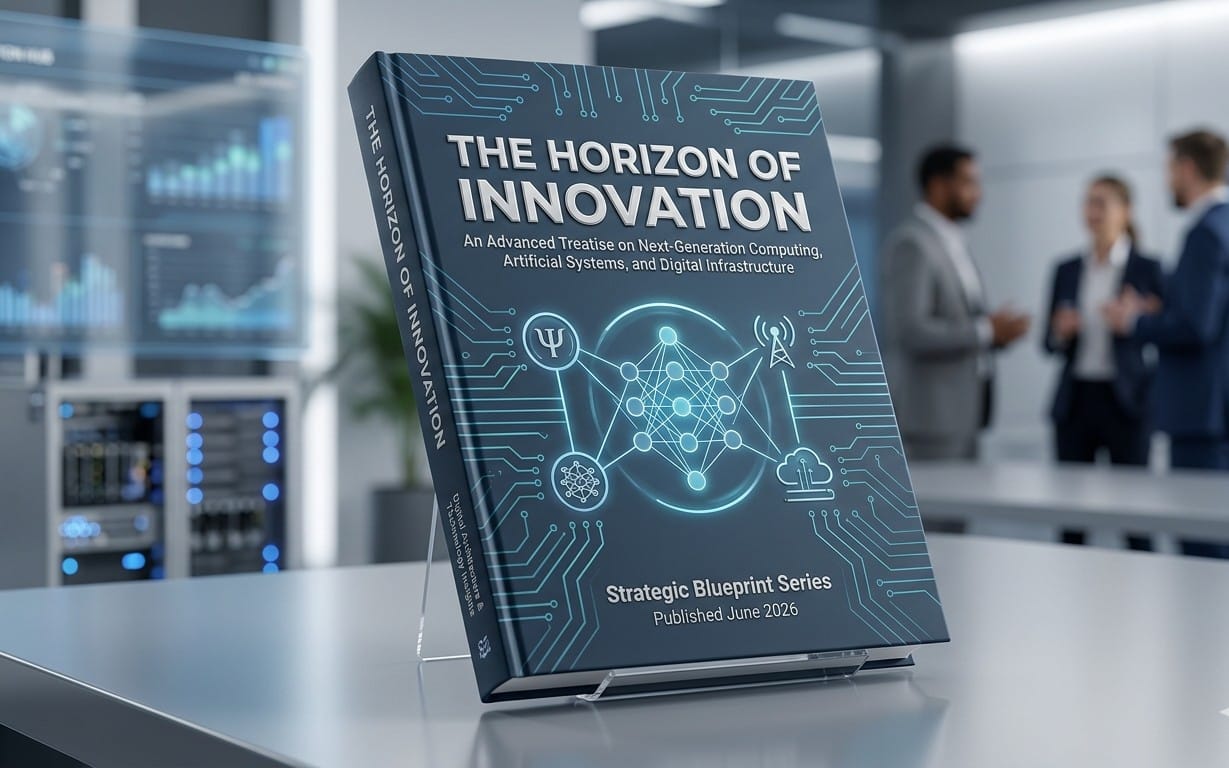 -20% СКИДКА
Наука и технологии
Advanced Technology
"The Horizon of Innovation," is an advanced technical treatise published in June 2026 that explores the cutting edge of computing and digital infrastructure. It serves as a strategic blueprint for understanding how emerging technologies are transitioning from theoretical concepts to industrial standards.
Описание товара
Document Overview: "The Horizon of Innovation"
Published in June 2026 by Digital Architecture & Technology Insights, this executive-level technical treatise acts as a strategic blueprint for next-generation computing architectures. The document bypasses high-level tech jargon to deliver deep architectural analysis regarding how artificial systems, quantum computing, edge networks, and security ecosystems are structurally merging.
Comprehensive Chapter Breakdown
Chapter 1: The Frontier of Artificial Intelligence & Autonomy
This section marks the structural transition from early heuristic AI models to highly integrated systems capable of generalized reasoning and real-time contextual mapping.
Large World Models (LWM): Moving past text-based Large Language Models, LWMs concurrently process visual, auditory, spatial, and contextual telemetry. This creates a unified vector space where multi-modal alignment loss equations allow automated agents to logically navigate physical reality rather than relying on basic statistical probability.
Autonomous Swarm Intelligence: Modern enterprise infrastructure is moving away from single, massive, centralized AI programs. Instead, it utilizes decentralized networks of smaller agents that split complex algorithmic tasks through micro-consensus protocols. This architecture yields a 94% reduction in computational overhead per node and isolates system failures to prevent total network degradation.
Chapter 2: Quantum Computation and Cryptographic Paradigms
Quantum mechanics has moved out of experimental physics labs and into scalable, functional high-performance computing arrays.
Fault-Tolerant Topologies: The industry is stabilizing quantum states using topological qubits powered by non-Abelian anyons. This design creates hardware-level defense against environmental noise and decoherence, enabling an $n$-qubit array to coherently span a Hilbert space of $2^n$ dimensions. These systems excel at molecular modeling, multi-variable logistics, and deep algorithmic processing.
The Post-Quantum Cryptography (PQC) Transition: Because Shor’s algorithm leaves classical asymmetric encryption methods (like RSA and ECC) entirely vulnerable, the report outlines an urgent migration to lattice-based cryptography. This framework relies on the mathematical complexity of finding shortest vectors in high-dimensional geometric spaces to thwart retroactive decryption attacks.
Chapter 3: Edge Architecture and High-Performance Infrastructure
Driven by the physical constraints of latency and the speed of light, data processing is rapidly migrating away from centralized hyperscale cloud hubs.
Intelligent Edge Fabrics: By deploying field machinery equipped with hardware-optimized Neural Processing Units (NPUs), networks can execute complex telemetry inferencing locally. This infrastructure results in a 12x reduction in bandwidth consumption and guarantees 99.99% operational continuity even during a total blackout of external network connections.
Advanced Silicon and Optical Interconnects: With standard silicon reaching its physical limits, the industry is transitioning to high-voltage, low-thermal semiconductors like Gallium Nitride (GaN) and Silicon Carbide (SiC). Simultaneously, Co-Packaged Optics (CPO) are embedding high-speed fiber pathways directly within chip assemblies, bypassing internal copper resistance and eliminating thermal throttling.
Chapter 4: The Cybersecurity Imperative in Zero-Trust Ecosystems
Static, perimeter-focused firewalls are no longer capable of defending enterprise networks against rapid, automated configuration drift exploits.
Comprehensive Zero-Trust Architecture: Operating under the core mandate of "never trust, always verify," every transaction must undergo continuous cryptographic validation. Networks utilize micro-segmentation to wall off individual network zones, preventing attackers from moving laterally if an asset is breached.
Continuous Risk Engines: User access profiles are continuously evaluated through a dynamic mathematical risk function:
$$R = f(I, D, L, T)$$
where risk ($R$) scales instantaneously based on Identity ($I$), Device health ($D$), physical Location ($L$), and Temporal windows ($T$).
Defensive Orchestration: Security Operations Centers (SOCs) leverage SOAR protocols (Security Orchestration, Automation, and Response) to detect system anomalies, revoke compromised keys, isolate networks, and deploy security patches autonomously within fractions of a second.
Наука и технологии
Advanced Technology
"The Horizon of Innovation," is an advanced technical treatise published in June 2026 that explores the cutting edge of computing and digital infrastructure. It serves as a strategic blueprint for understanding how emerging technologies are transitioning from theoretical concepts to industrial standards.
Теги
Частые вопросы
Доступ открывается сразу?
Да. Это цифровой товар — скачать его можно сразу после оплаты, прямо из своей библиотеки.
Можно ли использовать в коммерческих проектах?
Покупка включает стандартную лицензию для личного и коммерческого использования. Возможные ограничения смотрите в описании товара.
Какие условия возврата?
Действует гарантия возврата денег в течение 30 дн. Если что-то не так, запросите возврат в своём заказе — продавец его рассмотрит.
Какие форматы и размеры файлов я получу?
Вы скачаете файлы в том виде, в каком их подготовил продавец (около 36.11 KB). Форматы указаны в характеристиках и описании товара.
Обновления бесплатны?
Да — когда продавец выпускает новую версию, вы можете бесплатно скачать актуальные файлы из своей библиотеки. Последние изменения смотрите в истории версий.
Цена
$20.00