 Getly
Паки промптів ШІ для програмування
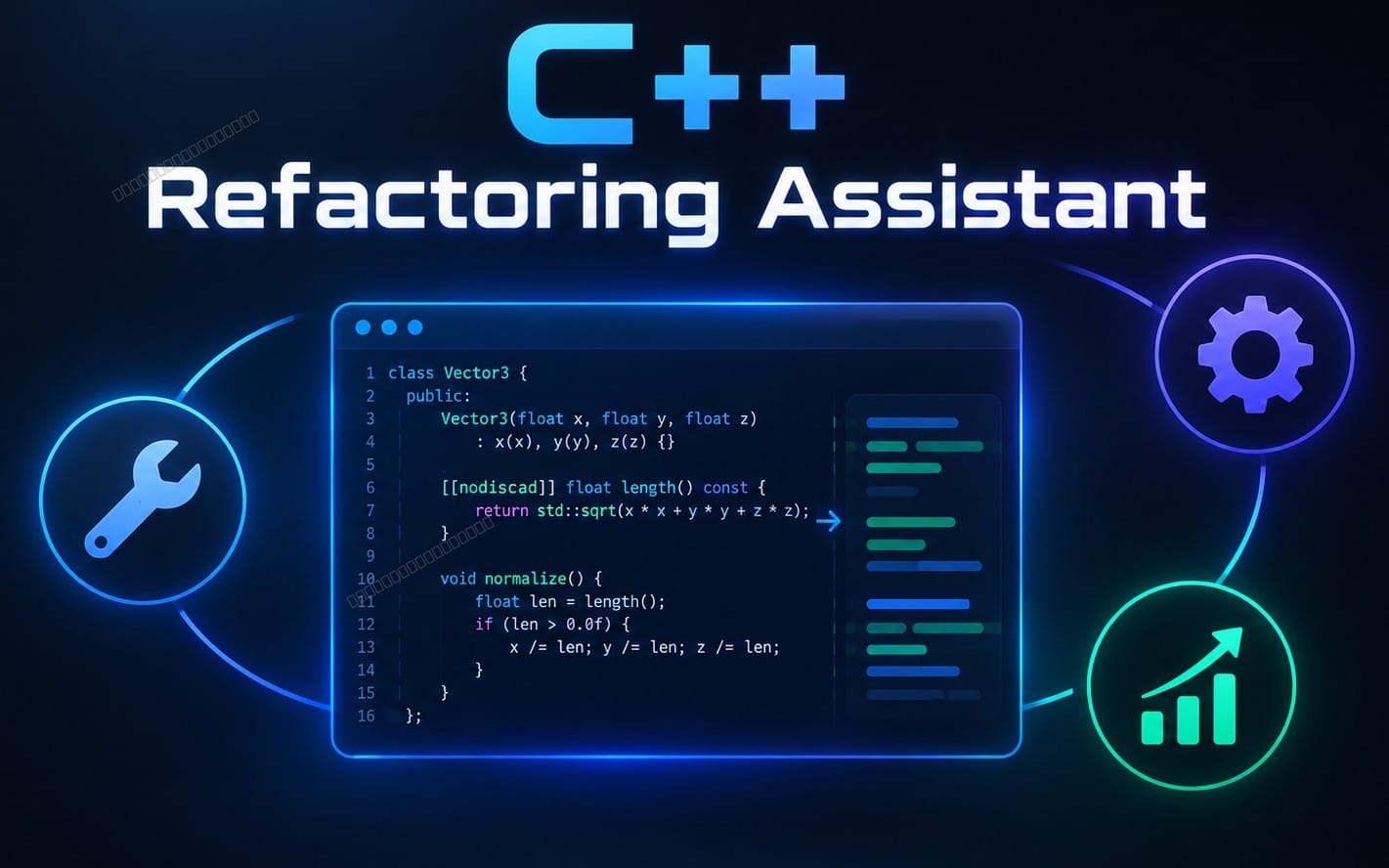
A Practical AI-Assisted Workflow for Safely Refactoring Legacy C++
Це оголошення показано мовою оригіналу (англійська).
Safely analyzing, testing, modernizing, and refactoring legacy C++ code. Get 30 structured prompts, a master system prompt, workflows, checklists, and guardrails for using AI coding assistants without blindly rewriting unfamiliar C++.
Що ви отримаєте: 1 файл · 45.04 KB · MD
Переглянути варіанти купівліОпис товару
The AI-Assisted Legacy C++ Refactoring Toolkit is a comprehensive prompt library and workflow framework designed for software engineers working with legacy C++ codebases. It provides a disciplined methodology for leveraging AI language models as engineering assistants while maintaining developer control over every change.
The toolkit addresses a common challenge in software maintenance: large, unfamiliar codebases where full rewrites are impractical. It offers a structured approach to understanding, testing, and incrementally improving such systems without introducing regressions or compromising stability.
Target Scenarios
The toolkit is applicable to codebases facing challenges such as:
Inherited or undocumented legacy C++ code
Migration from C++03/11/14 to newer standards
Unclear pointer ownership and manual memory management
Macro-heavy code and complex template metaprogramming
Fragile APIs and ABI-sensitive libraries
Insufficient test coverage and suspected undefined behavior
Concurrency hazards and performance bottlenecks
CMake and build system modernization
Review of AI-generated code changes
Core Methodology
The workflow follows a defined progression:
text
Recon → Understand → Assess → Test → Plan → Refactor → Verify → ReviewThis sequence emphasizes understanding before modification, characterization before refactoring, and verification after every change. The toolkit contains 30 structured prompts organized across seven sections: reconnaissance, architecture, modernization, quality and safety, performance, testing, and execution.
Key Principles
The toolkit operates on several foundational principles:
Incremental change over rewrites. Each modification should be small, independently verifiable, and reversible.
Evidence-based analysis. AI output is treated as a proposal requiring verification through compilation, testing, sanitizers, and human review.
Behavior preservation. Observable behavior remains unchanged unless explicitly intended.
Context awareness. Recommendations respect the current C++ standard, toolchain, platform, ABI, and performance constraints.
Uncertainty disclosure. The system prompt instructs models to mark uncertain claims and request missing context rather than fabricate details.
Included Components
Master System Prompt — establishes the AI's role, constraints, and output format
30 Task-Specific Prompts — covering ownership analysis, dependency mapping, modernization planning, concurrency review, performance investigation, test generation, and patch proposal
Variable Glossary — standardized input placeholders for consistent prompt construction
Pre-Flight Checklist — preparation steps before risky refactoring
Quick Reference Tables — situation-based and goal-based prompt selection
Recommended Chains — predefined prompt sequences for common workflows
Worked Example — demonstrating ownership analysis with correct and incorrect reasoning
Session Template — for long-running refactoring efforts requiring audit trails
Compatibility
The toolkit is designed for use with capable instruction-following language models including ChatGPT, Claude, Gemini, Copilot, DeepSeek, Grok, Qwen, Llama, and Mistral. It supports C++ standards from C++11 through C++23 and accommodates various build systems, compilers, and platforms.
Intended Use
This toolkit is intended for professional software engineers, technical leads, and architects engaged in maintaining or modernizing C++ systems. It assumes familiarity with C++ semantics, build systems, testing practices, and software design principles. The developer remains responsible for reviewing, validating, and approving all generated recommendations and code changes.
Що ви отримаєте
1 файл · 45.04 KB
- ai_workflow_refactoring_legacycpp_toolkit.mdMD · 45.04 KB
Паки промптів ШІ для програмування
A Practical AI-Assisted Workflow for Safely Refactoring Legacy C++
Це оголошення показано мовою оригіналу (англійська).
Safely analyzing, testing, modernizing, and refactoring legacy C++ code. Get 30 structured prompts, a master system prompt, workflows, checklists, and guardrails for using AI coding assistants without blindly rewriting unfamiliar C++.
Теги
Поширені запитання
Чи отримаю я доступ одразу?
Так. Це цифровий товар: ви можете завантажити його одразу після оплати, просто зі своєї бібліотеки.
Чи можна використовувати його в комерційних проєктах?
Так. Комерційне використання дозволено: користуйтеся в особистому бізнесі та в тому, що продаєте. Ви не можете перепродавати чи поширювати сам файл.
Яка у вас політика повернення коштів?
Ви можете запросити повернення коштів протягом 30 дн. Якщо щось не так, подайте запит зі свого замовлення, і команда Getly його розгляне.
Які формати та розміри файлів я отримаю?
Ви завантажите 1 файл - MD - загалом 45.04 KB.
Чи отримую я безкоштовні оновлення?
Так: коли продавець випускає нову версію, ви можете повторно завантажити свіжі файли зі своєї бібліотеки безкоштовно. Останні оновлення дивіться в журналі змін.
Ціна
$32.00