 -20% RABATT
Wissenschaft & Technik
Advanced Technology
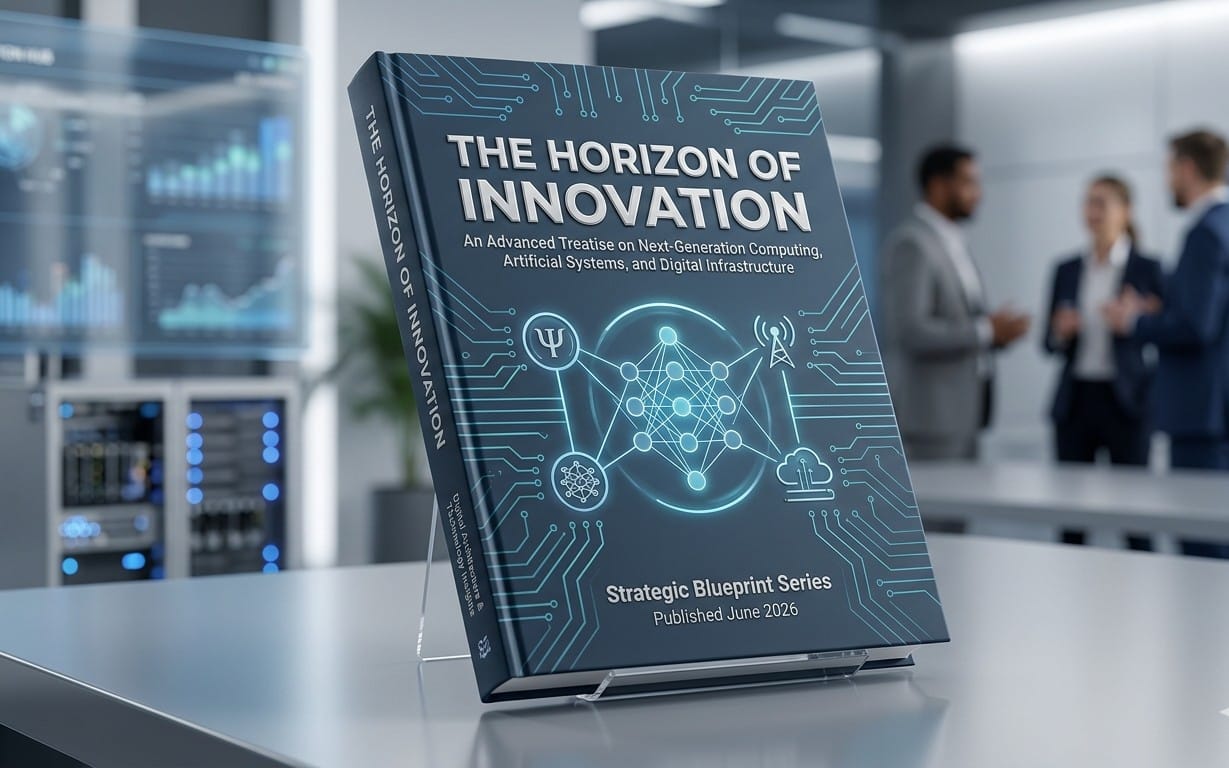
"The Horizon of Innovation," is an advanced technical treatise published in June 2026 that explores the cutting edge of computing and digital infrastructure. It serves as a strategic blueprint for understanding how emerging technologies are transitioning from theoretical concepts to industrial standards.
Produktbeschreibung
Document Overview: "The Horizon of Innovation"
Published in June 2026 by Digital Architecture & Technology Insights, this executive-level technical treatise acts as a strategic blueprint for next-generation computing architectures. The document bypasses high-level tech jargon to deliver deep architectural analysis regarding how artificial systems, quantum computing, edge networks, and security ecosystems are structurally merging.
Comprehensive Chapter Breakdown
Chapter 1: The Frontier of Artificial Intelligence & Autonomy
This section marks the structural transition from early heuristic AI models to highly integrated systems capable of generalized reasoning and real-time contextual mapping.
Large World Models (LWM): Moving past text-based Large Language Models, LWMs concurrently process visual, auditory, spatial, and contextual telemetry. This creates a unified vector space where multi-modal alignment loss equations allow automated agents to logically navigate physical reality rather than relying on basic statistical probability.
Autonomous Swarm Intelligence: Modern enterprise infrastructure is moving away from single, massive, centralized AI programs. Instead, it utilizes decentralized networks of smaller agents that split complex algorithmic tasks through micro-consensus protocols. This architecture yields a 94% reduction in computational overhead per node and isolates system failures to prevent total network degradation.
Chapter 2: Quantum Computation and Cryptographic Paradigms
Quantum mechanics has moved out of experimental physics labs and into scalable, functional high-performance computing arrays.
Fault-Tolerant Topologies: The industry is stabilizing quantum states using topological qubits powered by non-Abelian anyons. This design creates hardware-level defense against environmental noise and decoherence, enabling an $n$-qubit array to coherently span a Hilbert space of $2^n$ dimensions. These systems excel at molecular modeling, multi-variable logistics, and deep algorithmic processing.
The Post-Quantum Cryptography (PQC) Transition: Because Shor’s algorithm leaves classical asymmetric encryption methods (like RSA and ECC) entirely vulnerable, the report outlines an urgent migration to lattice-based cryptography. This framework relies on the mathematical complexity of finding shortest vectors in high-dimensional geometric spaces to thwart retroactive decryption attacks.
Chapter 3: Edge Architecture and High-Performance Infrastructure
Driven by the physical constraints of latency and the speed of light, data processing is rapidly migrating away from centralized hyperscale cloud hubs.
Intelligent Edge Fabrics: By deploying field machinery equipped with hardware-optimized Neural Processing Units (NPUs), networks can execute complex telemetry inferencing locally. This infrastructure results in a 12x reduction in bandwidth consumption and guarantees 99.99% operational continuity even during a total blackout of external network connections.
Advanced Silicon and Optical Interconnects: With standard silicon reaching its physical limits, the industry is transitioning to high-voltage, low-thermal semiconductors like Gallium Nitride (GaN) and Silicon Carbide (SiC). Simultaneously, Co-Packaged Optics (CPO) are embedding high-speed fiber pathways directly within chip assemblies, bypassing internal copper resistance and eliminating thermal throttling.
Chapter 4: The Cybersecurity Imperative in Zero-Trust Ecosystems
Static, perimeter-focused firewalls are no longer capable of defending enterprise networks against rapid, automated configuration drift exploits.
Comprehensive Zero-Trust Architecture: Operating under the core mandate of "never trust, always verify," every transaction must undergo continuous cryptographic validation. Networks utilize micro-segmentation to wall off individual network zones, preventing attackers from moving laterally if an asset is breached.
Continuous Risk Engines: User access profiles are continuously evaluated through a dynamic mathematical risk function:
$$R = f(I, D, L, T)$$
where risk ($R$) scales instantaneously based on Identity ($I$), Device health ($D$), physical Location ($L$), and Temporal windows ($T$).
Defensive Orchestration: Security Operations Centers (SOCs) leverage SOAR protocols (Security Orchestration, Automation, and Response) to detect system anomalies, revoke compromised keys, isolate networks, and deploy security patches autonomously within fractions of a second.
Wissenschaft & Technik
Advanced Technology
"The Horizon of Innovation," is an advanced technical treatise published in June 2026 that explores the cutting edge of computing and digital infrastructure. It serves as a strategic blueprint for understanding how emerging technologies are transitioning from theoretical concepts to industrial standards.
Tags
Häufige Fragen
Erhalte ich sofort Zugriff?
Ja. Dies ist ein digitales Produkt — du kannst es direkt nach dem Kauf aus deiner Bibliothek herunterladen.
Darf ich es für kommerzielle Projekte nutzen?
Dein Kauf enthält eine Standardlizenz für private und kommerzielle Nutzung. Etwaige Einschränkungen findest du in der Produktbeschreibung.
Wie sind die Rückerstattungsbedingungen?
Es gilt eine 30-tägige Geld-zurück-Garantie. Wenn etwas nicht stimmt, fordere die Rückerstattung in deiner Bestellung an und der Verkäufer prüft sie.
Welche Dateiformate und -größen erhalte ich?
Du lädst die Dateien genau so herunter, wie der Verkäufer sie zusammengestellt hat (ca. 36.11 KB). Die enthaltenen Formate findest du in den Produktdetails und der Beschreibung.
Erhalte ich kostenlose Updates?
Ja — wenn der Verkäufer eine neue Version veröffentlicht, kannst du die aktuellen Dateien kostenlos erneut aus deiner Bibliothek herunterladen. Aktuelle Änderungen findest du im Changelog.
Preis
$20.00